
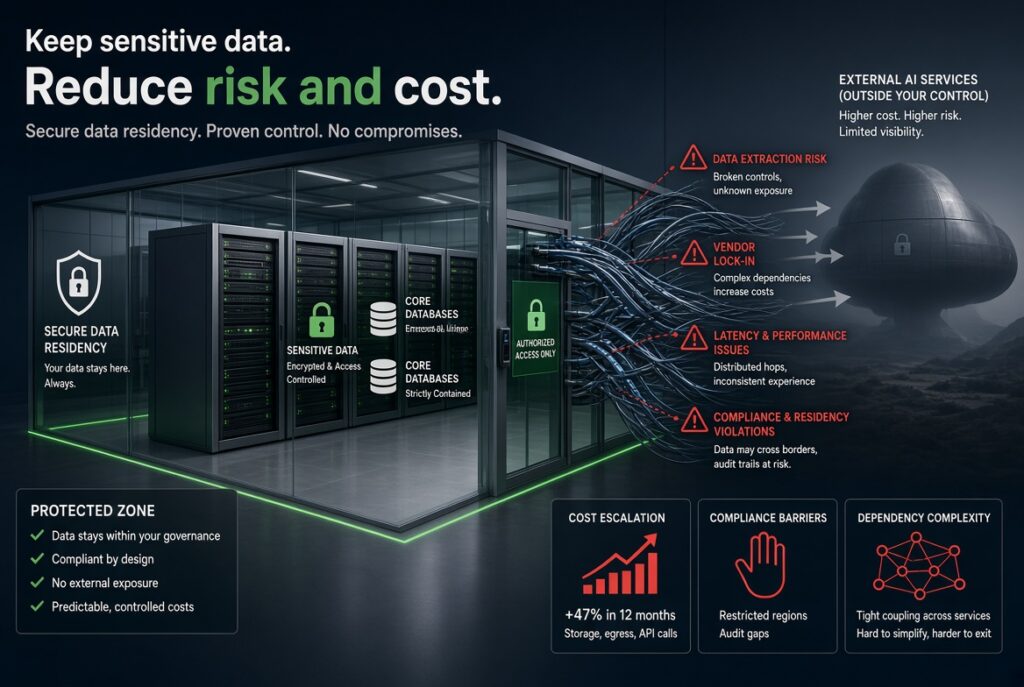
The idea of running databases, vector search, retrieval-augmented generation (RAG) pipelines, and AI agents together on infrastructure located at the customer site is compelling. The more useful question is not whether the technology exists, but: When does this kind of architecture actually make sense?
Four practical considerations determine whether a distributed private-AI deployment on commodity hardware and open-source software is the right fit.
1. Where the data needs to stay
Sensitive or business-critical data frequently must remain inside a distributed customer environment — a regional office, a factory floor, a satellite site, or a regulated data center. Continuously shipping that data to external AI services introduces latency, compliance friction, egress costs, and expanded attack surface.
In these cases the rational design keeps the data in place and brings the AI workload to it. Commodity servers or modest private-cloud footprints (standard x86 or ARM racks, network-attached or software-defined storage) become the substrate. Open-source databases such as PostgreSQL (with the pgvector extension), MySQL, or MariaDB continue to hold the operational data; the same machines or adjacent nodes host the vector indexes and inference runtimes. Nothing proprietary is required — only carefully chosen open components that respect data-residency boundaries.
2. How close AI needs to be to the database
Tight coupling between transactional data, vector search, RAG workflows, and agentic logic yields lower latency, stronger consistency, and simpler security posture.
An open-source private-AI stack achieves this by co-locating:
- The relational or document store (PostgreSQL + pgvector is a common, production-ready choice; alternatives include OpenSearch or Apache Cassandra with vector plugins).
- A purpose-built vector database when scale demands it (Milvus, Qdrant, Weaviate, or Chroma running on the same commodity cluster).
- RAG and agent frameworks (LlamaIndex, LangChain, or Haystack) that issue hybrid queries against both the operational database and the vector index.
- Local inference runtimes (Ollama, vLLM, Text Generation Inference, or llama.cpp) serving open models — Llama, Mistral, Gemma, or fine-tuned variants — so that embeddings, retrieval, and generation never leave the site.
All of these components can be packaged as containers or Kubernetes workloads and deployed on ordinary servers or small private Kubernetes clusters. The data remains behind the organization’s firewall; retrieval and agent loops execute locally. Network hops to public AI endpoints disappear, and the only external traffic is optional model-weight updates or telemetry that the operator chooses to allow.
3. Who manages the operational work
Private AI is not solely an AI problem. Someone must still perform deployment, patching, scaling, backup, high availability, disaster recovery, certificate rotation, and capacity planning.
Open-source tooling and commodity infrastructure make this manageable without proprietary control planes:
- Kubernetes (or lighter alternatives such as k3s or Nomad) provides the orchestration layer.
- Operators (CloudNativePG for PostgreSQL, the official Milvus or Qdrant operators, cert-manager, etc.) encode day-2 operations.
- Configuration and policy-as-code (Ansible, Terraform/OpenTofu, Flux or Argo CD) keep environments reproducible.
- Monitoring and alerting (Prometheus, Grafana, Loki, OpenTelemetry) give visibility across database, vector, and inference layers.
- Backup and restore can leverage open tools such as Velero, pgBackRest, or restic integrated with commodity object storage (MinIO or any S3-compatible backend).
High availability is achieved through standard patterns — replicated PostgreSQL, multi-replica vector indexes, and Kubernetes pod anti-affinity — rather than vendor-specific clustering. Disaster recovery is a matter of tested runbooks and geographic replication of the same open components. The operational burden remains real, but it is carried by widely understood, community-supported tooling rather than a single vendor’s proprietary management plane.
4. When the workload really needs a distributed private-cloud deployment
Not every use case requires the same footprint.
- Mid-scale workloads — departmental systems, remote offices, small-to-medium businesses, edge locations, or secondary data centers — fit comfortably on modest commodity clusters: a handful of servers running Kubernetes, PostgreSQL with pgvector, a lightweight vector store, and local LLM inference. These environments prioritize simplicity, cost predictability, and data locality over extreme scale.
- Large-scale, mission-critical core workloads demand more: multi-rack commodity clusters, Ceph or similar software-defined storage, full Kubernetes control planes with strong multi-tenancy, and carefully engineered HA/DR topologies. The same open-source building blocks scale upward; only the quantity of hardware and the rigor of operational practice change.
Organizations can therefore choose the appropriate hybrid posture — pure on-premises commodity racks, edge sites, or a combination of private data-center capacity plus selective public-cloud burst for non-sensitive workloads — without locking into any single proprietary stack. The decision reduces to matching data-residency requirements, latency budgets, operational maturity, and workload size against the capabilities of mature open-source components running on ordinary hardware.
In short, private AI that stays close to the data is achievable today with open-source databases, vector engines, RAG frameworks, local inference runtimes, and standard orchestration on commodity servers and data centers. The architecture makes sense precisely when data gravity, regulatory constraints, latency, or cost make continuous movement to external AI services the more expensive and riskier path.
| Scenario | Big Red Vendor Approx. Monthly | Open-Source/Commodity Approx. Monthly | Estimated Savings | Notes |
|---|---|---|---|---|
| Mid-scale steady (dept/remote) | $9,500–$12,000+ | $2,500–$7,000 | 40–70% | Typical range; higher savings with owned hardware and mature ops |
| BYOL Red Comapny vs. open-source | Lower software portion but still high infra floor | Same open-source | 30–60% | Existing Expensive Red licenses reduce but do not eliminate the gap |
| Heavy AI inference | Higher (more ECPU/GPU-equivalent) | Add commodity GPUs | 50%+ | Local open models avoid external API costs |
| 4-year TCO (rough) | $450k–$600k+ | $120k–$350k | Significant | Open-source avoids lock-in and commitment overages |