
The AI industry has spent years asking one question:
Which model is smartest?
That may be the wrong question.As companies deploy more models, more agents, more specialized systems, and more AI-powered applications, a different problem is becoming impossible to ignore:
Where should this request go?
That is the job of a router.
The AI stack is getting complicated
A modern AI application may have access to multiple models simultaneously.
One model might be better for reasoning. Another might be faster. Another might be dramatically cheaper. A specialized model might be better for coding, vision, extraction, classification, or a particular industry.
Then there are agents, tools, APIs, retrieval systems, enterprise data sources, and increasingly sophisticated inference infrastructure.
You don’t necessarily want every prompt going to the same model.
You want the right request to reach the right destination.That’s where prompt routing comes in.
And that creates an entirely new infrastructure opportunity.
PromptRouter.ai says exactly what it needs to sayThere are AI companies whose names require a paragraph to explain.Then there are names that communicate the product immediately.
PromptRouter.ai belongs in the second category.
The name combines three powerful concepts:
Prompt — the fundamental unit of interaction with an AI system.
Router — the mechanism that determines where something should go..ai — an unmistakable signal that the technology is built around artificial intelligence.
Put them together and the product concept is almost self-explanatory:
«Route every prompt to the best AI destination.»
That could mean routing based on cost, latency, capability, context, availability, security requirements, or virtually any combination of factors.
The router can become the decision layer
Think about what happens when an organization stops using one AI model and starts using ten.
The problem changes.
It is no longer simply:
“Which model should we use?”
It becomes:
“Which model should handle this request?”
That is an infrastructure problem.
A routing layer can sit between an application and its underlying AI providers, allowing the application to make intelligent decisions without hard-coding every model choice into the product.
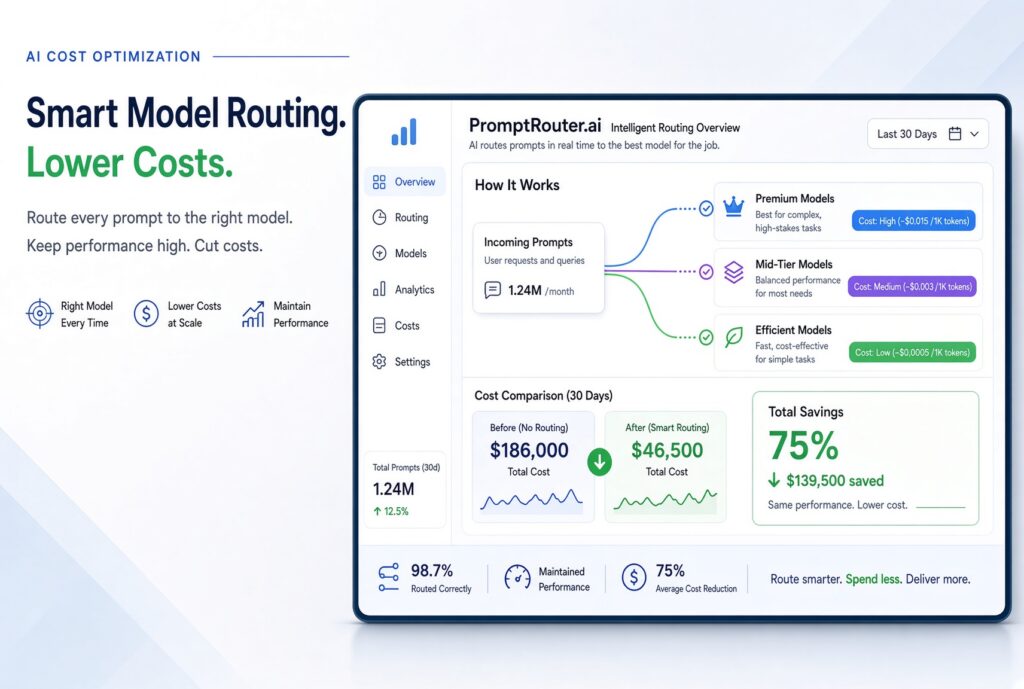
A company could route simple requests to inexpensive models, complex reasoning tasks to more capable models, sensitive workloads to approved infrastructure, and specialized tasks to models built specifically for them.
The router becomes the traffic cop for intelligence. And unlike a model itself, the routing layer can potentially remain valuable even as the underlying models change. Models will change. Routing will remain.
Today’s leading AI model isn’t necessarily tomorrow’s leading AI model. The names change. The benchmarks change. Prices change. Context windows change. New providers appear. Open-source models improve.
That creates a problem for companies building AI applications.
They don’t want their architecture permanently tied to whichever model happens to be winning this quarter.
A routing layer can provide abstraction.
The application asks for an outcome.
The router determines where the request should go.
That architecture can make an AI system more flexible, more resilient, and potentially less expensive to operate.
The intelligence may change. The need to route it doesn’t.
This is bigger than choosing the cheapest model
The obvious application is cost optimization.
But sophisticated routing can go much further.
A router could consider:
– Model capability
– Cost per token
– Response latency
– Reliability
– Context requirements
– Data sensitivity
– Geographic requirements
– Availability
– Task type
– User tier
– Regulatory constraints
– Historical performance
– Confidence thresholds
That turns routing from a simple lookup table into an intelligent infrastructure layer. And that is precisely why PromptRouter.ai has room to grow beyond its literal interpretation. A name for the product you build next.
Perhaps you’re building an AI gateway.
Perhaps you’re developing model arbitration.
Perhaps you’re creating an intelligent inference platform.
Perhaps you’re building an agent orchestration system.
Perhaps you’re developing an enterprise AI platform that decides which model should handle each request.
You could invent an abstract brand. Or you could give the market a name that immediately tells it what you do.
PromptRouter.ai
The name doesn’t try to sound futuristic. It doesn’t hide behind invented spelling. It describes the technology. And in infrastructure, clarity is often more valuable than cleverness. The domain is part of the positioning. A great technical company name doesn’t merely identify the company. It can establish the category the company intends to own. That’s the opportunity here.
PromptRouter.ai isn’t a domain name that needs AI bolted onto it.
AI routing is the reason the name exists. As AI systems become more heterogeneous, the ability to intelligently direct prompts and workloads across that ecosystem becomes increasingly important.
The companies that build that layer will need infrastructure.
They will need APIs. They will need observability. They will need policy engines. They will need optimization. And they will need a name.
PromptRouter.ai is available for the company building that future.
Not another chatbot.
Not another wrapper.
A name for the layer that decides where the intelligence goes: PromptRouter.ai
Route the right prompt to the right intelligence.