
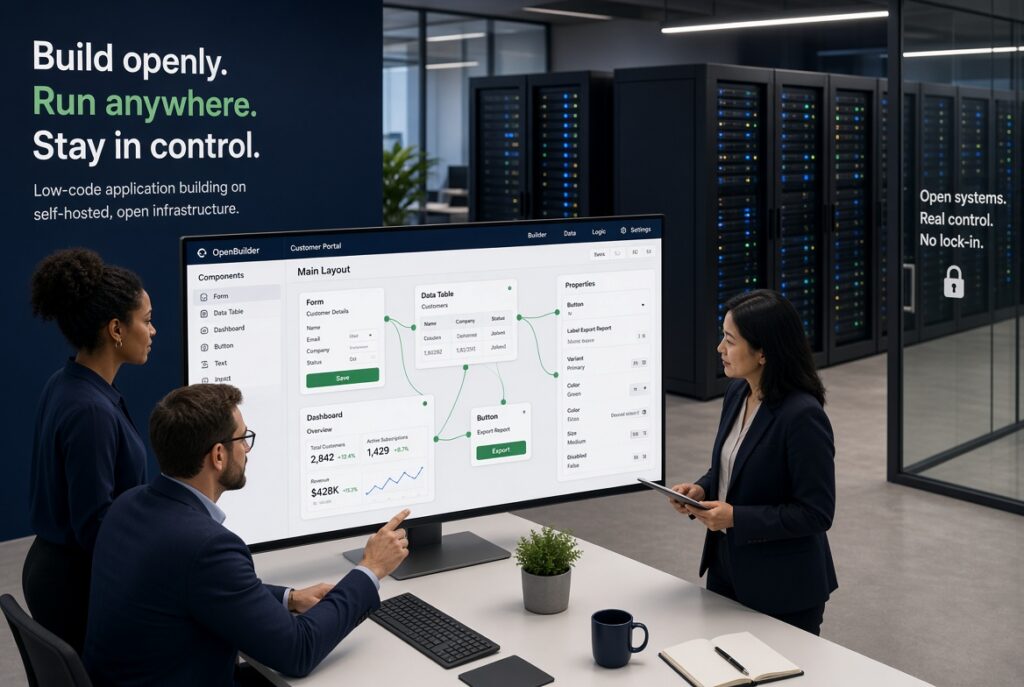
Low-code and no-code application builders have become essential for organizations that need to deliver internal tools, administrative interfaces, forms, dashboards, and data-centric workflows quickly. Traditional approaches require substantial custom coding; pure spreadsheet tools lack structure and security; fully custom development is slow and expensive. A well-designed low-code platform sits in the middle: it provides visual builders, reusable components, data connectors, and controlled extensibility so business and technical teams can ship functional applications in days rather than months.
Many proprietary platforms achieve this speed by tightly coupling the application layer to a specific commercial database engine and its surrounding ecosystem. That coupling delivers convenience in the short term but introduces long-term constraints: license dependencies, limited portability of applications and data models, restricted choice of underlying infrastructure, and reduced ability to run the same applications against standard open databases or across hybrid and edge environments. When the application builder, the database, the licensing model, and the operational tooling are inseparable, organizations often find themselves locked into a single vendor’s roadmap, pricing, and deployment options.
Open-source low-code platforms reverse this dynamic. They run on commodity hardware or any standard data center, connect to widely used open databases such as PostgreSQL and MySQL, and give teams full ownership of the code, the data, and the runtime. The result is lower cost of ownership, greater architectural freedom, and the ability to keep sensitive data and processing under direct control. The most mature projects have reached production-grade reliability, strong community support, and feature sets that match or exceed many proprietary alternatives for the majority of internal-tool and departmental application use cases.
Core Advantages of the Open-Source Approach
Open-source platforms typically excel in several areas that matter for long-term sustainability:
- Self-hosting and data residency — Applications and data remain inside the organization’s own infrastructure or private cloud. There is no forced data movement to an external managed service.
- Database independence — Strong native support for PostgreSQL, MySQL, and other standard engines allows teams to use the same database technology already running other systems, or to choose the engine that best fits performance and compliance needs.
- Transparent licensing and cost — Core functionality is free to run without per-user, per-core, or proprietary runtime fees. Optional commercial support or cloud-hosted versions exist for those who want them, but they are not required.
- Extensibility and code ownership — JavaScript, Python, or similar languages can be used for complex logic. Source code is available for inspection, auditing, and customization.
- Integration breadth — Most platforms offer dozens of connectors to databases, APIs, file stores, and messaging systems, making it straightforward to build applications that span existing systems rather than creating a new silo.
- Deployment flexibility — Docker, Kubernetes, and simple single-node installs work on commodity servers, edge locations, or any data center. Scaling follows ordinary infrastructure practices rather than vendor-specific rules.
These characteristics make open-source platforms particularly attractive for organizations that already operate open-source databases, prioritize data sovereignty, or want to avoid multi-year commitments tied to a single commercial stack.
Leading Open-Source Platforms
Several projects have emerged as practical, production-ready alternatives. Each has a distinct emphasis; the best choice depends on the mix of developer involvement, data complexity, and workflow needs.
Appsmith stands out for teams that want a developer-friendly internal-tool builder. It provides a rich drag-and-drop interface with a large library of UI widgets (tables, forms, charts, maps, and more). Applications are built by connecting widgets to queries against databases or APIs and adding JavaScript for business logic and transformations. Native Git integration supports version control, branching, and code-review workflows that many engineering teams already use. The project is licensed under the permissive Apache 2.0 license, which simplifies commercial use and redistribution. Self-hosting is straightforward via Docker or Kubernetes, and the platform connects cleanly to PostgreSQL and many other data sources. It is especially strong for admin panels, operational dashboards, and CRUD applications that need both visual speed and the ability to drop into code when necessary.
ToolJet offers a similar visual builder focused on internal tools, with particularly broad connector support and growing AI-assisted generation features. Teams can describe requirements in natural language and receive a starting application structure, then refine it. It includes a built-in database option for rapid prototyping while still supporting external PostgreSQL and other engines. The platform is released under the AGPL license; organizations that modify the software and expose it externally should review the implications carefully, but unmodified internal use is common and unconstrained. ToolJet’s multiplayer editing and extensive integration catalog make it attractive for collaborative teams building multi-source applications.
Budibase leans further toward no-code and workflow-centric applications. It includes its own data layer, visual form and screen builders, and a capable automation engine for approvals, notifications, and multi-step processes. This makes it effective for operational tools, portals, and lightweight business applications where non-developers need to participate in design. Self-hosting is supported, and the platform can also connect to external databases. Its licensing (primarily GPL-oriented) is suitable for internal deployments; organizations planning to redistribute modified versions should examine the details.
NocoDB and Baserow take a spreadsheet-first approach. They turn existing SQL databases into collaborative, Airtable-style interfaces with views, forms, filters, and access controls. This style is ideal when the primary need is structured data management, team collaboration around tables, and simple applications generated from that data. Both projects support self-hosting, work well with PostgreSQL, and expose APIs so more sophisticated front-ends can be built on top if required. They excel as modern replacements for shared spreadsheets or lightweight departmental databases.
NocoBase targets more complex business systems. It emphasizes a data-model-driven architecture, a plugin system, and the ability to construct CRM-style, ERP-style, or custom operational applications. Teams that need richer relational modeling, extensible components, and longer-lived business applications often evaluate it alongside the more UI-centric builders above.
Other notable options include Directus (strong as a headless data platform with an admin interface) and various specialized tools for forms or SQL-driven pages. The ecosystem continues to evolve rapidly; most of the platforms listed receive regular updates and have active communities.
Deploying Effectively
Selection criteria should start with the dominant use case:
- Heavy developer involvement and complex UI logic → Appsmith or ToolJet.
- Rapid forms, approvals, and operational workflows with mixed technical skill → Budibase.
- Collaborative data management and simple applications → NocoDB or Baserow.
- Model-driven, extensible business systems → NocoBase.
All of the major platforms support Docker-based installation and can run on commodity servers or standard Kubernetes clusters. For production, common practices include placing the application behind reverse proxies and identity providers, using managed or self-hosted PostgreSQL with proper backups and high availability, and applying ordinary network segmentation and secrets management. Because the platforms are open, security reviews can examine the actual code rather than relying solely on vendor assurances.
Performance and scale are generally governed by the underlying database and infrastructure rather than artificial platform limits. A well-tuned PostgreSQL instance on commodity hardware handles the query volumes typical of internal tools without difficulty. Horizontal scaling of the application tier follows standard container practices.
Migration Considerations and Realistic Expectations
Moving from a tightly coupled proprietary environment requires more than a simple export. Data models, forms, validation rules, and any custom logic must be reconstructed. The open platforms make this feasible because they work against standard databases: existing tables can often be connected directly, after which new interfaces are built visually. Complex procedural logic may need to be rewritten as JavaScript, SQL functions, or workflow steps. The investment is typically repaid by the elimination of proprietary licensing and the regained ability to run the same applications in any environment.
Open-source platforms are not identical to every proprietary feature set. Extremely sophisticated enterprise workflow engines, deep embedding of certain database-specific capabilities, or highly specialized reporting may still require additional components or custom code. In practice, the majority of departmental and internal applications fall well within the capabilities of the tools described above.
Conclusion
The combination of mature visual builders, broad database connectivity, self-hosting, and open licenses has produced a set of low-code platforms that deliver speed without surrendering control. Organizations that previously accepted the constraints of a proprietary application builder tied to a single commercial database now have credible, production-ready alternatives that run on ordinary infrastructure, work with standard open databases, and keep both data and applications under the organization’s own governance.
By evaluating Appsmith, ToolJet, Budibase, NocoDB/Baserow, NocoBase, and related projects against concrete use cases, teams can replace vendor lock-in with architectural freedom while still achieving the rapid delivery that low-code was always intended to provide. The result is lower long-term cost, greater flexibility, and applications that remain portable as infrastructure and business needs evolve.