
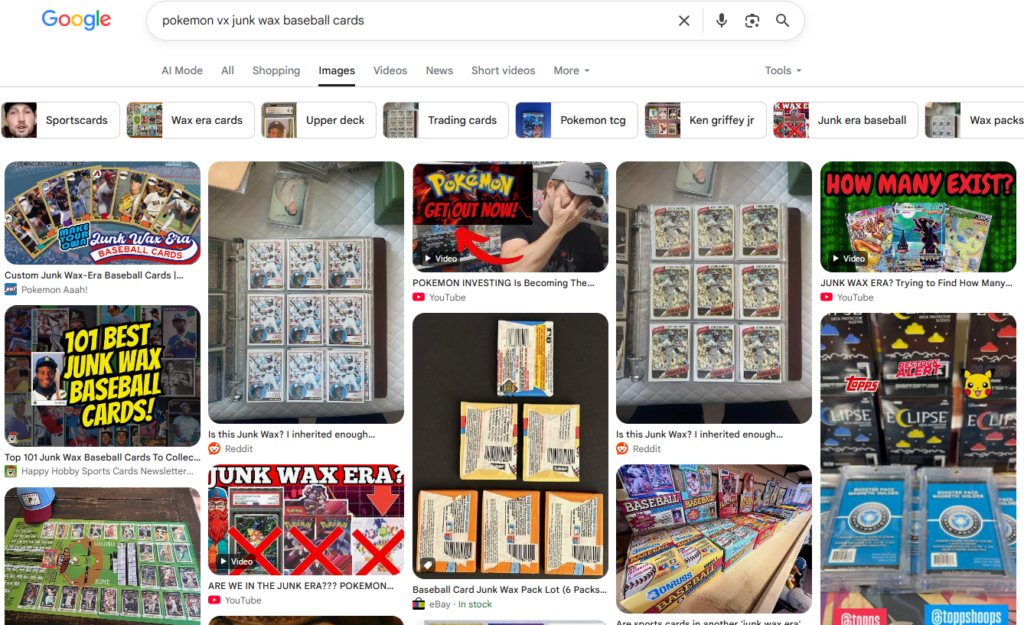
Pokémon cards are less likely to suffer the exact same fate as the baseball card “junk wax” bubble of the late 1980s–early 1990s, though they face related risks of correction in overproduced modern segments. The markets share some superficial similarities (speculation, high production volumes, investor interest), but fundamental differences in scarcity design, demand drivers, intellectual property strength, and market structure make a total collapse of modern Pokémon values far less probable.
The Baseball Card Bubble / Junk Wax Era
The junk wax era is generally dated roughly 1986–1993 (sometimes extending to 1994). Demand for baseball cards surged in the 1980s as collecting shifted from a kids’ hobby toward adult speculation and “investment.” Multiple competing manufacturers (Topps, Fleer, Donruss, Score, Upper Deck, and others) responded by flooding the market with enormous print runs—often millions or more copies of individual cards.
Key characteristics:
- Almost no meaningful scarcity mechanisms early on (few serial-numbered cards, limited inserts, or true chase rarities in packs).
- Cards were largely interchangeable base issues of active players.
- Speculators bought cases expecting future rarities; stores and investors stockpiled.
- The crash accelerated with the 1994 MLB players’ strike, which temporarily tanked interest in the sport itself. Supply massively outstripped demand. Most cards from the era became nearly worthless in bulk (even many star rookies in average condition). Card shops closed, and the hobby contracted sharply for years. Only pre-junk-wax cards, certain high-grade stars, and later limited inserts retained meaningful long-term value.
The core problem was a pure supply-side imbalance combined with demand that was heavily tied to one sport’s popularity and speculative fervor rather than ongoing utility or multi-generational cultural power.
The Current Pokémon TCG Market (as of mid-2026)
Pokémon has experienced multiple boom-bust cycles (late 1990s–early 2000s, the COVID-era surge around 2020–2021, a subsequent cooling for some modern product, and a strong resurgence tied to the franchise’s 30th anniversary). Production is enormous: The Pokémon Company has printed roughly 10 billion cards per year in recent fiscal periods, pushing cumulative worldwide totals past 85 billion by early 2026. That is a staggering absolute number.
Yet demand has frequently outpaced even this capacity. Products still sell out, scalping persists in places, and The Pokémon Company has expanded printing infrastructure (including a major new facility expected online later in the decade) while trying to manage allocation. Market data from early 2026 showed many cards climbing in price—driven by anniversary nostalgia, competitive play needs, special arts, and limited supply of chase pieces—rather than broad softening. High-end examples (certain Special Art Rares, vintage holos, exclusive promos) continue to command strong secondary-market prices, while sealed product for popular sets has often held or appreciated.
Key Differences That Reduce the Odds of a Mirror-Image Crash
- Built-in scarcity and chase mechanics: Modern Pokémon sets deliberately tier rarity (commons/uncommons vs. holos, Ultra Rares, Special Illustration Rares/Secret Arts, etc.). Pull rates for top chase cards create genuine scarcity even amid high overall print volumes. Baseball junk wax largely lacked this until late in the era. Value concentrates heavily in the rare pulls and high-grade copies rather than entire base sets.
- Dual utility (play + collect): Pokémon has an active competitive Trading Card Game with format rotations that create ongoing demand for new cards from players, not just collectors or investors. Baseball cards were almost purely collectible/speculative and tied to athletes whose careers (and relevance) eventually end.
- Evergreen IP and multi-generational demand: Pokémon is a continuously refreshed media franchise (games, anime, merchandise, apps). New kids enter every generation while adults retain nostalgia. There is no single equivalent of a “1994 strike” that can crater the entire intellectual property overnight. Baseball demand fluctuated more directly with the sport’s popularity and labor issues.
- Company control and lessons learned: The Pokémon Company tightly controls the IP and adjusts print runs with more data than 1980s–90s card companies had. Competing manufacturers racing each other to print more was a bigger driver in junk wax. Pokémon also benefits from a sophisticated global secondary market, grading populations (PSA and others), transparent sales data, and sealed-product collecting as a distinct investment class.
- Historical resilience within Pokémon itself: After the original boom cooled, vintage cards (Base Set, etc.) recovered strongly over time. Post-COVID modern corrections hit some overprinted sets hard, but the overall market did not collapse into junk-wax territory, and popular chase cards and sealed product often rebounded with new waves of interest.
Similarities and Real Risks
Overproduction remains a legitimate concern. Commons and many mid-tier modern cards will almost certainly be abundant (and low-value) long-term, just as junk-wax base cards are. Speculative excesses—buying purely for flips rather than play or genuine collecting—can inflate prices temporarily and lead to sharp corrections when hype fades or print runs catch up. Grading population reports can suppress values for cards with high numbers of PSA 10s. Economic downturns, shifts in collector attention, or successful digital alternatives could pressure the market. Some modern sealed product has already experienced meaningful price drops after heavy printing.
Sports cards themselves have faced renewed “Junk Wax 2.0” warnings in the 2020s due to high production of modern parallels and base cards, showing the pattern can recur even with better tools.
Nuances and Likely Outcomes
- What is most vulnerable: Raw modern commons/uncommons, heavily printed mid-tier sealed product from less popular sets, and speculative holdings bought at peak hype. These can behave like junk wax—abundant and low-value once the cycle turns.
- What is more resilient: True chase cards (especially low-pop high grades), early/vintage material with established scarcity, popular sealed sets that were relatively constrained, and cards tied to enduring cultural icons (Charizard variants, special Pikachus, etc.). The competitive play element and continuous media support provide a floor that baseball largely lacked.
- Time horizon matters: Short-term volatility and corrections are normal and have already occurred. Long-term total devaluation of the modern era on the scale of junk wax is less likely because the demand side is structurally stronger and more diversified.
- Collector vs. pure investor perspective: People who buy cards they like for play, nostalgia, or aesthetics are better insulated. Pure speculation amplifies both upside during booms and downside during corrections.
In short, the baseball junk-wax collapse was a specific combination of massive undifferentiated supply, speculative mania without scarcity tools, and a demand shock tied to one sport. Pokémon has higher absolute production volumes today, but it layers intentional rarity, dual play/collect demand, and a far more robust cultural franchise on top. Selective corrections and the permanent cheapness of most modern bulk cards are realistic; a wholesale erasure of modern-era value is not the most probable path. Markets for collectibles remain cyclical and risk-prone—especially when treated primarily as investments—but the structural differences are significant.