
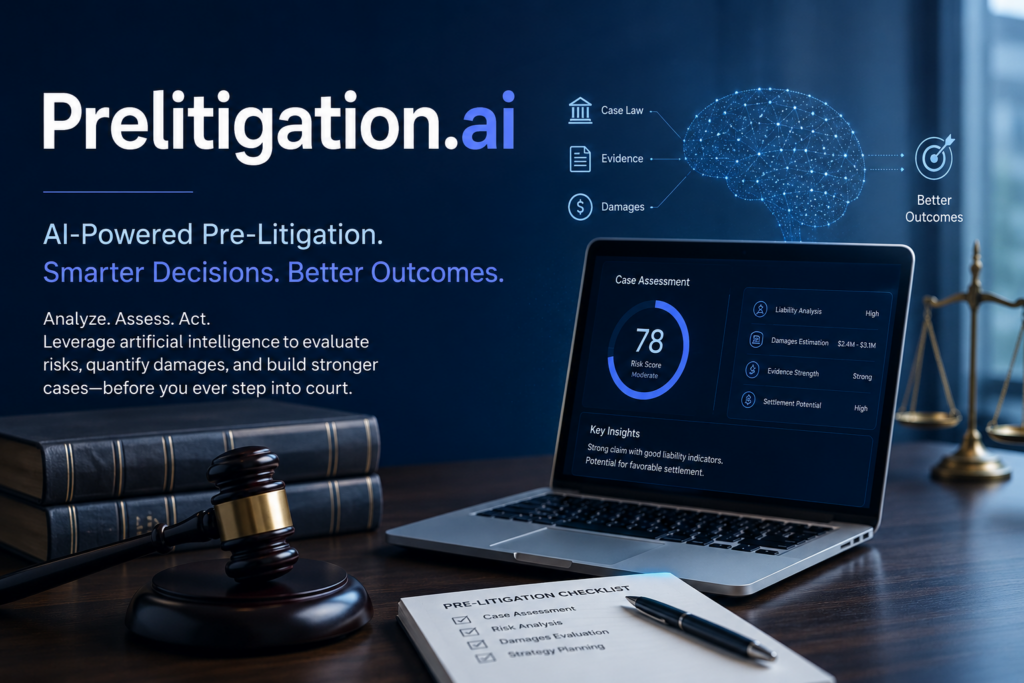
**Prelitigation.ai** is a highly descriptive, category-defining domain that sits at the intersection of a large, high-pain legal workflow and the rapid maturation of vertical AI. “Prelitigation” (or pre-suit) refers to the phase of a dispute that occurs after an incident or claim arises but before a formal lawsuit is filed—intake, investigation, medical/record gathering, liability and damages evaluation, demand packages, insurer negotiations, and settlement. This stage is document- and data-heavy, repetitive, time-sensitive, and often the primary driver of law-firm economics and access-to-justice outcomes. Pairing it with the `.ai` extension immediately signals modern, AI-native tooling.
Its commercial weight comes from the fact that pre-litigation work relies heavily on structured extraction from medical records, police reports, insurance policies, photos, and correspondence—exactly the kind of work where large language models, retrieval-augmented generation, and specialized agents deliver measurable ROI today.
Market Context That Makes the Domain Valuable
Legal technology is a multi-tens-of-billions market growing at double-digit rates, with the AI subset expanding significantly faster (projected CAGRs in the high 20s percent range in recent analyses). Within that, personal injury (PI) has emerged as one of the hottest verticals.
Companies have raised substantial capital from top investors and demonstrated that firms can dramatically increase caseload capacity, shorten time-to-demand, and improve settlement outcomes without proportional headcount growth.
Other activity includes AI fact-finding packages, automated demand drafting tools, and academic or startup work on agentic systems for prelitigation analysis. The pain points are clear: high administrative burden, staffing shortages, inconsistent quality in demand packages, slow medical-record retrieval, and pressure to maximize recoveries while controlling costs.
Pre-litigation is also where most cases resolve; only a minority proceed to formal litigation. Capturing and optimizing that stage therefore touches a large share of the overall legal-services value chain (PI alone is frequently cited in the $50B+ range in the U.S.).
Core Ways a Business Could Leverage the Domain
1. Vertical AI SaaS or Platform for Law Firms (Especially Plaintiff PI)
Position Prelitigation.ai as the dedicated operating system for the pre-suit phase. Core capabilities that map cleanly to the brand include:
– Automated or AI-assisted intake and case triage (including bilingual voice agents).- Intelligent extraction and structuring of medical records, bills, police reports, and other evidence, with chronologies and summaries.
– Generative drafting of high-quality demand packages, settlement offers, and supporting exhibits, trained or fine-tuned on large volumes of real case outcomes.
– Predictive valuation models (settlement ranges by venue, injury type, insurer, treating providers, etc.).
– Workflow orchestration, automated follow-ups with insurers and providers, lien handling, and negotiation support tools.- Analytics dashboards tracking time-to-demand, conversion rates, policy-limits recovery rates, and staff efficiency.
Differentiation could come from pure software (versus managed service), multi-practice expansion beyond PI (employment, consumer, construction, commercial disputes), stronger defense-side tools, or superior integrations with existing case-management systems. The domain itself becomes a powerful SEO and brand asset for searches related to “prelitigation AI,” “AI demand letter,” or “pre-suit automation.”
2. Hybrid Managed Service / “Pre-Litigation as a Service”**
Follow the model proven by players: pair proprietary AI agents with experienced paralegals or case managers. Law firms outsource the entire pre-litigation workflow for a per-case or volume-based fee that undercuts fully loaded internal staffing costs. The brand “Prelitigation.ai” can own the category language while the underlying delivery mixes automation with human accountability and attorney oversight. This reduces the pure-software sales friction that many law firms still feel toward fully autonomous tools.
3. Insurance, Corporate, and Defense-Side Tools
Shift the lens to the other side of the claim. Insurers and corporate legal departments spend enormous resources evaluating liability, setting reserves, and negotiating before suit. An AI platform under this domain could offer early case assessment, fraud or exaggeration signals, comparable-settlement analytics, and accelerated resolution workflows. Reducing the percentage of claims that become lawsuits is a high-value outcome for these buyers.
4. Consumer or Access-to-Justice Oriented Products (Higher Risk, Higher Mission Fit)
A more ambitious (and regulatory-sensitive) play is a direct-to-consumer or self-help oriented tool that helps individuals evaluate potential claims, understand typical settlement ranges, generate initial demand correspondence, or prepare for conversations with counsel or insurers. Related examples already exist in specialized niches (e.g., domestic-violence support companions in certain jurisdictions). Success here requires extreme care around unauthorized practice of law (UPL) rules, clear disclaimers, mandatory attorney review pathways, and often jurisdiction-by-jurisdiction compliance. The upside is expanding access and creating a top-of-funnel data or lead engine that feeds B2B products.
5. Marketplace, Mediation, or Early Dispute Resolution Layer
Position the site as an AI-facilitated hub for online dispute resolution, neutral case evaluation, or matching parties with mediators/arbitrators before formal litigation. Generative AI can help surface facts, propose settlement frameworks, or simulate negotiation ranges, while human neutrals remain in the loop. This leans into the preventive and efficiency narrative implied by “prelitigation.”
6. Data, Insights, and Adjacent Products
Anonymized, aggregated pre-litigation data becomes a secondary asset: reports on settlement trends by injury type or insurer behavior, benchmarking tools for firms, or risk-scoring products sold to underwriters and businesses. Content marketing, CLE-style education, and thought leadership under the domain reinforce category ownership.
Branding, Go-to-Market, and Monetization Advantages
The domain is short, memorable, and keyword-perfect. It supports a clean brand narrative (“the AI layer for everything that happens before you file”) and makes content, advertising, and partnership conversations easier. Target early adopters among high-volume plaintiff PI firms that already feel staffing pressure, then expand. Integrations, SOC 2 / HIPAA compliance, clear audit trails, and attorney-in-the-loop design are table stakes for trust.
Monetization options include pure SaaS subscriptions, usage- or per-case fees, hybrid managed-service pricing, enterprise licenses for large firms or carriers, and carefully structured success-based elements (ethics rules constrain pure contingency arrangements in many places).
White-labeling for other legal-tech platforms is another path.
Competition is real and well-funded in the PI vertical; differentiation on depth of domain data, quality of outputs, integration experience, or practice-area breadth is essential.
Longer-Term Implications and Strategic Upside
Owning Prelitigation.ai positions a company as the obvious brand for an entire workflow stage rather than a single feature (demand letters only, records only, etc.). As AI agents become more capable, the platform can expand upstream into risk prevention and early detection or downstream into litigation support and post-settlement processes. Success also contributes to broader access-to-justice goals by lowering the cost and increasing the speed of resolving meritorious claims. In a market where vertical specificity and proprietary data create durable advantages, the combination of a precise domain, focused product, and accumulating case outcomes can compound into a meaningful moat.
In short, the domain is unusually well-suited to a focused legal-AI business that attacks a high-volume, high-friction stage of the dispute lifecycle. The most straightforward and currently proven path is a B2B (or hybrid) offering aimed at plaintiff personal-injury and adjacent high-volume practices, with clear expansion routes into insurance/corporate tools, multi-practice coverage, and carefully designed access-to-justice products.
Buy Prelitigation.ai