
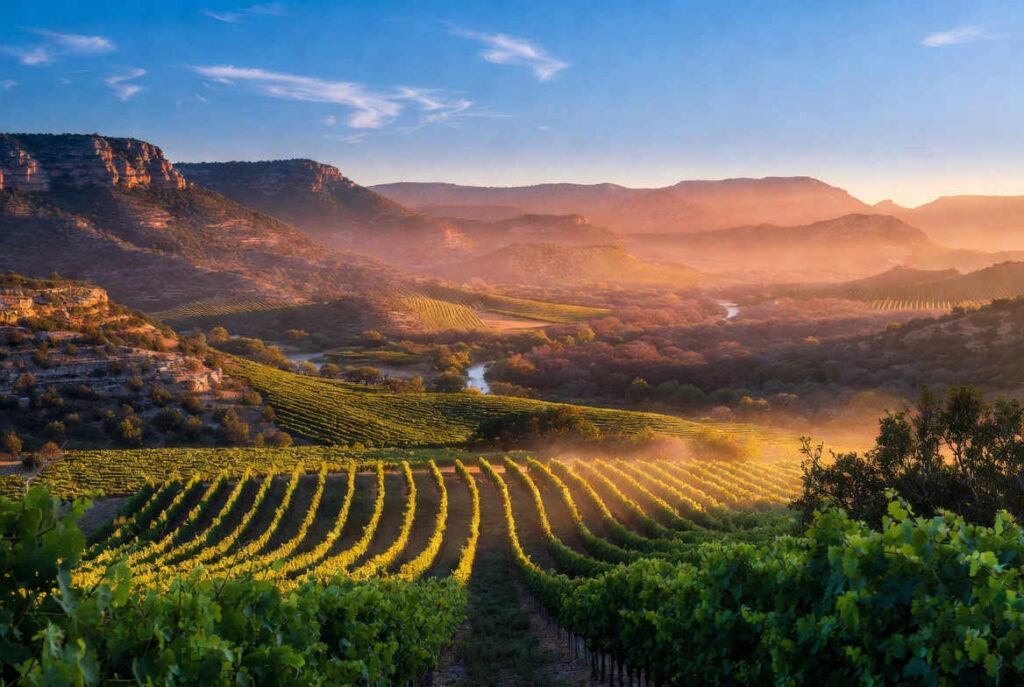
Stand on a high ridge in the Texas High Plains near Lubbock on a late-summer evening and the scale of the place becomes almost abstract. Flat cotton and sorghum fields stretch to the horizon under a vast sky, broken only by orderly rows of grapevines that catch the last light. A few hundred miles southeast, in the rolling limestone hills west of Austin and San Antonio, the scene shifts: limestone outcrops, live oaks, and tasting-room patios filled with visitors who have driven the 290 Wine Trail for the afternoon. These two landscapes — one the quiet engine of grape production, the other the public face of Texas wine — together tell the story of an industry that has moved from curiosity to genuine consequence.
Texas now ranks among the top five U.S. states in wine production volume and fourth in the number of wineries. More striking is its economic footprint: according to the 2025 WineAmerica economic impact study, the Texas wine industry generates $24.39 billion in total economic activity, supports roughly 136,700 jobs, and contributes more than $3.4 billion in tax revenue. That places Texas second only to California in overall economic impact from wine. Roughly 14,000 acres are planted to wine grapes across more than 600 producers. The numbers reflect both rapid recent growth and a deeper, longer history.
Historical Roots: Missionaries, Rootstock, and a Modern Revival
Spanish missionaries planted the first European grapevines near present-day El Paso in the 1600s. In the late nineteenth century, Denison horticulturist T.V. Munson developed phylloxera-resistant rootstocks from native Texas species; his work helped save the French wine industry and earned him France’s Legion of Honor. The oldest continuously operating bonded winery in the state, Val Verde Winery in Del Rio, was founded in 1883 by Italian immigrant Frank Qualia and survived Prohibition by producing sacramental wine.
Prohibition and its aftermath largely silenced commercial winemaking for decades. The modern revival began in the 1970s. Texas Tech professor Clinton “Doc” McPherson and colleagues established experimental vineyards on the High Plains and, in 1976, co-founded Llano Estacado Winery — one of the first new commercial operations of the postwar era. From that foothold the industry expanded, first cautiously with familiar French varieties, then more confidently with grapes better suited to Texas heat and soils. By the early twenty-first century the state had formal American Viticultural Areas, a growing tourism infrastructure, and wines that began winning serious recognition beyond state lines.
Geography and Terroir: Two Engines, Many Microclimates
Texas currently has eight AVAs, though plantings also exist outside formal boundaries. Two dominate the industry’s geography and psychology.
The Texas High Plains AVA (established 1993) covers more than eight million acres on the Llano Estacado at elevations of roughly 3,000 to 4,000 feet. It produces an estimated 70–85 percent of the state’s wine grapes. The climate is semi-arid, with strong diurnal temperature swings that preserve acidity even as daytime heat builds sugar and flavor. Soils are often sandy or loamy, and the region’s irrigation comes largely from the Ogallala Aquifer. This is primarily a grape-growing rather than tourism region; many of the best High Plains fruit travels to Hill Country or other wineries for fermentation and bottling.
The Texas Hill Country AVA (1991) is one of the largest AVAs in the United States by land area — more than nine million acres — though planted acreage remains far smaller. Nested within it are the smaller Bell Mountain and Fredericksburg in the Texas Hill Country AVAs. Elevations range from about 800 to over 2,000 feet. Limestone and granite soils, combined with warm days and somewhat cooler nights, favor aromatic and Mediterranean-style wines. This is the tourism heartland: the 290 corridor between Austin and Fredericksburg draws the majority of the state’s 2.6 million annual wine-country visitors.
Other AVAs add diversity. The Texas Davis Mountains AVA sits at higher elevations (up to 8,000-plus feet) on volcanic and granitic soils, offering cooler conditions relative to the surrounding desert. Escondido Valley and Mesilla Valley occupy arid West Texas country. Texoma, along the Red River, has historical importance through Munson’s work and grows both vinifera and hybrid varieties. The Gulf Coast and eastern regions rely more heavily on disease-resistant hybrids such as Blanc du Bois and Black Spanish (Lenoir) because of higher humidity and Pierce’s disease pressure.
Grapes and Styles: Matching Variety to Place
Early modern plantings often followed the California model — Cabernet Sauvignon, Merlot, Chardonnay. Many of those varieties can and do produce good wine in Texas, but consistency has proven elusive under heat, freezes, and disease pressure. Over the past two decades a deliberate shift has occurred toward varieties that thrive in warm, dry Mediterranean and Iberian climates.
Tempranillo has emerged as a flagship red for many producers, delivering structured wines with dark cherry, plum, spice, and savory notes. Mourvèdre (sometimes labeled Mataro) offers depth and age-worthiness. Grenache, Tannat, Aglianico, Sangiovese, and Montepulciano also perform well. On the white side, Viognier, Roussanne, Picpoul Blanc (the “lip-stinger” for its bright acidity), and Chenin Blanc have found strong expressions. Hybrids such as Blanc du Bois and Black Spanish remain important in higher-pressure disease zones.
The result is a stylistic range that no longer feels like an imitation of somewhere else. High Plains fruit often shows mineral and savory edges; Hill Country wines can be juicier and more aromatic. Blends that draw from both regions are common and frequently successful.
Buy HillCountryTempranillo.com
Recognition, Producers, and the Quality Leap
Quality recognition has accelerated. In 2026, Texas wines earned their first gold medals at the Decanter World Wine Awards — the world’s largest wine competition — with entries from Ab Astris (Souzao), Turtle Creek (Tannat), Adega Vinho (Tempranillo), and Spicewood Vineyards (a Tempranillo-Petit Verdot blend). Strong showings in other major competitions continue. Wineries frequently cited for consistent excellence include Bending Branch (early adopter of Tannat and Picpoul Blanc), William Chris, Pedernales Cellars, Llano Estacado, Becker Vineyards, Messina Hof, and a growing list of smaller estate producers.
Many of the most interesting wines now come from growers and winemakers who treat Texas as a distinct place rather than a warmer version of Napa or Bordeaux. Estate plantings, careful site selection, and thoughtful canopy and irrigation management have raised the ceiling.
Economic Impact, Tourism, and Challenges
Wine tourism is a major economic driver, especially in the Hill Country, where tasting rooms, restaurants, lodging, and events generate hundreds of millions in visitor spending. The industry’s $24.39 billion total impact includes not only grape growing and winemaking but also wholesale, retail, tourism, and supplier effects across the state.
Challenges remain real. Pierce’s disease, transmitted by sharpshooter insects, is a persistent threat, particularly in the Hill Country, Gulf Coast, and eastern regions; High Plains and higher-elevation sites face lower pressure. Late spring freezes, extreme heat, drought, and occasional fungal disease in wetter years can reduce yields or quality. National wine-market softness has at times made it harder for growers to sell fruit. Yet the industry has responded with better variety matching, disease-resistant plantings, improved vineyard practices, and stronger direct-to-consumer and tourism models.
Experiencing Texas Wine
The classic introduction is a Hill Country weekend centered on Fredericksburg or the 290 corridor — multiple tasting rooms within short drives, often with food pairings, live music, or overnight stays. High Plains visits are more specialized and rewarding for those interested in the source of most Texas grapes; several producers near Lubbock offer tours and tastings. Val Verde in Del Rio provides a living link to nineteenth-century history. Statewide, many wines are available through Texas retailers, restaurants, and online clubs.
Texas wines pair naturally with the state’s own cuisine: Tempranillo or Mourvèdre with smoked brisket, Picpoul Blanc or Blanc du Bois with Gulf seafood or spicy Tex-Mex, richer reds with game or grilled meats. The best bottles reward attention rather than novelty.
Texas wine is no longer an emerging curiosity. It is a mature, multi-billion-dollar industry rooted in distinct terroirs, informed by both ancient and modern history, and increasingly confident in its own identity. The High Plains quietly supplies the majority of the fruit; the Hill Country translates that fruit into visitor experiences and brand recognition; smaller AVAs and hybrid plantings expand the palette. Challenges of climate, disease, and market perception persist, yet the trajectory of quality and economic contribution is clear.
Like the pecans of Seguin and Groves, Texas wine expresses a particular relationship between people, place, and product. It is less about imitating other regions and more about discovering what these soils, elevations, and weather patterns can do best. The results — in the glass, in the tasting room, and in the broader economy — continue to deepen.
Next in the series: Saffron farming in Texas
Buy HillCountryTempranillo.com