
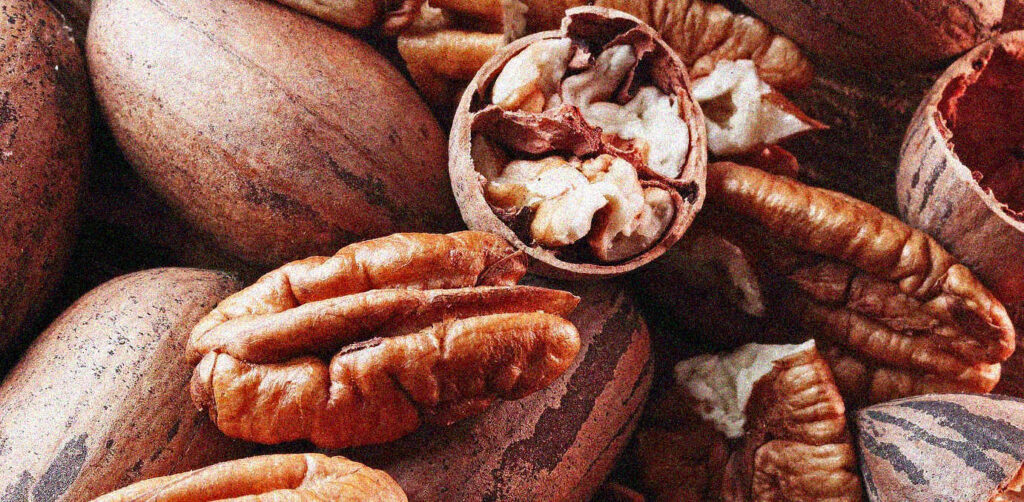
Part 1: Pecans from Seguin and Groves — The Nutty Heart of Texas
Drive into Seguin on a crisp autumn morning and the air itself seems to carry a faint, buttery sweetness. Along the Guadalupe River bottoms, native and improved pecan trees stand in long, orderly ranks or scatter in wilder thickets, their branches heavy with green husks that will soon split to reveal the rich, oily kernels inside. A few miles north of downtown, a 16-foot fiberglass pecan rests beside a big red barn. In front of the Guadalupe County Courthouse sits an older, smaller concrete version. Both claim — with Texas-sized confidence — to be the world’s largest. Roughly 250 miles to the east, in the Golden Triangle town of Groves, another giant fiberglass pecan (this one held aloft by a cheerful squirrel named Grover) greets visitors at City Hall. These oversized monuments are more than roadside oddities. They are playful emblems of a deeper truth: pecans are woven into the soil, history, economy, and identity of these two Texas communities in ways that are both serious and joyfully eccentric.
Historical Roots: From “River of Nuts” to Official State Tree
The story begins long before any fiberglass sculpture. In the early 16th century, Spanish explorer Álvar Núñez Cabeza de Vaca, shipwrecked and held captive along what is now the Guadalupe River, survived in part by eating the abundant wild pecans that lined the banks. He called the waterway the “river of nuts,” providing one of the earliest written European accounts of the tree. Indigenous peoples across what would become Texas had already relied on pecans for centuries as a staple food, trade good, and source of oil and flour.
Pecans (Carya illinoinensis) are native to North America, and Texas sits near the heart of their natural range. The tree became the official state tree of Texas in 1919. Native stands still thrive in the deep alluvial soils of river bottoms across roughly 150 counties, while improved (cultivated) orchards now dominate commercial production. Guadalupe County, home to Seguin, has long ranked among the state’s stronger producers, benefiting from the rich bottomland soils along the Guadalupe.
Seguin earned its reputation as the “Pecan Capital of Texas” through both geography and deliberate promotion. Local dentist Edmund “Doc” Darilek bought farmland in 1946 and began planting an orchard in 1958. By 1962 he had constructed a 5-foot-long, 1,000-pound concrete-and-plaster pecan and placed it in front of the Guadalupe County Courthouse specifically to advertise the region’s growing industry. That first giant nut launched a decades-long, good-natured rivalry that would eventually involve Missouri and multiple reclaimings of the “world’s largest” title.
Groves tells a parallel but distinct story. In the early 20th century (around 1910–1920), developer Asa E. Groves and partners arranged for thousands of pecan trees — estimates range from 2,500 to 6,000 — to be planted across hundreds of acres near Port Arthur. The plantings helped market the new subdivision that eventually became the city of Groves (named for Asa himself, not the trees). What began as a real-estate amenity evolved into a community identity. The annual Pecan Festival, launched in 1969, has grown into a multi-day celebration that draws families from across the Golden Triangle. A 17-foot fiberglass pecan at City Hall, complete with the squirrel mascot Grover, keeps the theme visible year-round.
The two towns therefore represent complementary facets of Texas pecan culture: Seguin as a working agricultural and promotional center with multi-generational orchards, and Groves as a community that turned early plantings into civic tradition and festival spirit.
The Battle of the Giant Pecans
No account of these places is complete without the saga of the oversized nuts. Doc Darilek’s 1962 courthouse pecan held the informal “world’s largest” claim for two decades. In 1982, Missouri pecan growers in Brunswick answered with a 7-by-12-foot, 12,000-pound concrete replica of their Starking Hardy Giant variety. Seguin lost the title but never stopped promoting itself as pecan capital. A mobile fiberglass version built by local grower Kenneth Pape in the early 2000s added another contender. Then, in 2011, the Leadership Seguin class of the local chamber of commerce raised $5,000 in donations and unveiled an 8-by-16-foot fiberglass pecan at the Texas Agricultural and Heritage Center (the Big Red Barn). The title returned to Texas.
Groves later installed its own 17-foot version, complete with squirrel, as part of its festival branding. These sculptures function as both tourism magnets and affectionate self-parody. Visitors photograph them, festivals revolve around them, and the ongoing (mostly friendly) competition keeps the towns in the public eye. The Texas Pecan Museum at the Big Red Barn in Seguin adds educational substance to the spectacle, displaying tools, history, and the cultural significance of the nut.
Growing and Harvesting: From Native Stands to 38 Varieties
Commercial pecan production in Texas mixes native trees (often managed with minimal inputs in river-bottom “groves”) and improved cultivars planted in denser orchards. Improved varieties offer larger nut size, higher kernel percentage, thinner shells, and better disease resistance, though natives retain loyal fans for their intense flavor. Texas typically ranks among the top three or four U.S. producers; recent estimates place annual output in the 30- to 45-million-pound range depending on weather, alternate bearing cycles, and disease pressure. Georgia and New Mexico currently lead overall volume, but Texas remains a major player with deep cultural ownership of the crop.
In Seguin, the living link to Doc Darilek’s original vision is 38 Pecans, still operated by his grandsons. The family orchard contains roughly 2,700 trees (some accounts note expansion toward 5,000 across sites) and grows 38 distinct varieties — the source of the business name. Varieties range from classics such as Pawnee, Cheyenne, and Sioux to others selected for flavor, size, and adaptability to Central Texas conditions. Harvest typically runs from October into December or even January in heavy years. Trees are shaken mechanically or by hand; nuts are gathered, cleaned, sorted, and either sold in-shell or cracked and packaged as halves and pieces. Recent seasons have seen the farm benefit from better rainfall after multi-year drought stress, producing heavier, well-filled nuts.
Pecan trees are alternate bearers — they tend to produce a heavy crop one year and a lighter one the next — and they are vulnerable to drought, late freezes, and fungal diseases such as pecan scab. Irrigation, careful variety selection, and integrated pest management are essential for consistent commercial yields. The labor of harvest and the capital required for equipment mean that many smaller orchards focus on direct-to-consumer sales, gift packs, and value-added products rather than pure commodity volume.
Festivals: Going Nuts in Public
Both towns turn the harvest season into community celebration. Seguin’s Pecan Fest (marking its 20th anniversary in 2025 and continuing into 2026) spreads across downtown Central Park and satellite sites including the Big Red Barn. Expect live music, historic tours, a Kids Zone, dozens of vendors, food-truck competitions featuring pecan-inspired dishes, cracking contests, and exhibits from local growers such as 38 Pecans. The event has grown into a signature fall weekend that draws visitors from across the region.
Groves’ Pecan Festival, reaching its mid-50s by the mid-2020s, runs several days in October and includes carnival rides, live music, food vendors, a pageant, parade, and the ever-present giant pecan. It began as a simple one-day event in 1969 tied to the local harvest and has become one of the Golden Triangle’s major family fall gatherings, with proceeds supporting community causes.
These festivals do more than sell pecans; they reinforce local identity, support small businesses, and give visitors a tangible connection to the landscape that produced the nut.
Flavor, Uses, and the Texas Table
Fresh Texas pecans are prized for their high oil content, rich flavor, and versatility. Improved varieties often deliver a buttery, mild-to-bold taste with a satisfying crunch; natives can be more intense and slightly more tannic. They appear in classic Southern desserts (pecan pie, pralines, pecan-studded cakes and cookies), savory applications (pecan-crusted fish or chicken, salads, stuffings), and modern Texas twists — think tequila-Tajín spiced pecans, curried candied pecans, or honey-pecan ales from local breweries.
Simple preparations often showcase quality best: lightly toasted with salt, candied with cinnamon and sugar, or ground into meal for coating mixes. Many Seguin producers sell both plain halves and flavored products, coating mixes, and honey butters. Because pecans are high in healthy fats, protein, and minerals, they also fit contemporary interest in nutrient-dense snacking.
Economic Realities and Ongoing Challenges
Pecans contribute meaningfully to local and state economies through farm income, processing, tourism, and retail. Direct-to-consumer and value-added sales help smaller operations capture more of the retail dollar. At the same time, the industry faces familiar agricultural pressures: prolonged drought and extreme heat that stress trees, disease pressure that rises in wetter years, labor availability for harvest, and competition from larger-producing states and imports. Climate variability makes long-term planning difficult; a mild, rainy summer can produce a bumper crop, while a late freeze or extended dry spell can slash yields. Alternate bearing further complicates cash-flow management. Yet the cultural attachment remains strong — few other crops inspire giant sculptures, dedicated museums, and multi-decade festivals.
Visiting and Buying
In Seguin, start at the courthouse lawn for the original giant pecan, then head to the Texas Agricultural and Heritage Center / Big Red Barn for the larger one and the Texas Pecan Museum. Schedule a visit or appointment at 38 Pecans (557 Seitz Road) during harvest season (typically mid-October onward) for fresh in-shell or shelled nuts, flavored products, and a look at a working orchard. Downtown shops and restaurants frequently feature pecan dishes. In Groves, the City Hall pecan and the October festival offer the easiest entry points; local markets often carry fresh nuts during season.
Online ordering from family operations such as 38 Pecans extends the reach year-round. Freshness matters: new-crop pecans (harvested that fall) taste noticeably brighter than older stock.
GrovesPecans.com is for sale! | SeguinPecans.com is for sale!
The pecans of Seguin and Groves illustrate something essential about Texas food culture. They are simultaneously ancient (native trees feeding people for centuries) and modern (improved varieties, mechanical harvest, value-added products). They support working farms and generate playful roadside monuments. They appear on festival tables and in high-end recipes. They link river-bottom ecology to community identity and economic livelihood. In a state that prides itself on scale and independence, the humble pecan manages to be both bigger-than-life and deeply rooted in specific places.
These two towns show that a single native nut can sustain orchards, festivals, museums, family businesses, and collective pride across very different corners of Texas. As the next harvest approaches each fall, the trees continue their quiet work of turning sunlight, water, and soil into one of the state’s most distinctive and enduring products.
(End of Part 1. Next in the series: Wines from Texas’s growing wine regions.)