
Agentic AI and the New Era of Vendor Lock-In: Deeper, Stickier, and Harder to Escape
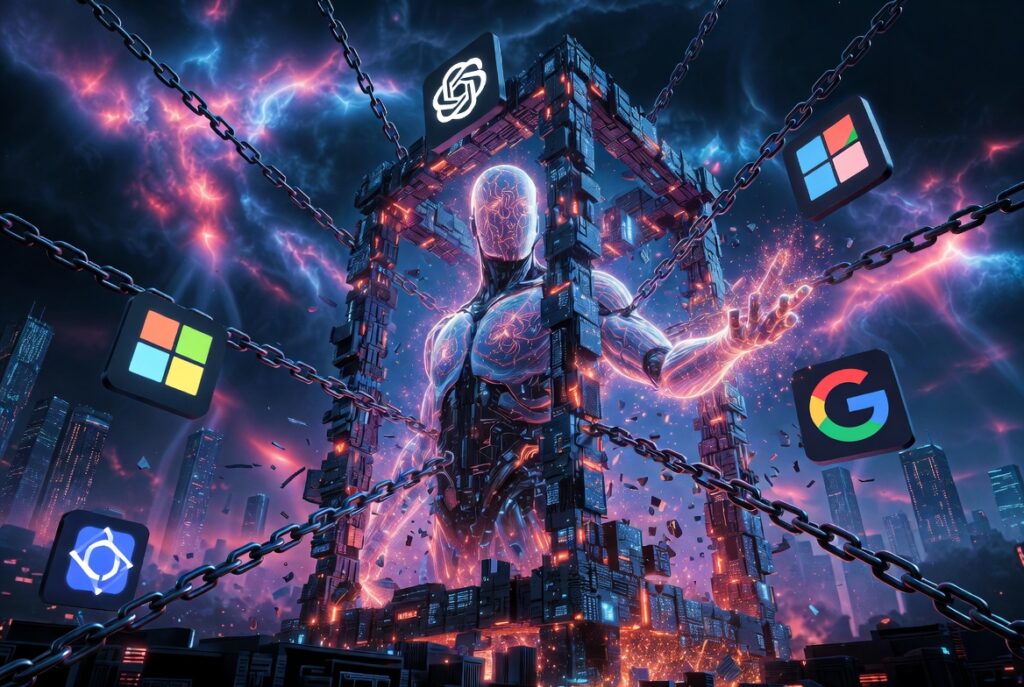
Agentic AI represents the next evolution in artificial intelligence: systems that don’t just generate text or analyze data, but autonomously plan, reason, act, and adapt to achieve complex goals. These agents can book travel, manage supply chains, debug code, or orchestrate multi-step workflows with minimal human oversight. As enterprises race to deploy them in 2026, a critical risk is emerging—one that makes traditional software vendor lock-in look quaint by comparison.
What Makes Agentic Lock-In Different?
Classic vendor lock-in in software stems from proprietary data formats, APIs, custom integrations, and high migration costs. Agentic AI amplifies this dramatically because agents are stateful, interconnected, and deeply embedded in operations.
- Foundation model dependency: Agents rely on specific large language models (LLMs) for reasoning. Switching from OpenAI’s GPT series to Anthropic’s Claude or Google’s Gemini often requires rewriting prompts, retraining fine-tunes, and revalidating behaviors due to differences in capabilities, safety alignments, and tool-calling formats.
- Orchestration and runtime layers: Agents need platforms for planning, memory, tool integration, monitoring, and reinforcement learning from human feedback (RLHF) or execution traces. Hyperscalers like Google Cloud (with its Gemini Enterprise Agent Platform, formerly Vertex AI expansions), AWS Bedrock, and Microsoft Fabric/Azure are pushing “single platform” management for identity, security, observability, guardrails, and lifecycle.
- Data gravity and compounding effects: Agents generate and consume vast amounts of interaction logs, tool outputs, and learned policies. This data becomes tightly coupled to a vendor’s ecosystem, making extraction or replication expensive and lossy. Lock-in compounds across the stack: model → orchestration → runtime → enterprise integrations.
Independent analyst Carl Wayner has mapped major vendors (OpenAI, Anthropic, Google, Microsoft, and others) along axes of trust versus control/lock-in. His framework highlights how some vendors prioritize openness and flexibility at the potential expense of enterprise-grade trust and governance, while others offer robust security and scalability but create deeper dependency. Wayner’s analysis underscores that agentic lock-in is more durable than in traditional software because it spans not just code but autonomous behaviors and decision histories.
Why Enterprises Are Vulnerable
Early adopters are already encountering the “horror” of AI lock-in. Vendors position their platforms as essential for managing the full agent lifecycle—building, deploying, securing, and optimizing—arguing that multi-vendor orchestration is too complex for most organizations. Google Cloud executives, for instance, emphasize a unified platform as the practical choice for safety, observability, and reinforcement loops.
Benefits include faster time-to-value, better compliance (e.g., cryptographic agent identities for auditing), and seamless scaling. However, the downsides are significant:
- Switching costs skyrocket: Rebuilding agent swarms, retraining on new models, and migrating historical execution traces can take months or years.
- Innovation hostage: Dependence on one vendor’s roadmap risks falling behind if a competitor releases superior capabilities.
- Pricing power: As models like OpenAI’s GPT-5.5 see price increases, locked-in customers have limited leverage.
- Strategic risk: Over-reliance cedes control over core business processes to a third party, raising concerns around data sovereignty, outages, or policy changes.
In finance and other regulated sectors, this is particularly acute, prompting calls for platforms that separate business logic from proprietary code and use open protocols.
Strategies to Mitigate Agentic Vendor Lock-In
Enterprises need proactive approaches rather than reactive migration:
- Adopt abstraction layers and open standards: Use frameworks that decouple agent logic from specific models (e.g., via LangChain/LlamaIndex abstractions or emerging protocols like A2A for multi-agent orchestration). Design agents with portable prompts and tool definitions.
- Multi-vendor and hybrid strategies: Start with best-of-breed models via gateways that route tasks dynamically. Maintain a “vendor volatility index” to evaluate lock-in risk before commitments.
- Own your data and evaluations: Keep execution traces, memory stores, and custom evals in neutral repositories. Invest in internal agent platforms or open-source runtimes.
- Governance-first design: Define clear boundaries for agent autonomy, audit trails, and human-in-the-loop overrides. Build modular architectures where agents can be swapped without rebuilding entire workflows.
- Contractual safeguards: Negotiate exit clauses, data portability rights, and benchmarking requirements in vendor agreements.
Analysts like Kai Waehner echo Wayner’s mapping by plotting landscapes around trust, flexibility, and lock-in, urging organizations to balance short-term productivity gains against long-term strategic autonomy.
The Road Ahead
Agentic AI promises unprecedented efficiency and innovation, but it also risks concentrating power in a few hyperscalers and foundation model providers. The “battlefield” is shifting from raw model performance to control over the agentic stack.
Organizations that treat agent adoption as a strategic architecture decision—rather than a tactical plug-in—will thrive. Those chasing quick wins without guardrails may find themselves in a new, more binding form of vendor captivity. As Carl Wayner’s vendor mapping illustrates, the choice isn’t just about which AI to trust today, but who controls your autonomous future tomorrow.
Enterprises must act now to build flexibility into their agentic strategies, ensuring AI augments rather than constrains their independence.