
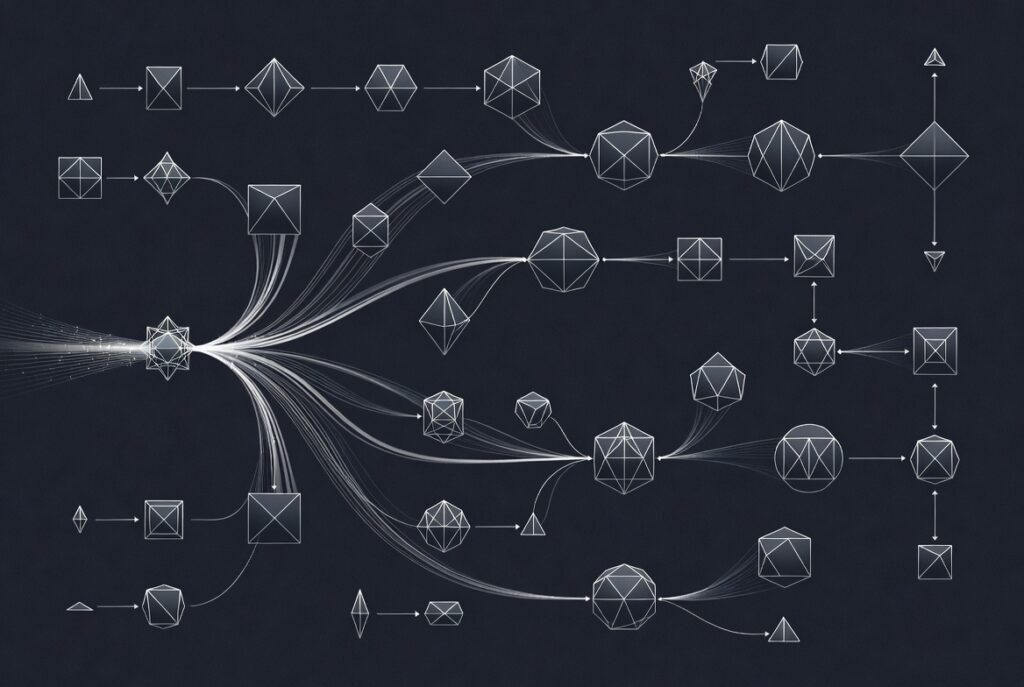
In the rapid evolution of large language models, enterprises have raced to integrate powerful frontier systems into customer support, internal tools, coding assistants, and decision workflows. Yet a quiet financial hemorrhage has accompanied this adoption. The problem is not that flagship models lack capability. It is that they are routinely asked to perform work far beneath their cost structure. This mismatch—often called “token regret”—has turned what should be a productivity multiplier into an escalating infrastructure tax. The emerging solution is the AI model router: an intelligent traffic-control layer that decides, for every incoming prompt, which model should handle it. What began as a clever developer optimization is hardening into core enterprise architecture.
1. The Core Infrastructure Problem: Token Regret
Token regret arises when organizations default every query—regardless of difficulty—to the most capable (and expensive) available model. A simple customer greeting, a password-reset request, a short FAQ lookup, or a routine code-completion suggestion is routed to systems such as GPT-4o or Claude 3.5 Sonnet (and their successors). These models deliver excellent results, but their pricing reflects the heavy reasoning, long-context, and safety machinery required for far more demanding tasks.
The economics are stark. Input tokens on a frontier model can cost twenty times more than those on a capable mid-tier or open-weight alternative; output tokens often show even larger multiples. When an enterprise processes millions of low-stakes interactions daily, the cumulative waste becomes material. Support tickets that a lightweight classifier and a fast open-source model could resolve for fractions of a cent instead consume several cents each. Coding agents that rename variables or generate boilerplate documentation are billed at the same rate as multi-file architectural refactors. The result is not merely higher monthly invoices; it is distorted unit economics that make AI features harder to scale profitably and harder to justify to finance teams.
This pattern is widespread. Many production systems still treat the language-model layer as a single black box. Developers or product managers select one “best” model at design time and leave the choice static. Because frontier models are impressive, the temptation is strong to use them everywhere. The hidden cost surfaces later in usage dashboards and quarterly reviews. Recent industry commentary has highlighted the same dynamic: even as per-token prices fall, overall enterprise bills continue to rise because request complexity, multi-step agent loops, and indiscriminate model selection inflate total volume.
The AI model router addresses this bottleneck directly. It functions as an intelligent traffic cop sitting in front of a portfolio of models. Rather than forcing every prompt through the same expensive pipeline, the router inspects the request, estimates the required capability, and dispatches it to the cheapest model that can meet quality and latency targets. When the router works well, organizations retain frontier performance for the tasks that truly need it while diverting the bulk of traffic to efficient alternatives. Early production deployments and product integrations report cost reductions of 30–60 percent with little or no measurable degradation in end-user quality.
2. How Modern Prompt Routing Works
Contemporary routers combine several complementary techniques. The most common architectures blend lightweight classification, rule-based intent logic, and confidence-driven fallback cascades.
Complexity Scoring A fast, inexpensive classifier—often a small fine-tuned model, an embedding similarity lookup, or even a carefully engineered heuristic—examines the incoming prompt. Signals include length, presence of technical vocabulary, nested conditionals, code snippets, mathematical notation, or multi-hop reasoning cues. The classifier assigns a complexity tier (for example, trivial, routine, moderate, or frontier). Trivial and routine prompts are steered toward fast, low-cost models; higher tiers escalate. Because the classifier itself consumes negligible tokens and runs in milliseconds, the overhead is small relative to the savings.
Intent-Based Rules Many organizations layer explicit business logic on top of complexity scores. Greetings, status checks, and simple retrieval questions can be hard-routed to open-source edge models or specialized small models optimized for latency. Requests involving legacy code debugging, multi-step planning, legal or medical nuance, or high-stakes customer communications escalate to frontier APIs. Intent classification can be performed by the same lightweight model or by a separate semantic router that matches the prompt against a library of labeled examples. This approach is particularly effective in customer-support and coding-assistant domains, where the distribution of query types is relatively stable and well understood.
Fallback Cascades No classifier is perfect. When a cheaper model returns low confidence, incomplete answers, or explicit uncertainty signals, the router can transparently forward the original prompt (or the partial response plus the original prompt) to a stronger model. The user experiences a seamless response; the system records the escalation for later analysis and possible retraining of the classifier. Cascades can be multi-stage: edge model → mid-tier open-weight model → frontier model. Confidence thresholds, latency budgets, and cost ceilings are tunable parameters. Production systems often log every routing decision so that teams can audit both quality and spend.
Additional refinements appear in mature deployments. Some routers incorporate user- or tenant-level preferences (prefer speed, prefer quality, or prefer lowest cost). Others maintain a live performance–cost Pareto frontier and continuously update model rankings from observed outcomes. Semantic routers using embedding similarity can route not only by complexity but by domain expertise—sending financial questions to one specialist model and creative writing to another. The net effect is a dynamic, multi-model stack rather than a monolithic dependency on any single provider.
3. The Market Ecosystem and the Shift to Infrastructure Backbone
The urgency of intelligent routing is amplified by the broader market dynamics visible on aggregator platforms. OpenRouter, which provides a unified gateway across hundreds of models from dozens of providers, has become a revealing window into real usage. Its 2025 State of AI report, based on more than 100 trillion tokens of anonymized traffic, documented a clear trend: open-weight models have risen from a marginal share to roughly one-third of total volume by late 2025, with Chinese-developed models contributing a substantial and rapidly growing portion of that open-source traffic.
By mid-2026 the platform was processing on the order of 250 trillion tokens per month, reflecting both organic growth and the practical advantages of multi-model access. Developers and enterprises increasingly treat the model layer as a portfolio rather than a single vendor commitment. Cost, latency, context length, specialization, and data-sovereignty constraints all vary; a router that can navigate that portfolio in real time becomes valuable infrastructure rather than an optional optimization.
Open-source and open-weight models have closed the practical intelligence gap for large classes of work. While frontier closed models still lead on the most difficult reasoning and agentic benchmarks, mid-tier and specialized open models now deliver competitive quality on routine coding, customer interaction, summarization, and many knowledge tasks—at a fraction of the price. The result is a natural division of labor that routers formalize. High-volume, lower-stakes traffic migrates to efficient models; scarce, high-stakes traffic remains on the frontier. This pattern is already visible in product launches: coding tools such as Cursor have introduced built-in routers that automatically select among available models according to modes that balance intelligence, cost, or speed, reporting substantial savings without quality loss. Similar orchestration layers are appearing in media generation and other vertical domains.
The competitive and economic implications are significant. Vendor lock-in becomes less attractive when a routing layer can shift traffic overnight. Pricing pressure intensifies on frontier providers because customers can reserve their most expensive capacity for the work that truly requires it. At the same time, the existence of capable open models creates a credible outside option that disciplines the entire market. For enterprises, the ability to express cost, latency, and quality preferences at the infrastructure level turns AI from a variable and often opaque expense into a more predictable, optimizable resource.
Conclusion: From Developer Hack to Enterprise Backbone
Prompt routing began as a pragmatic response by cost-conscious developers who noticed that not every request needed a frontier model. It has matured into a foundational capability. Complexity scoring, intent rules, and fallback cascades together form a control plane that sits above the model marketplace. Platforms that expose many models through a single API accelerate the adoption of that control plane; real-world usage data from those platforms demonstrates both the demand for multi-model flexibility and the rapid improvement of open alternatives.
In the coming period, organizations that treat model selection as a static design-time decision will continue to experience token regret at scale. Those that invest in intelligent routing—whether built in-house, adopted from cloud providers, or integrated into application platforms—will convert the same underlying model capabilities into materially better unit economics and greater operational resilience. Prompt routing is no longer a nice-to-have developer technique. It is becoming the traffic-management and cost-control layer without which enterprise AI cannot scale efficiently. The companies that master it will treat the expanding universe of models not as a confusing menu of options but as a managed, orchestrated resource—exactly the infrastructure posture required for the next phase of widespread AI deployment.
Are you building AI cost controls and prompt routing solutions? Buy PromptRouter.ai today