
Kaffa landrace coffee is one of the most fascinating areas of coffee because it represents coffee before humans standardized it.
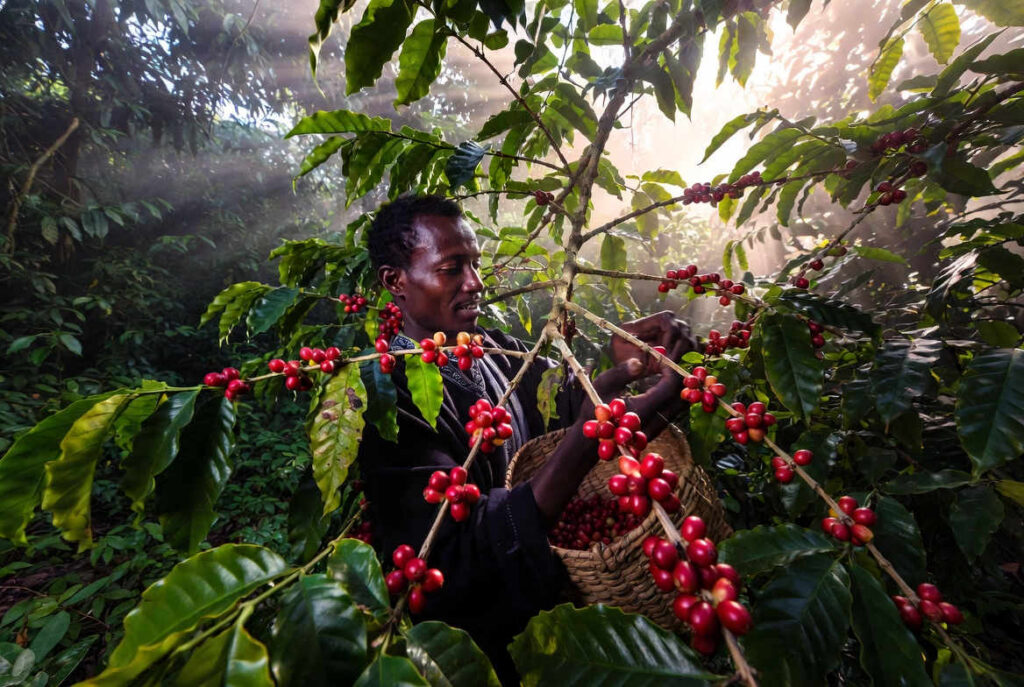
What is “Kaffa”?
Kaffa (also spelled Kefa) is a region in southwestern Ethiopia. It is widely considered one of the original homes of wild Coffea arabica. In fact, the word “coffee” is often said to derive from Kaffa, although linguists debate whether it instead comes from the Arabic word qahwa.
Unlike commercial coffee plantations, Kaffa still contains large tracts of native forest where coffee evolved naturally over thousands of years.
What is a landrace?
A landrace is a locally adapted population that has evolved naturally with limited human breeding.
Think of it like this:
- Wild coffee → untouched populations in forests.
- Landrace coffee → farmers selected good plants over centuries, but there was no organized breeding program.
- Cultivar/variety → intentionally bred and stabilized varieties like Bourbon, Typica, SL28, or Geisha.
Many Ethiopian coffees labeled “heirloom” are actually mixtures of dozens—or even hundreds—of local landrace genotypes.
Why is Kaffa coffee genetically important?
Arabica has surprisingly little genetic diversity worldwide because nearly every commercial coffee tree descends from a tiny number of plants exported from Yemen centuries ago.
Kaffa forests are different.
Researchers have found enormous genetic diversity there:
- different disease resistance
- drought tolerance
- different flowering times
- unique flavors
- different caffeine concentrations
- different bean sizes
- adaptation to varying elevations
This makes Kaffa one of the world’s most valuable genetic reservoirs for future coffee breeding.
As climate change threatens coffee production, breeders increasingly look back to Ethiopian landraces for genes that can improve resilience.
Flavor characteristics
There isn’t one “Kaffa flavor” because every forest contains many genetically distinct populations.
However, coffees from the region often show notes such as:
- jasmine
- bergamot
- blueberry
- peach
- black tea
- honey
- floral sweetness
- citrus
Some lots are intensely fruity while others are chocolate-forward.
That’s part of the appeal.
Forest coffee
One unique aspect of Kaffa is “forest coffee.”
Rather than planting rows of identical trees, farmers harvest naturally occurring coffee growing beneath the forest canopy.
The system is remarkably biodiverse:
- native trees
- birds
- insects
- wild mammals
- naturally regenerated coffee
Many conservation groups consider maintaining forest coffee economically important because it gives local communities an incentive to preserve forests instead of clearing them.
Why specialty coffee buyers love it
Roasters seek Kaffa coffees because they often offer:
- rare genetics
- unique cup profiles
- traceability
- conservation value
- limited production
Some lots are sold specifically because they come from ancient forest populations.
Is “Kaffa Landrace” a specific variety?
No.
This is a common misconception.
“Kaffa Landrace” doesn’t refer to a single cultivar.
Instead, it usually means coffee descended from the diverse local populations found in the Kaffa region.
A single farm may actually contain dozens of genetically distinct trees, all marketed under the same regional designation.
Why it matters for the future
Many coffee scientists view Ethiopia’s wild and landrace populations as a kind of “insurance policy” for global coffee. If diseases, pests, or hotter climates make today’s commercial varieties less viable, breeders may be able to develop new cultivars using the rich genetic diversity preserved in places like Kaffa.
It’s similar to the role that wild relatives of wheat, rice, and corn play in safeguarding future food security.
“KaffaLandrace.com (descriptive domain name for sale)” has strong storytelling potential. It evokes authenticity, biodiversity, and coffee’s origins—but because it’s a broad genetic designation rather than a single variety, it works best as educational content or sourcing information rather than as a product name by itself.