
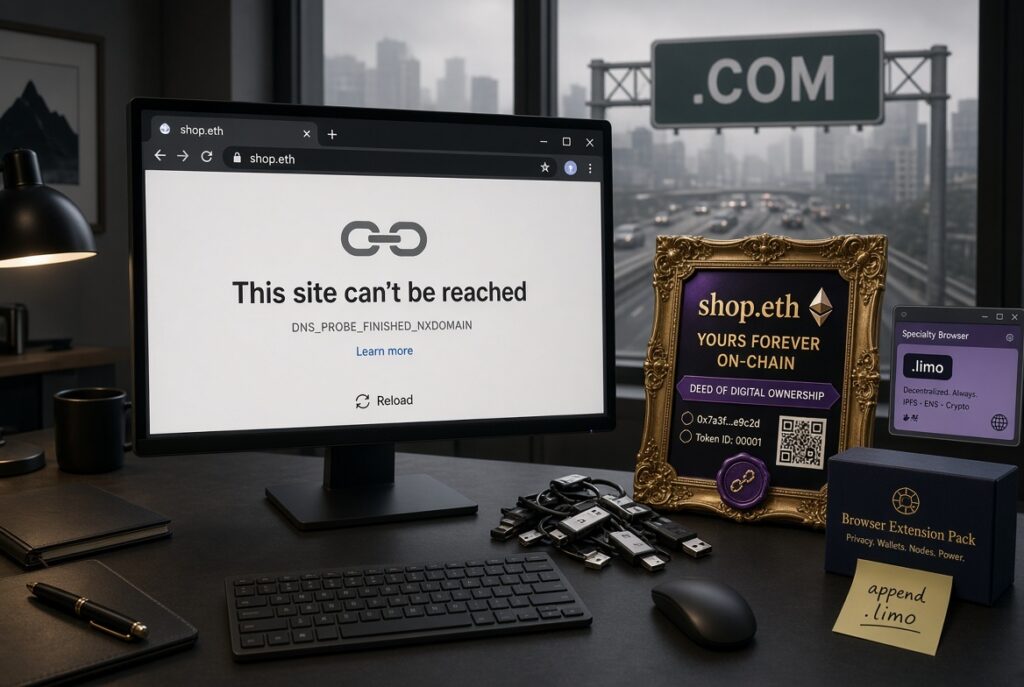
The pitch was simple. Buy yourname.eth or yourname.crypto once, own it forever, point it at a website, a wallet, and an identity, and never again rent a name from ICANN, GoDaddy, or a government. Blockchain would do what DNS politics could not: make naming permissionless, censorship-resistant, and valuable.
Five years after the peak of that pitch, the largest seller of those names has called the category a craze that stayed niche. The largest retail registrar that tried Handshake walked away. The most credible protocol in the space is asking ICANN for a conventional TLD. That is not a temporary lag. It is what happens when a naming system is built for a problem the public internet does not have, and fails the problems the public internet actually has.
A name on the internet is not a token. It is a coordination primitive. It has to resolve in every browser, work with email, be enforceable when someone steals a brand, survive the company that sold it, and mean the same thing to a bank in Tokyo and a phone in Lagos. Web3 domains fail that test in ways that compounding “decentralization” cannot fix.
1. Resolution is not optional, and browsers never conceded
Type nytimes.com into Chrome, Safari, Firefox, or Edge and it works. That is not a feature of the brand. It is a feature of a single shared root that those browsers already query.
Web3 names do not live in that root. They live in parallel registries: ENS on Ethereum, Unstoppable across several chains, Handshake as its own blockchain, plus a long tail of copycat services. To open one as a website you need an extension, a custom resolver, a gateway such as name.eth.limo, or a specialty browser. Brave and Opera added some support. That is not the internet. Combined they are a rounding error next to Chromium and WebKit.
This is not a missing integration that “will land next year.” Browser vendors have had years, documentation, libraries, and lobbying. They did not ship native resolution because doing so would mean:
- picking winners among competing, colliding namespaces
- sending user lookups to blockchain RPC providers
- accepting a security and collision surface ICANN itself has warned about
- breaking the assumption that a hostname means one thing everywhere
ICANN’s own technical staff put the deployment problem bluntly: unless users install software or reconfigure every device, alternate names fail with “domain not found.” That is death for a consumer product. People do not install infrastructure to visit a site. Sites that require infrastructure do not get visited.
Gateways paper over this for demos and do not solve it. vitalik.eth.limo is not vitalik.eth. It is a third-party HTTP service that can go down, get blocked, inject content, or log requests. The moment you need a gateway, you have reintroduced the intermediary the blockchain was supposed to remove — and you have a URL nobody will print on a billboard.
Search engines mostly do not index IPFS sites behind these names. Certificates and public-suffix rules assume the DNS. Corporate proxies, parental filters, and school networks assume the DNS. The installed base is not waiting to be educated. It is already finished.
2. Trademark law is not a nice-to-have
DNS is not loved because it is elegant. It is used because when someone registers paypal-security.example in bad faith, there is a path: UDRP, courts, registrar compliance, and a body of decisions going back a generation. Banks, luxury brands, and governments will not put their primary identity on a system where that path does not exist.
Web3 names sit outside ICANN policy. UDRP does not apply. A trademark owner who finds nike.eth or wellsfargo.crypto held by a stranger generally cannot use the process that recovers nike.com. Some providers keep reserved lists or ad hoc dispute windows. Those are private customer-service policies. They are not battle-tested law, they are not consistent across chains, and they can be changed or ignored. Unstoppable has reserved names for brands in ways holders have described as opaque. ENS has historically offered little comparable process.
The “uncensorable” selling point is the same fact restated as a virtue. If a court cannot compel a transfer, a phishing name stays up. That is attractive to a small set of political dissidents and a large set of squatters. It is fatal for any company that has a legal department.
There is a second collision problem that trademark law cannot even reach. Unstoppable sold strings such as .wallet, .crypto, .nft, and .dao as if they were TLDs. ICANN’s 2026 gTLD round is the actual process by which those strings can become real internet TLDs — for someone else. The company that spent years telling buyers the names would one day resolve in ordinary browsers then declined to apply for several of those strings, citing cost versus expected sales, and issued refunds. Holders who treated the ICANN promise as part of the asset were left with an on-chain collectible.
A name that can be cloned in another registry, overridden by a future ICANN TLD, or dropped by the company that minted it is not an internet name. It is a ticket in a private game.
3. The governance problem is legitimacy, not the absence of a Discord
Saying these systems have “no governance” is too clean. They have plenty of governance. The wrong kind.
Unstoppable is a company. It sets prices, freezes strings, chooses which extensions live, and has already killed one: .coin was dropped after a collision, taking resolution away from on the order of 100,000 sold names. A registry that can unplug an entire TLD is not “yours forever.” It is a vendor with a smart-contract frontend.
ENS is a protocol plus a DAO. That is better engineering and still not internet governance. Token-weighted voting is not how you run a global public namespace. Capture, apathy, and the gravitational pull of large holders are known DAO failure modes. More telling: ENS is not trying to replace the root. It applied for .ens as a conventional gTLD. .eth itself cannot be an ICANN TLD in the ordinary way because the three-letter string is reserved as Ethiopia’s ISO code. The flagship Web3 naming project is seeking a seat inside the system it was marketed as rendering obsolete.
Handshake tried the hardest version of the dream — auction a new root, let anyone run a TLD, replace ICANN. Namecheap’s 2026 exit was the market’s verdict. Browsers never resolved HNS natively. Email never worked. The remaining users live in specialty browsers and custom resolvers, which is where alt-roots always end.
Internet naming governance is ugly on purpose. It includes governments, trademark owners, infrastructure operators, and a bias toward not breaking what already works. That slowness is why google.com still means Google after twenty-five years of political fights. A DAO or a startup cannot buy that legitimacy by putting a hash on a chain.
4. There is one internet root, and that is not a conspiracy
The IANA root zone is not sacred because ICANN is beloved. It is sacred because it is unique. Every recursive resolver, every phone, every laptop, every IoT device is already configured — directly or through an ISP — to start from that root. The root server system is anycasted, over-provisioned, independently operated, and has survived attacks, key ceremonies, and decades of operational scar tissue.
An alternate root is easy to stand up and almost impossible to make universal. History is a graveyard of them: Alternic, New.net, OpenNIC, Name.space, Yeti. They failed for the same reason Handshake failed. You cannot bootstrap a second default. Users will not change their resolver to reach your sites, and sites will not exist if users cannot reach them. ICANN has documented the collision risk when the same string exists in two namespaces: the user gets the wrong destination, or an error, or a security incident. That is not a branding dispute. It is how you phish a bank.
Blockchain does not create a new physical path to “the internet.” Packets still traverse the same networks. TLS still needs certificates issued against names CAs recognize. Mail still needs MX records that Gmail and Outlook will accept. A ledger that says you own shop.crypto does not make Chrome ask that ledger.
People sometimes answer this with “just wait until wallets are the browser.” That is a hope that the entire client layer of the internet will be replaced so that a naming product can work. Products that require the rest of civilization to relocate do not become mainstream. They become subcultures.
5. This movie already played, without the word “blockchain”
RealNames (1996–2002) sold “keywords” that resolved in Internet Explorer’s address bar without a TLD. It raised more than $100 million, signed Microsoft, and processed enormous query volume. When Microsoft stopped routing those queries and sent them to MSN Search instead, the company collapsed in weeks. Distribution was the product. The keywords were a file on someone else’s computer.
AOL Keywords worked only inside AOL. Keyword: NFL was magic if you were a subscriber and nonsense if you were not. As users left the walled garden for the open web, the keyword system became a museum piece. Captive namespaces die when the captive audience leaves.
Alt-roots of the 1990s and 2000s sold “real” TLDs that were not in the IANA root. The pitch was always the same: ICANN is a bottleneck, we will be the free market, early buyers will be rich. None of them became how you reach a website.
Web3 domains are RealNames with an NFT and a worse distribution story. RealNames at least sat inside the dominant browser. Web3 names sit outside every dominant browser and ask the user to install something. Adding a token standard does not fix a distribution problem. It adds a speculative market on top of an unresolved one.
6. Blockchain is the wrong tool for the job people thought they were buying
Separate two products that marketing glued together.
Product A: a human-readable alias for a wallet. alice.eth → 0x… inside MetaMask, Coinbase Wallet, Rainbow. This works today, in a closed loop of crypto apps. It is useful in the way a Discord handle is useful. ENS in particular has real integration density in Ethereum software. That is not nothing.
Product B: a domain name. A string that is a website, an email address, a brand, a login hint, a certificate identity, and a thing you put on a van. This is what people thought they were buying when they paid four and five figures for short .eth and .crypto names during the 2021 bubble.
Blockchain helps Product A. It does not help Product B.
For Product B, a public chain adds:
- Latency and cost to updates that DNS handles with a TTL and a $12 renewal
- Permanent, public history of every record you ever set, including contact fields you later regret
- No native email. Gmail will not treat you@you.eth as a normal mailbox. Experimental “web3 email” products are more wallets-that-send-messages than SMTP. Businesses live on email. A name that cannot receive an invoice is not a business name.
- Fragmentation. The same string can exist on ENS, Unstoppable, Handshake, Solana Name Service, and the next chain. There is no single owner of “the name.”
- A business model that fights the infrastructure. Unstoppable’s one-time purchase sounds consumer-friendly and leaves the operator with no reason to maintain an extension after the mint. ENS’s renewal model is more honest and still does not buy you a browser.
- Speculation as the actual use case. A large share of registrations were inventory, not sites. When the NFT market cooled, so did the story that these names were “the next .com.” High secondary volume among flippers is not the same as demand from people who need a homepage.
The features that sound like breakthroughs are usually restatements of tradeoffs. “No renewal” means no contracted operator with skin in the game. “Cannot be seized” means cannot be recovered when stolen or used for fraud. “Decentralized website” usually means a static IPFS folder that Google does not index and that still needs a gateway for anyone normal to see.
If the problem was “I want a short name for my Ethereum address,” a naming contract on Ethereum is a reasonable answer. If the problem was “ICANN and registrars exist,” blockchain is a slogan. The public internet already has a naming system. It is old, political, and imperfect, and it works in 5 billion browsers without an extension.
Other reasons the category cannot normalize
Network effects run the other direction. DNS has every website, every email, every certificate authority, every CDN, every enterprise directory. Web3 names have crypto wallets and a handful of dapps. New users go where names already work. That loop does not reverse because a white paper says it should.
“Valuable” was a 2021 price, not a cash-flow. A name is valuable when someone needs it to operate. insurance.com is valuable because insurers and customers meet there. A rare .eth is valuable if the next speculator believes the last speculator. After the issuer of millions of those names says the mainstream market is traditional DNS, the greater-fool bid has to get more foolish, not less.
Security theater cuts both ways. Self-custody means if you lose the key, the name is gone, with no “forgot password.” If a helper app or a company-controlled registry key exists, you are back to trusting a vendor — the thing you paid extra not to do. Most people will not run their identity like a Bitcoin cold wallet. Most people should not.
The honest product already exists, and it is boring. You can tokenize a real .com. You can import a DNS name into ENS so the same string works as a wallet alias and as a normal website. That hybrid admits the truth: the valuable, resolvable, legally real object is still the ICANN name. The chain is an accessory. Accessories do not replace the thing they clip onto.
The niche that remains — and why it is not “mainstream”
It is possible, even likely, that .eth survives indefinitely as an Ethereum username. Wallets will keep resolving it. Collectors will keep trading short names. A slice of crypto-native sites will keep publishing via eth.limo. That is a community handle system with a secondary market. IRC had nicks. AOL had screen names. Discord has usernames. None of those became the address of the web.
Mainstream means: a restaurant puts it on a receipt, a university puts it on a diploma, a bank puts it on a statement, a grandmother types it from a handwritten note, and it works. That bar is not ideological. It is operational. Web3 domains have not cleared it after a full market cycle, a billion dollars of narrative, millions of mints, and explicit retreats by the firms that sold the dream.
Adding “blockchain” did not create a better namespace. It created a parallel one that cannot see or be seen by the one everyone already uses. Parallel namespaces that require special clients are hobbies. The internet already chose a root, a legal process, and a client stack. It is not going to choose again so that a token can look like a domain.