
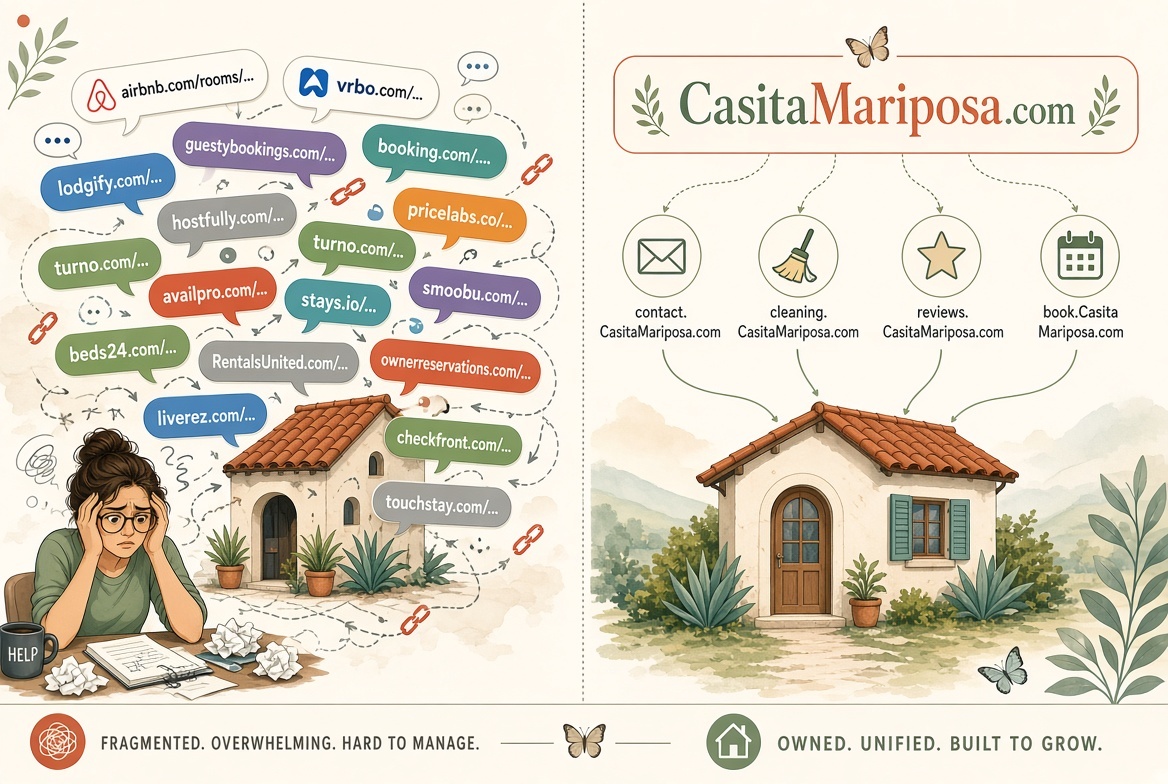
Casita Mariposa is not a software product. It is a fictional single property used to illustrate a simple point: when the owner of that one house controls the domain name, the URLs, the brand, and the ability to move the booking engine all stay with them. The same logic applies whether you have one property or fifty—the domain is owned at the property or brand level, not by the vendor.
Most short-term rental operators treat their domain name as an afterthought—a small technical detail once the real work of listing on Airbnb and Vrbo is done. In practice, the domain is one of the few assets that gives a host lasting control over traffic, brand, and future options.
The Default Trap
A host who lists only on Airbnb (or lives entirely on a PMS-provided subdomain) does not own the front door to their business. Guests find them through someone else’s platform. Bookmarks, search rankings, and repeat-guest habits all point at an address the host does not control. If the platform changes its rules, raises fees, or suffers an outage, there is nothing to redirect and no owned relationship to fall back on.
What Domain Ownership Actually Buys
Consider a multi-property operator like Jungle House in Columbus. They run dozens of units, generate thousands of reviews, and actively push direct bookings. Their public booking experience lives on their own domain (book.junglehouse.org and junglehouse.org), powered today by Guesty’s booking engine. The reviews displayed on that site are aggregated via a tool like Revyoos, pulling social proof that largely originated on Airbnb and other OTAs onto a page the operator controls.
The domain is the piece that makes the rest durable:
- The URL is theirs. Guests, Google, and past customers learn one address. That address does not change if the operator later switches booking engines.
- SEO and links survive a migration. When every important page lives on a domain the operator controls, those URLs can be 301-redirected to a new system. Rankings and bookmarks transfer instead of disappearing.
- The brand is memorable and ownable. People remember “junglehouse.org.” They do not remember a long platform subdomain.
- Vendor lock-in is reduced at the traffic layer. The OTAs and the PMS remain useful for volume and operations, but they no longer own the destination of the traffic. The engine underneath the domain can be replaced; the address guests already know cannot be taken away.
The Practical Continuity Plan
Smart operators treat the domain as an insurance policy. They keep a simple inventory of every important URL on their current booking site—homepage, individual property pages, location or category pages, policies, and any high-traffic content. If they ever need to move from one booking engine to another (Guesty to Lodgify, or to something else entirely), they can point the domain and immediately 301 every old URL to its equivalent on the new system. The cutover is not instant—channels, calendars, and payments still need careful migration—but the guest-facing address and the search equity attached to it remain intact.
Why This Matters More Than It Seems
In a business where hosts constantly balance OTA volume against the desire for independence, most tools solve one slice of the problem: calendar sync, review widgets, dynamic pricing, guest messaging. The domain sits underneath all of them. It is the low-cost piece of infrastructure that turns “we also have a website” into “we control where our traffic goes.”
Operators who own their domain can still use Airbnb and Vrbo as acquisition channels. They can still rely on a PMS for operations. They can still display aggregated reviews and capture emails for repeat business. The difference is that the front door belongs to them. If a vendor becomes unreliable or disappears, they keep the address, the brand, and the ability to point both at a new engine. Everyone else starts over.
That is the quiet, practical value of a domain name in short-term rentals.