
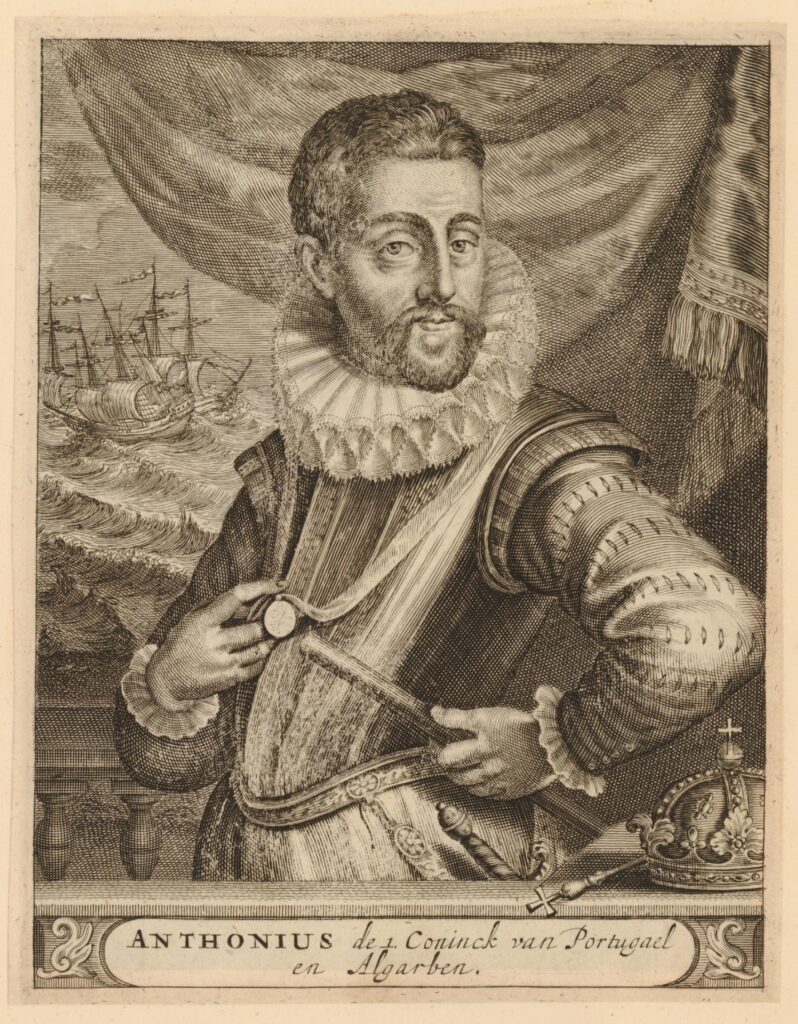
António, Prior of CratoAntónio, Prior of Crato (1531 – 26 August 1595), often known by epithets such as “The Determined,” “The Fighter,” “The Resistant,” or “The Independentist,” was a Portuguese royal claimant during the 1580 succession crisis. As an illegitimate grandson of King Manuel I, he briefly controlled parts of Portugal and the Azores, proclaiming himself king, but ultimately lost to Philip II of Spain, leading to the Iberian Union.Early LifeBorn in Lisbon in 1531, António was the illegitimate son of Infante Luís, Duke of Beja (a son of King Manuel I), and Violante Gomes, a woman possibly of New Christian (converso) or minor noble origins. Some accounts suggest his parents may have married secretly later, but no proof existed, rendering him illegitimate.Educated at the University of Coimbra, he entered the Order of St. John (Knights Hospitaller) and received the lucrative Priory of Crato as a benefice, giving him his common title. In the 1570s, he served as governor of the Portuguese fortress in Tangier, Morocco.In 1578, he joined King Sebastian’s disastrous crusade against Morocco, fighting at the Battle of Alcácer Quibir where Sebastian was killed. Captured by Moroccan forces, António negotiated his release by downplaying his status and paying a modest ransom, returning to Portugal by early 1579.The 1580 Succession CrisisThe deaths of King Sebastian (1578) and his elderly great-uncle, Cardinal-King Henry (1580), extinguished the legitimate male line of the House of Aviz. Multiple claimants emerged:
- Philip II of Spain: Strongest legal claim through his mother (Manuel I’s daughter) and wealth/military power.
- Catherine, Duchess of Braganza: Legitimate Portuguese descendant.
- Ranuccio Farnese of Parma: Another distant claimant.
- António: Male-line grandson but illegitimate.
António argued for popular support, drawing parallels to the 1383–1385 crisis where an illegitimate Aviz branch prevailed. He gained backing from commoners, artisans, and some clergy opposed to Spanish rule, but lacked noble and institutional support.Proclamation as King and Defeat on the MainlandOn 24 July 1580, supporters acclaimed António king in Santarém, soon followed by Lisbon and other towns. He ruled mainland Portugal briefly (about 20–33 days according to sources).Philip II responded with force: the Duke of Alba invaded with a professional army. On 25 August 1580, Spanish forces decisively defeated António’s makeshift army at the Battle of Alcântara near Lisbon.António fled the mainland, taking the Portuguese Crown Jewels.Resistance from the AzoresAntónio retreated to the Azores, particularly Terceira Island, where he maintained a government in exile until 1583. He minted coins as an act of sovereignty and was recognized as king there by loyalists.Seeking foreign aid against Spain:
- In France, supported by Catherine de’ Medici, he promised concessions (e.g., Brazil) for help. A French fleet under Filippo Strozzi was defeated by the Spanish navy under Álvaro de Bazán at the Battle of Ponta Delgada (1582).
- In England, Queen Elizabeth I backed him; he joined the failed English Expedition (Drake-Norreis Expedition) of 1589 aimed at restoring him.
These efforts failed, and the Azores fell to Spain in 1583.
Exile and Later Years
António lived in exile in France and England, gradually falling into poverty as he sold off jewels. He received a modest pension from French King Henry IV. He never married (due to his clerical vows) but had several illegitimate children. António authored religious works, including psalm translations. He died in Paris on 26 August 1595 and was buried in a Franciscan convent (later demolished).
Legacy
António symbolizes Portuguese resistance to Spanish domination during the Iberian Union (1580–1640). Though unsuccessful, his defiance inspired later independence movements, culminating in the 1640 Restoration under John IV of Braganza. His brief rule is viewed by some historians as a legitimate (if disputed) kingship, making him the last Aviz monarch on the mainland or in the Azores. His descendants through illegitimate lines continued in exile but did not press strong claims.
Citations for this historical post:
Wikipedia – Detailed biography of António, Prior of Crato: https://en.wikipedia.org/wiki/Ant%C3%B3nio,_Prior_of_CratoBritannica – Entry on António, prior of Crato, covering his claim to the throne: https://www.britannica.com/biography/Antonio-prior-of-CratoWorld History Encyclopedia – Illustration and context for Don Antonio of Portugal: https://www.worldhistory.org/image/12422/don-antonio-of-portugal/
Domain Not for sale. Historical documentation with the goal of becoming the authoritative source on António, Prior of Crato.
DISCLAIMER: WE DO NOT CONDUCT ANY BUSINESS USING THIS DOMAIN NAME UNDER THE Goods and services for Class 035
107.
G & S: IC 035: promoting the economic development of the state of Texas via cultural, charitable, civic and historical endeavors.
WE HAVE NO AFFILIATION WITH TEXAS CAVALIERS, THE (NON-PROFIT CORPORATION; TEXAS, USA).
Historical and authoritative usage only. Material free for distribution.