
The phrase is already in the culture. CivicChic.com is the address that owns it.
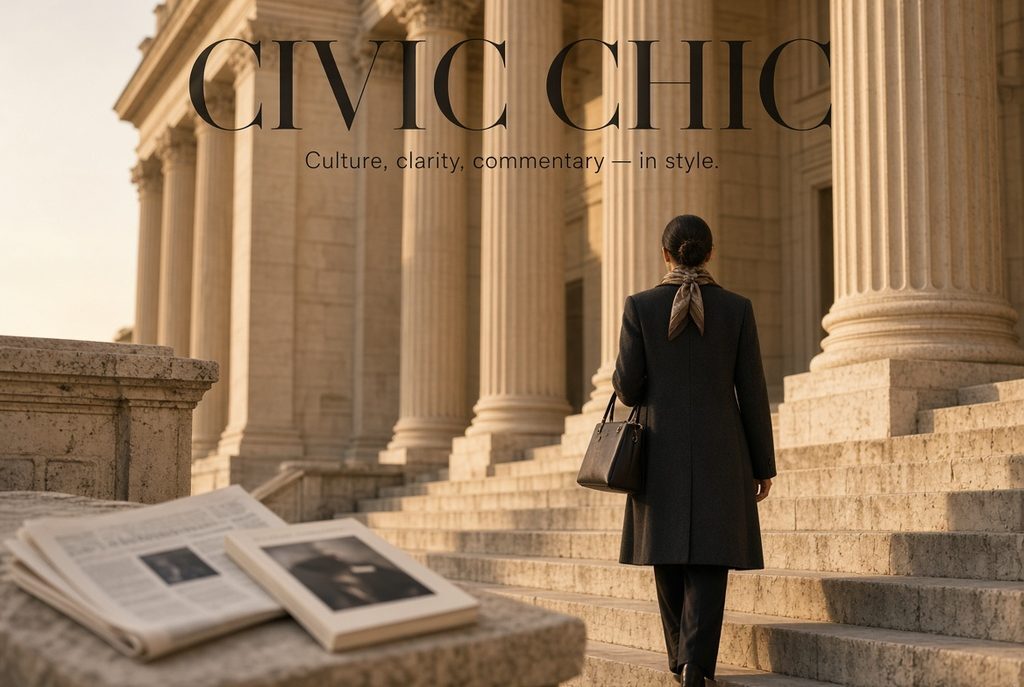
A recent headline put it cleanly: Civic Chic: Culture, clarity, commentary — in style. That is not a slogan looking for a home. It is a description of a lane that already exists: viral pop-culture moments, societal critique, and mainstream news, delivered with taste instead of noise.
Most media names apologize for one half of that job. They sound civic and dull, or chic and empty. This one does both in two spoken syllables.
What the name actually does
Civic is public life: cities, citizenship, the news cycle, the argument in the street and the comment section. Chic is discernment: the edit, the tone, the refusal to look sloppy while saying something sharp.
Together they describe a publication, a show, a newsletter, a studio, or a brand that treats current events as a matter of style as well as substance. Readers already understand the pairing. You do not have to explain it on a first date, a podcast intro, or a pitch deck.
That is the commercial fact. A two-word .com that people can hear once and type correctly is not decoration. It is the shortest version of the positioning statement.
Why this name, and why now
“Chic” has become one of the internet’s working words for taste, restraint, and cultural judgment. It is attached to outfits, habits, politics, interiors, and entire moods. At the same time, civic life — news, institutions, cities, public manners — is the other half of every feed.
The collision is already happening in social media and in headlines. What has not been locked down is the exact-match .com.
That matters for a simple reason. Brands in this category live or die on recognition. You cannot spend three years teaching people how to spell a coined word when the culture has already supplied a real one. CivicChic.com is dictionary English, six-plus-four letters, no hyphen, no country-code afterthought, no “the” to remember.
Say it on air. Put it on a tote. Drop it in a bio. It looks like a masthead.
Who this domain is for
Not a parked page. An operator.
- A culture desk that covers the viral clip and the civic consequence
- A newsletter or podcast that wants law, society, entertainment, and fashion in one house style
- A media company tired of names that sound like think tanks or like clothing labels
- A founder who needs the brand to do the first thirty seconds of selling
If your work is pop culture with a spine, commentary with an edit, or news that does not arrive looking like a press release, this is the name that already describes the product.
It is also large enough to hold adjacent businesses: a magazine, a membership, a studio, merch, events, a shop. The phrase does not trap you in one format.
What you are buying, specifically
You are not buying a clever string of letters. You are buying:
- Exact-match identity. The brand and the URL are the same word.
- Category clarity. Civic + chic is a positioning, not a random compound.
- Speech value. Two stress points. No invented spelling. No “how do you spell that?”
- Masthead presence. It works in a browser bar, a TV lower-third, and a book spine.
- Room to grow. Editorial first, commerce second — or the reverse — without changing the name.
Comparable two-word .coms in media and lifestyle sell because they save years of brand education. The buyer who waits usually pays more, or settles for CivicChicOnline, GetCivicChic, or a social handle that does not match the site.
The mistake is treating this as a pretty URL
Pretty URLs are cheap. Names that already function as headlines are not.
If you launch on a lesser domain, every interview, every outbound link, and every “search us” moment leaks attention to whoever later sits on the real name. If you already work in this lane under a longer or fuzzier title, this is the upgrade that makes the work look inevitable.
Ogilvy’s rule still holds, even if the typeface has changed: the consumer is not a moron. She can tell when a brand name is doing real work and when it is costume jewelry. CivicChic.com does real work. It tells her the beat before the first paragraph.
The next step is not a brochure. It is the name.
The domain is for sale. The sales and checkout page is the domain itself.
If the name is the brand you intend to build — culture, clarity, commentary, in style — take the address that already says it.