
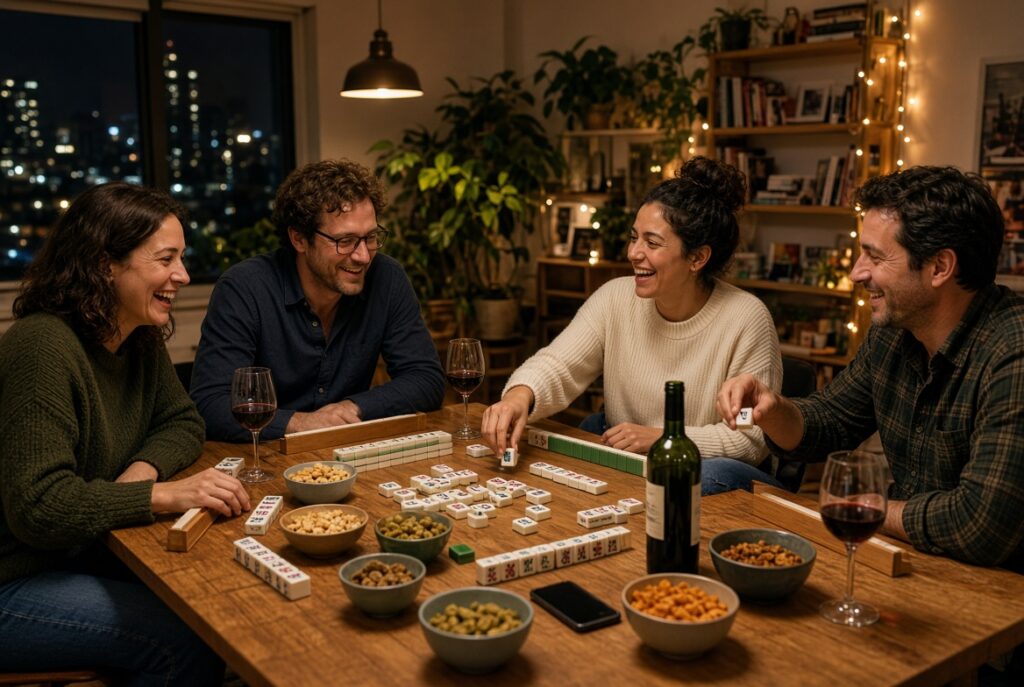
Mahjong is no longer a grandmother’s afternoon ritual confined to Florida rec rooms and synagogue sisterhoods. In 2026, it is one of the fastest-growing social hobbies in the United States: waitlists for beginner lessons, sold-out open-play nights, dedicated “mahjong rooms” in new homes, celebrity tables in Los Angeles, and designer tile sets that sell out in minutes.
The numbers are no longer anecdotal. Eventbrite reported a 179 percent jump in mahjong events nationwide between 2023 and 2024. Yelp searches for mahjong clubs surged nearly 4,500 percent year over year. Evite data showed mahjong game nights up 94 percent, with two in five of those gatherings happening at home. Online, nearly 1.8 million Americans played on a single platform, Mahjong 4 Friends, in the past year, and recent-quarter play ran more than three times the three-year average.
For entrepreneurs, this is not just a fad. It is a multi-sided market: hardware (sets, mats, racks), software (club tools and apps), services (lessons, events, hospitality), and culture (content, apparel, home design). The category already has a breakout brand. Dallas-based Oh My Mahjong, founded in 2022, has surpassed $30 million in annual revenue with 360 percent year-over-year growth and says it sells a mahjong mat every 10 seconds in the United States.
That is the kind of signal that usually arrives after a market is already crowded. In mahjong, large parts of the map are still open.
A Game With Several American Lives
Mahjong developed in 19th-century China and reached the United States in the 1920s, when Joseph Babcock helped popularize a Westernized version. It became a national fad, then settled into two durable American communities: Chinese American families who kept regional Chinese, Hong Kong, and later Japanese riichi styles alive, and Jewish women who, in 1937, founded the National Mah Jongg League (NMJL) to standardize what is now called American Mah Jongg.
The NMJL still sits at the center of the American version. Membership comes with the annual card of winning hands — $14 standard, $15 large print — and the League now counts more than 350,000 members. Expert estimates put the broader American Mahjong player base at 600,000 to 750,000 and growing. That is several times the size of organized contract bridge.
American Mahjong is not the same game as Chinese mahjong. It uses jokers, an annual changing card of hands, and the Charleston tile-passing ritual. Of U.S. clubs that name a variant, about 98 percent play American/NMJL rules. Chinese and riichi groups exist, especially in university towns and diaspora community centers, but they are a smaller slice of the commercial boom.
The latest wave began during COVID, especially in Texas and the broader South, when people needed a reason to gather that did not depend on a bar. Historian Annelise Heinz, author of Mahjong: A Chinese Game and the Making of Modern American Culture, has argued that earlier American waves were real — but this one is different because it is being driven by a durable hunger for connection. Those needs are not going away.
Who Is Playing — and Where the Map Is Moving
The core player is still familiar: women over 55, often Jewish, concentrated in the Northeast, Florida, and Southern California. Men remain a small share of the American-rules base. What changed is the edge of the table. Millennials and Gen Z are arriving through TikTok, Instagram, campus clubs, and pop-up nights rather than family tradition. Jewish summer camps have added the game as an elective. Asian American social clubs in New York, Los Angeles, and Denver are using it as heritage and nightlife at the same time. Celebrities from Julia Roberts and Blake Lively to Meghan Markle and Cindy Crawford have made the tiles a lifestyle object.
Geography has also shifted. Bam Good Time’s 2026 club census found 1,026 unique clubs across 51 states and territories. Texas leads in raw count (97), followed by Florida (85), California (70), New Jersey (55), and Pennsylvania (50). Per capita, the story is Southern and surprisingly small-city: New Jersey is densest overall, but Alabama, South Carolina, Massachusetts, Mississippi, and Tennessee all sit above five clubs per million residents. Online play data from Mahjong 4 Friends points to a “Mahjong Belt” stretching through Lafayette, Louisiana; Charleston, South Carolina; Raleigh; Athens, Georgia; and other Southern metros. Wednesday afternoon remains the traditional slot. The growth opportunity is evenings, weekends, and mixed-age rooms.
Dallas–Fort Worth has become a design capital of the boom. Homeowners are converting unused rooms into dedicated parlors. Local companies sell swanky sets that cost hundreds of dollars. That aesthetic — pastel mats, floral tiles, “Dot Crak Bam” pillows — is what social media amplified. It is also what created a backlash when some redesigns were accused of flattening Chinese history. Entrepreneurs who ignore that tension will eventually pay for it in brand risk.
Why This Trend Has Legs
Several structural forces are stacked in mahjong’s favor: Loneliness and “soft socializing.” After the pandemic, Americans looked for low-pressure ways to be together without performing a night out. Mahjong requires four people, conversation, and hours at a table. Eventbrite has grouped it with a broader rise in activity-first socializing.
The sober-curious shift. Gallup data shows younger adults drinking less than previous generations at the same age. Mahjong is social, competitive, and alcohol-optional. Bars and pickleball clubs have noticed: some facilities now add mahjong to activate lounge space and daytime hours.
Tactile luxury in a screen age. A $350–$475 designer set photographs well. Limited drops sell out in minutes. Accessories — racks, pushers, card folios, travel bags, punny hats — turn one purchase into a recurring “tilescape.” Oh My Mahjong’s growth is the proof case. Chinese factories have noticed too; some suppliers report shipping thousands of American-style sets a month into the U.S. market.
An installed base plus a funnel
The NMJL card creates an annual ritual. Clubs create local density. Social media creates discovery. Teaching businesses convert curiosity into competence. Once people can play, they need a regular table. That flywheel is why waitlists persist even after the first media cycle.Independent market research cited in 2026 industry coverage has valued the global Mah Jongg game market around $1.9 billion in 2025, with further growth projected through the next decade. Treat those figures as directional rather than audited, but they match what operators on the ground report: beginner classes filling, shelves emptying, and instructor networks scaling.
The Opportunity Map for Entrepreneurs
The market is not one business. It is a stack. The winners so far picked one layer and executed with taste and community, not just inventory.1. Product: sets, mats, and the accessory flywheelPremium American sets now routinely sell in the $350–$500 range; luxury and fashion crossovers go much higher. The profit is not only the first set. It is mats (high velocity), racks, pushers, bags, card holders, themed drops, and gifts. Anthropologie, Tuckernuck, and other retailers have already entered. There is still room for:
- Mid-price “first good set” products for new players who will not spend $400
- Private-label lines for clubs, hotels, and pickleball facilities
- Culturally grounded designs that treat Chinese symbolism as heritage, not decoration
- Durable club-grade sets built for teaching volume, not Instagram
Manufacturers in Shenzhen and elsewhere are actively courting U.S. boutiques and private-label brands with American 166-tile configurations. The barrier is no longer sourcing. It is brand, quality control, and storytelling.
Teaching and certification
Demand for lessons is outrunning supply. Yelp searches for mahjong lessons rose 819 percent in the same window as the club-search spike. Oh My Mahjong has certified more than 1,000 “Mahji Mentors.” Local operators from Park City’s Après Mahjong to Connecticut’s Haus of Mahj and New York’s Green Tile Social Club report that beginner pipelines feed open play, private events, and merch.
A lean model looks like this: three-session beginner course, then $20–$30 open play, then private parties and corporate bookings. Consistency of curriculum matters more than charisma. Evening and weekend inventory is underserved because the legacy game still lives on Wednesday afternoons.
Clubs, pop-ups, and hospitality
There are more than 1,000 known clubs, but many cities still have no professional operator. Successful formats include:
- Recurring open play in restaurants, cideries, hotels, and pickleball lounges
- Supper-club and speed-dating nights for younger players
- Membership studios with reserved tables
- Home-parlor design consulting in boom metros
- Tournament weekends and “scrambles”
Green Tile Social Club scaled from a living room to events with hundreds of guests. Après Mahjong in Park City went from “Utah has no mahjong business” to multiple events a day and 1,500 people taught. The replicable insight: partner with venues that need midweek traffic. They provide space; you provide a crowd that eats and drinks.
Software and infrastructure
Bam Good Time (formerly Mahjic) is building the category’s operating system: club directories, payments, scheduling, score tracking. NMJL has its own online play product. The white space is still large — discovery, handicap systems, hybrid online-to-offline onboarding, and tools that serve both American and Chinese/riichi communities without collapsing them into one ruleset.
Media, education, and brand worlds
How-to YouTube, card-analysis newsletters, podcasts, and “learn the new card every April” products already have audiences. The annual NMJL card is a content calendar that resets every spring. Apparel, jewelry, and home goods sit on top of that identity. The risk is sameness. The opportunity is specificity: city scenes, diaspora rules, competitive riichi, senior cognitive-health programming, campus leagues.
Adjacent real estate and facilities
If pickleball is the outdoor analog, mahjong is the indoor one. Facilities already experimenting with tile nights are using unused lounge square footage. New-home builders in Texas are treating a mahjong room as a lifestyle amenity. Event planners are booking bridal showers and team-building around tiles. That is a B2B sales motion, not only a consumer one.
How to Enter Without Getting Crushed
The category looks friendly. It is also taste-driven and culturally loaded.
Respect the source
Mahjong is a Chinese game with a complicated American afterlife. Players and journalists have already criticized brands that treat tiles as a blank canvas. The commercially durable path is collaboration and credit, not erasure.
Pick a ruleset and a customer
American Mahjong is the volume market. Chinese, Hong Kong, and riichi scenes are smaller but loyal and underserved by pretty pastel branding. Trying to be all variants at once usually produces a muddled product.Sell the second hour, not the first tile. The money in this boom compounds after people know how to play. Lessons, open play, replacement cards, mats, and community tools beat a single Amazon listing.
Go where the calendar is empty
Afternoon women’s clubs are well served in many Sun Belt and Northeast suburbs. Mixed-gender evenings, Gen Z pop-ups, corporate bookings, campus clubs, and secondary cities in the Mahjong Belt are not.
Price for the ritual
A $25 open-play night that sells out is a better business than a $12 night that feels cheap. Players are already paying $400 for sets. They will pay for a well-run room.
The Bottom Line
Mahjong in America is following the pickleball pattern: an old game, a new social need, a photogenic object, a teaching bottleneck, and a suddenly national map. The difference is that mahjong is indoor, four-player, and accessory-rich. That makes it friendlier to e-commerce, hospitality partnerships, and local service businesses than a sport that needs courts.The window will not stay this open. Instructor networks are forming. Big retailers are stocking sets. Club software is aggregating demand. The entrepreneurs who win the next five years will be the ones who turn a viral table into a weekly habit — and a weekly habit into a brand people can find.If you are building in this category, the first asset is often the name people type when they decide they want in.
Premium Mahjong Domains for Sale — Ready for Immediate Purchase. These names are available now for operators, product brands, clubs, media companies, and marketplaces that want a clean URL before the category finishes professionalizing. Click any domain to review or acquire it.
New York & neighborhood mahjong
Location-first names. Strongest for local clubs, classes, or city-specific sites.
- EastVillageMahj.com
- ManhattanMahj.com
- BronxMahjong.com
- RiverdaleMahjong.com
- MatchaAndMahjong.com (also lifestyle / café vibe)
Social, brunch & lounge brands
Friends, drinks, gatherings — good for events, memberships, or hospitality concepts.
- PassTheBam.com
- BamLounge.com
- DollysAndDrinks.com
- BrunchAndBams.com
- BamsWithFriends.com
- PungLounge.com
Classic tile language
Built from suits and calls: dots, bams, craks, dollys, pung, chow, winds, seasons.
- DotDollyPung.com
- DollysAndCraks.com
- DotsAndBams.com
- CraksAndDots.com
- PungAndChow.com
- WindTiles.com
- SeasonTiles.com
- DotTiles.com
- LuckyBams.com
Aesthetic & material-inspired names
Mood and object imagery more than game mechanics. Fits décor, gift, or design-forward brands.
Custom, designer & premium sets
Commerce language: personalized, artisan, editions, premium. Best for shops or set makers.
- TraditionalMahjong.com
- PersonalizedMahjongSets.com
- PersonalizedMahjong.com
- CustomMahjongSets.com
- ArtisanMahjong.com
- MahjongEditions.com
- DesignerMahjong.com
- PremiumMahjong.com
Leagues & hybrid games
Organized play, or mahjong crossed with rummy.
- MahjongLeagues.com
- MahjongRummy.com (also fits rummy variants)
Canasta, burako, biriba, lami & other rummy variants
Latin American and other rummy-family games — not American mahjong, even when the name includes “tiles.”