
How American Mahjong Became a Subscription Game—and Why the League Still Collects the Toll
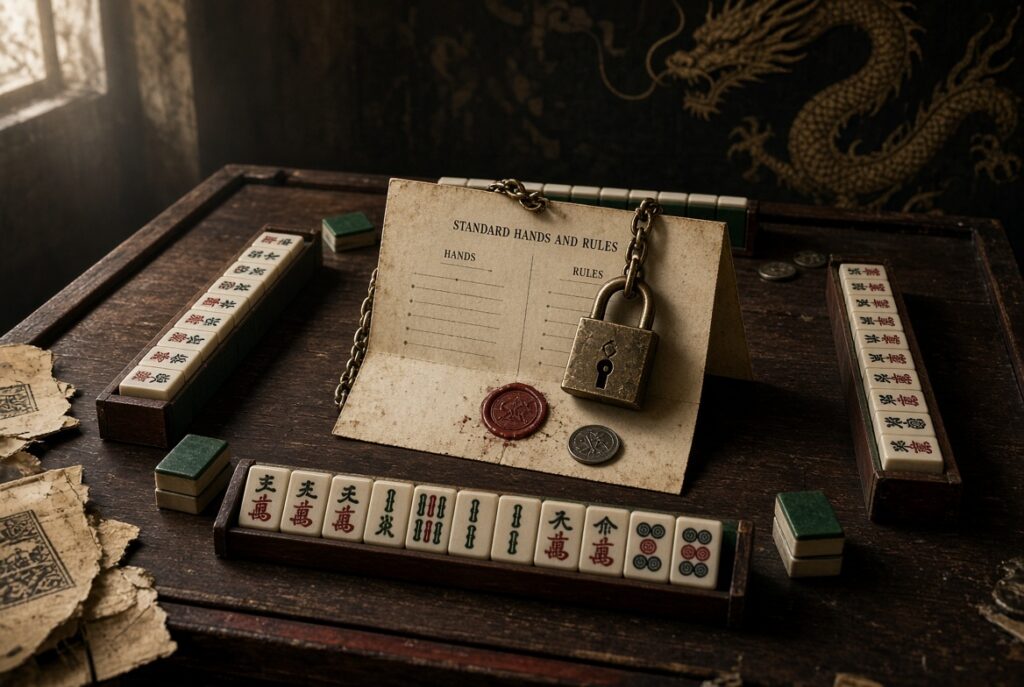
Chess does not expire in March. Go does not ship a new constitution every spring. Chinese, Hong Kong, and Japanese mahjong do not require players to repurchase the right to win. American mahjong does. That is not a charming tradition that happened to survive. It is the operating system of an industry: a yearly paper product that functions as membership, rulebook, tournament credential, and copyrighted choke point all at once.
The National Mah Jongg League has spent nearly ninety years turning a folk game into a closed circuit. The annual card is the lock. Clubs, teachers, digital platforms, cruise tournaments, and a new generation of lifestyle brands are the doors that only open if you pay. The League does not need to sell $400 resin sets. It monetizes forced obsolescence and regulatory vendor lock—and then watches a secondary economy of instructors, apps, “card analyses,” and alternative franchises grow in the friction it creates.
That is the corporate veil of American mahjong. The tiles are interchangeable. The card is not.
A folk game with a private legislature
Mahjong exploded into the American mainstream as a 1920s fad. In 1937, a group of Jewish women in New York founded the National Mah Jongg League to stabilize a chaotic American ruleset. They succeeded so completely that “mahjong” in much of the United States now means one specific variant: 152 tiles plus jokers, a Charleston pass, racks, and a trifold card listing the only hands that count this year.
That last piece is the innovation that changed the economics. In Chinese-style play, winning patterns are a public grammar. You learn pungs, chows, and scoring, and the language does not reset because a committee in Manhattan printed a new pamphlet. In the American game, the valid hands are a private catalog. Last year’s card is not a vintage curiosity. At a club table or a sanctioned event, it is often a dead document. The League’s own sales copy and the wider market treat current-year NMJL-rules play as requiring the current card.
The comparison that keeps surfacing in the community is the right one: it is as if Monopoly periodically rewrote property values and replaced railroads with crypto, then sold you the new deed list as a condition of sitting down.
Standardization has real social value. Tables can form across cities. Tournaments can score without a three-hour house-rule negotiation. Beginners can be told there is one “official” target. The problem is what the League did with that public good. It did not publish a stable standard and step back. It made the standard a consumable.
The annual card: forced subscription dressed as tradition
Every spring, players wait for a piece of card stock that costs $14 in standard size and $15 in large print—membership, bulletin, and “Official Standard Hands and Rules” bundled together. In 1973 the card cost 75 cents. The product is still paper. The price is not.
The membership numbers are deliberately foggy. The League does not publish a modern audited census. Community estimates put card-buying members around 300,000 to 350,000, with total American-style players perhaps 600,000 to 750,000 once you include pirates, multi-card households, and people who play only on apps or house cards. A 2020 League meeting, one of the few times officials spoke in public numbers, put membership near 338,000 and card sales close to 500,000, the gap explained by snowbirds, teachers, and group buyers who purchase more than one.
Do the arithmetic the industry prefers you not do in one place. At $14–$15 a card, a few hundred thousand units is not a bake-sale. It is recurring, high-margin, demand-inelastic revenue on a product whose economic effect is to make last year’s product obsolete for current-year play. Even a conservative 350,000-card year clears about $5 million in gross card receipts before wholesale markups, collector volume, and the secondary retail channel that now sells the same card for $18–$20. A 500,000-card year is closer to $7 million. Paper and postage are not $7 million.
This is not how games usually work. It is how software used to work when publishers shipped a new boxed version every year and let last year’s disc rot. The League built an annual replacement cycle decades before software subscriptions normalized the same economic logic before most of Silicon Valley named it, then wrapped it in sisterhood and charity.
The lock is social, which is stronger than a DRM key. You can theoretically keep playing the 2024 card in your living room forever. The moment you want to sit at the club, join the cruise tournament, follow the teacher’s lesson, or settle a rules argument with something other than “because I said so,” the current card is the passport. That is vendor lock without a vendor contract. The table itself is the enforcement mechanism.
Copyright as a tollbooth, not a creative act
U.S. copyright law does not protect game rules. Section 102(b) of the Copyright Act excludes ideas, procedures, systems, and methods of operation. The League does not own mahjong. It does not own the idea of a 14-tile hand, a Charleston, or a pung of dragons. What it owns is the expression of this year’s catalog: layout, typography, color blocking, the particular arrangement of text on a trifold. That is enough.
Enough, in practice, to make photocopying a friend’s card a potential infringement; to scare Amazon sellers of lookalike cards; to keep apps from simply scanning the trifold into a UI; and to force every digital platform that wants “authentic NMJL play” into a licensing conversation or a workaround. Registered copyrights on the annual card go back decades. Statutory damages for registered works can be severe enough that most small developers will not test the boundary.
Watch how the workaround economy actually functions. I Love Mahj, the dominant online American-mahjong platform, tells users it cannot display the official card because of copyright—and also that players can select NMJL cards from 2019 through 2026 inside the game. The visual artifact is fenced. The hands, as playable data, are the product people actually need. The League’s copyright does not have to cover the rules to tax the interface. It only has to make reproducing the sacred object legally risky.
That is gatekeeping with a respectable legal costume. A community standard that should be a public protocol becomes a branded publication. Developers, tournament organizers, and teachers then pay either in license fees, in legal caution, or in the labor of inventing a parallel card so they can operate at all.
The secondary market is not a side effect. It is the rest of the machine.
Once the valid universe of winning hands changes every twelve months, a whole tutoring industry becomes structurally necessary.
Every April, instructors drop “card analysis” videos that run past an hour. FAQ pages appear explaining which hands survived, whether “ANY” in parentheses makes a dragon pair autonomous, and which printed line is a trap. Players buy laminated cheat sheets, racks with card slots, and subscriptions to sites that will tell them what the League meant. The business ecosystem has learned to monetize the confusion.
The same cycle feeds digital platforms. One popular platform charges on the order of $6 a month and lives or dies on current-card support, practice tools, and the annual migration. Retailers time accessory spikes to the card drop: new sets, new bags, new mats, because the ritual of renewal is a shopping season, not just a rules update. Market write-ups now describe the NMJL card as a “recurring demand signal” for a category independently estimated in the billions globally—numbers that should be treated as industry-PR fog, but that correctly identify the card as the calendar the commerce runs on.
Even the League’s own online offering is part of the toll structure: a members-only internet game sold as an add-on in the bulletin for $50 a year, on top of the card. The organization that defines the ruleset also sells a gated digital room in which those rules obtain.
None of this requires a cartoon villain in a back office rubbing his hands. It requires a rules monopolist that changes the target every year and then lets an ecosystem of “helpers” charge rent on the learning curve.
The 2025 misprint was a stress test. The League failed it.
A private legislature that cannot ship a correctly colored pamphlet on time has a problem that is not merely operational. When your entire authority rests on being the unique source of this year’s legal hands, a two-month outage is an admission that the kingdom has one printing press and no redundancy. Players discovered they were not members of a standards body. They were subscribers to a fulfillment house with a 1990s website and no public accountability for the delay.
That is when the “nonprofit” story stopped working as insulation.
The corporate veil: League Inc., Foundation, family
After Ruth Unger’s death in 2015, leadership passed to her sons, David and Larry Unger. The public-facing charity story and the operating company are not the same entity. There is National Mah Jongg League Inc., which sells the cards and runs the operation, and National Mah Jongg League Foundation Inc., a 501(c)(3) private foundation in Harrison, New York.
The Foundation is the part you can see. Recent IRS filings show on the order of $14.2 million in net assets and charitable disbursements that in recent years have clustered around $0.5 million to $1.0 million, with officers listed at $0 compensation on the Foundation side. It behaves like an endowed grantmaker sitting on investments, not like an organization whose primary activity is printing 350,000 cards. Cause IQ even describes it as operating as a corporate foundation of the League.
What you cannot see as easily is the Inc.: the entity that cashes the $14 checks. D Magazine, reporting on the Dallas tile brands that spent years as wholesale card sellers, put the problem in one sentence: the split identity meant that “a relatively small portion of the league’s estimated annual income was transparently accounted for as charitable donations.” The Mahjong Line, described as one of the top wholesalers, was paying “hundreds of thousands of dollars” a year to the NMJL. During the 2025 delay, a $90,000 check cashed in January sat for months while no cards shipped. That is not a charity anecdote. That is working-capital capture.
Charity is real in this story, and pretending otherwise is sloppy. The League’s collector system—bulk buyers who take a cut directed to a designated cause—has moved serious money to local groups. The 2026 bulletin claimed designated charities would receive more than $1 million from that partnership. The Foundation writes checks to hospitals, Jewish communal funds, cancer research, St. Jude. Players who buy the card in part because “it goes to charity” are not fools. They are customers of a narrative that is partially true and structurally incomplete.
The incomplete part matters. A private foundation with $14 million in assets distributing roughly the IRS minimum-plus is not proof of a scam. It is proof that decades of card surplus can become a family-adjacent endowment while the operating company remains the black box that actually gates the game. The League has been in this posture for a very long time. A 1940s federal tax case already treated list-and-tile sales as a commercial enterprise that dwarfed dues. The “we are a charity that happens to sell a card” line is older than most of the current player base. The commercial tail has always been capable of wagging the mission.
Predatory is a moral word. The mechanism is simpler: captured demand.
Call the tactic what it is without needing a confession.
Forced obsolescence. Change the legal hands every year so last year’s purchase is socially dead.
Vendor lock. Make club play, tournament play, and “official” digital play require the current publication.
IP enclosure. Copyright the layout hard enough that reproduction, even for a friend, is framed as infringement, while the underlying rules remain in the gray zone the League does not want adjudicated.
Drama as demand. Ambiguous wording, odd hand constructions, valuation quirks, and the occasional misprint produce comment-section wars. Those wars send people to teachers, YouTube explainers, and replacement cards. The 2026 card cycle already has public FAQs about “complex hands and valuation oversights.” That is a product-management choice dressed as tradition.
Nonprofit camouflage. Route enough money through collectors and a foundation that criticism sounds ungrateful, while the operating receipts and family control stay off the main stage.
None of this is illegal on its face. Plenty of sports leagues sell official rulebooks. What those leagues rarely do is invalidate last year’s strike zone and require a new laminated card before you can play catch with your neighbors.
The new franchises are not liberation. They are a second enclosure.
The 2025 breakdown did not produce a public-domain ruleset. It produced more cards.
The Mahjong Line—already a polarizing Dallas brand from the 2020–21 cultural-appropriation fight over luxury “modernized” sets—used the League’s failure as the pretext for The Big Card: $10 instead of $15, January release instead of April, statistical scoring built with I Love Mahj’s simulation firehose, a promised charity slice ($4 of each sale in the early pitch), waterproof stock, line numbers, 25,000 orders on release day. Kate LaGere’s line was the industrial thesis in plain speech: the League has no mechanism to test the card. “We can do this better.”
Oh My Mahjong answered with an International Mahjong Card that leans into blanks and a different accessibility pitch. Mahjong Press shipped a waterproof annual card and a starter card, with lawyers on retainer to stay “fully compliant and legally distinct.” Older alternative publishers—Marvelous Mah Jongg, Siamese, various association cards—suddenly looked like a market instead of a curiosity.
This is competition. It is also fragmentation as a business model. Teachers immediately warned that four cards at $10–$15 each is not freedom; it is a $60 annual stack and a map of cliques. You will not carry every card to every table. Groups will pick a denomination. Tournaments will pick a sponsor. The interoperable commons that was the League’s only genuine public service starts to dissolve, and each new publisher has an incentive to keep its catalog proprietary enough to sell next year.
The Mahjong Line’s own history sits inside the same veil. In 2021 the brand was blasted—fairly, on the marketing language—for selling expensive “refreshed” sets that stripped or restyled Chinese iconography and talked like it had discovered the game. Critics called it colonization; Diet Prada amplified it; the founders described threats and doxxing. Historian Annelise Heinz and others pointed out the longer American pattern: white and Jewish-American institutions have been Americanizing, monetizing, and re-narrating mahjong since the 1920s. The NMJL is that history’s most successful institution, not its opposite. A luxury tile company and a New York card monopoly are not moral antonyms. They are sequential layers of the same enclosure.
So the “new game and franchises” do two things at once. They puncture the League’s claim that there is no alternative. They also prove that the money is in owning a ruleset-shaped object, not in leaving the rules in the commons. A statistically prettier card with a charity percentage is still a card you are expected to buy again.
What an open game would look like—and why the industry resists it
Chinese official, Hong Kong, and riichi rulesets have arguments, regional variants, and governing bodies. They do not have a $15 yearly permission slip to declare a win. The patterns are learnable. Sets from any maker work. Apps implement the rules because the rules are not a trademarked pamphlet.
American mahjong could have evolved the same way: a stable public hand catalog, optional seasonal variants published as freely copyable PDFs, tournament series that compete on hospitality and fairness rather than on who licensed the trifold. Copyright would still protect a publisher’s unique graphic design. It would not protect the idea that only one committee may decide that Consecutive Run #3 is legal this year.
That version of the game is worse for incumbents. It is better for players who move cities, for beginners who should not need a spring shopping ritual, for developers who want to build tools without kissing a ring, and for anyone who thinks a social game should not have a single point of failure in a New York mail room.
The counterargument from League loyalists is not frivolous. A shared card is why a woman from Tampa can sit down in Scottsdale and know what “Odds #7” means. Alternatives, they say, will Balkanize the living-room network that is the game’s actual product. That is a real coordination problem. It is also the oldest defense of every standards monopolist: interoperability requires us, therefore you must pay us, therefore we may change the standard on our schedule.
There is a third path the industry keeps refusing: a player-owned standards consortium that publishes the hands under an open license, sells optional pretty printings, and donates on the books. Collectors could still raise money for sisterhoods. Teachers could still teach. Apps could implement the same file. The League could compete as a publisher instead of ruling as a ministry.
It will not volunteer for that demotion. Gatekeepers do not open the gate because the metaphor is unflattering.
The tell
If the annual card were primarily a community service, the League would treat a misprint as an emergency to be fixed in public, publish audited card-sale and cost figures, separate the ruleset from the souvenir, and license the hands cheaply or freely to any app that wanted to grow the game.
What it actually does is ship a perishable artifact, copyright the artifact, delay the artifact, collect on the artifact, and let the resulting argument sell more artifacts.
The drama may not be intentional. But the model monetizes it anyway. Every ambiguous hand, every late mailing, every Facebook thread about whether a dragon pair “corresponds,” every new Dallas card that claims to be kinder and more statistical, sends the same signal: you cannot just play. You must buy your way into this year’s legality.
That is not how a folk game should work. It is how a tollbooth works. The tiles were never the product. The permission was.
This article relies on public NMJL materials, IRS Form 990-PF filings for the National Mah Jongg League Foundation, contemporaneous reporting on NMJL’s annual meetings, D Magazine, The Wall Street Journal, and public materials published by competing mahjong-card companies. Revenue calculations are estimates based on publicly reported historical membership and card-sales figures and current published card prices. Where operating-company financial information is unavailable, this article distinguishes documented facts from estimates and analysis.