
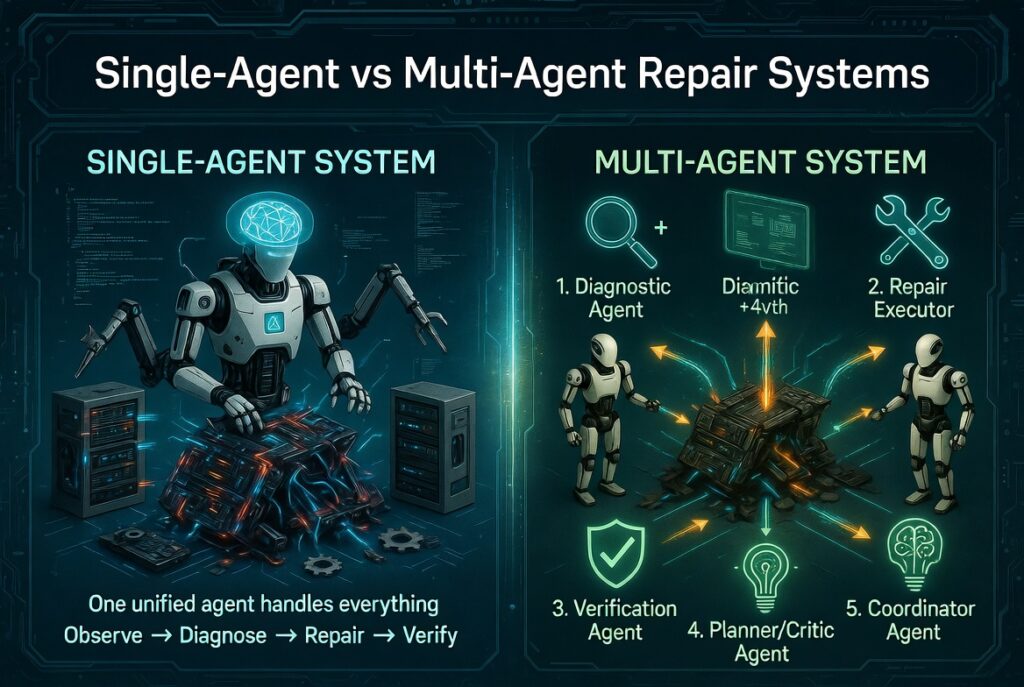
In an era of agentic AI—where autonomous systems can plan, act, and adapt—repair systems have evolved from reactive human-led processes to proactive, intelligent frameworks. These systems detect faults, diagnose root causes, and execute fixes across domains like software, networks, robotics, and industrial maintenance. At the heart of the debate is a fundamental architectural choice: single-agent repair systems (one unified AI entity handling the entire repair loop) versus multi-agent repair systems (a team of specialized agents collaborating toward a common goal).
This article explores the definitions, trade-offs, real-world applications, and decision framework for single-agent versus multi-agent repair systems.
What Are Single-Agent Repair Systems?
A single-agent repair system consolidates all logic—perception, planning, diagnosis, repair execution, verification, and learning—into one autonomous AI entity. It operates like a solo specialist: it receives an issue (e.g., a network alarm, buggy code, or equipment anomaly), reasons step-by-step, uses tools (APIs, simulators, or actuators), and completes the repair loop independently.
Key characteristics:
- Unified context and memory.
- Sequential or iterative execution (e.g., observe → diagnose → repair → verify).
- Simpler prompt engineering and deployment.
Examples include LLM-powered tools for automated program repair (APR), where a single agent analyzes code, reproduces bugs, generates patches, and tests them in a loop. In simpler maintenance scenarios, a single predictive maintenance agent might monitor sensors and trigger automated fixes.
What Are Multi-Agent Repair Systems?
Multi-agent repair systems distribute responsibilities across multiple specialized agents that communicate, coordinate, and sometimes compete or critique each other. A central orchestrator (or emergent collaboration) breaks down the repair task, delegates subtasks, and synthesizes results. Agents might include a diagnostic specialist, a repair executor, a verifier, a critic for error-checking, and even domain-specific experts (e.g., hardware vs. software).
Key characteristics:
- Specialization and modularity.
- Parallel processing where possible.
- Explicit coordination protocols (hierarchical, peer-to-peer, or debate-based).
- Shared memory or knowledge graphs for context.
In practice, this looks like hierarchical setups in network fault healing (service-layer and network-layer agents) or robotics swarms where multiple robots inspect and repair collaboratively.
Head-to-Head Comparison
| Aspect | Single-Agent Repair Systems | Multi-Agent Repair Systems |
|---|---|---|
| Architecture | One unified agent with all tools and logic | Multiple specialized agents + orchestration |
| Best For | Simple, linear, well-defined repairs | Complex, cross-domain, multi-step repairs |
| Speed & Latency | Faster (no coordination overhead) | Potentially slower due to communication, but parallelizable |
| Scalability | Limited by context window and model capability | Highly scalable; add agents for new domains |
| Fault Tolerance | Single point of failure | Resilient; one agent failure doesn’t halt the system |
| Debugging & Maintenance | Straightforward (one execution trace) | Complex (needs observability across agents) |
| Cost | Lower operational/token cost | Higher due to inter-agent messaging |
| Accuracy on Complex Tasks | Good for focused repairs; prone to hallucinations | Higher via specialization, critique, and verification |
| Examples | Single LLM for code patching or basic IT fixes | Network fault healing, multi-robot inspection/repair, predictive maintenance teams |
Data drawn from enterprise AI analyses and specific repair PoCs.
Advantages and Challenges
Single-Agent Advantages:
- Simplicity and rapid deployment—ideal for prototypes or narrow domains.
- Coherent reasoning (no loss of context between handoffs).
- Easier auditing and governance.
Single-Agent Challenges:
- Struggles with highly complex or cross-functional repairs (e.g., coordinating network layers + services).
- Single point of failure and limited parallelism.
Multi-Agent Advantages:
- Specialization leads to deeper expertise (e.g., one agent excels at root-cause analysis via LLMs and knowledge graphs; another verifies via digital twins).
- Improved reliability through internal critique loops and redundancy.
- Better handling of dynamic, uncertain environments (common in real-world repair).
Multi-Agent Challenges:
- Coordination overhead (latency, message passing, conflict resolution).
- Increased complexity in design, monitoring, and debugging.
- Higher costs from multiple LLM calls.
Real-World Applications
- Software Bug Repair (Automated Program Repair): Single-agent systems (e.g., a standalone RepairAgent) handle end-to-end Java or code fixes efficiently for isolated bugs. Multi-agent frameworks shine for complex issues, with dedicated coder, tester, debugger, and critic agents collaborating—often achieving higher patch success rates through debate and verification.
- Network Fault Repair: TM Forum’s multi-agent Catalyst uses hierarchical agents, LLMs, knowledge graphs, and digital-twin simulations to automate detection-to-repair loops. It achieves ~40% faster mean time to repair and 90% automation coverage—far beyond what a single agent could manage across vendors and domains.
- Robotics and Physical Repair: Multi-agent robotic systems enable cooperative inspection and repair (e.g., on-wing aircraft or infrastructure). Swarms divide tasks for efficiency and redundancy, unlike a lone robot limited by reach or capability.
- Industrial Predictive Maintenance: Multi-agent setups in manufacturing assign roles like anomaly detection, failure prediction, scheduling, and parts inventory—reducing downtime dramatically compared to monolithic single-agent predictors.
Self-healing AI systems in SRE (Site Reliability Engineering) further highlight why multi-agent often wins for enterprise repair: a single agent cannot simultaneously query multiple tools and domains effectively.
When to Choose Which?
- Choose Single-Agent when: Tasks are focused, sequential, and time-sensitive; budget or expertise is limited; or the repair domain is narrow (e.g., simple code fixes or basic device maintenance).
- Choose Multi-Agent when: Problems involve multiple domains, require high reliability, or benefit from parallelism/specialization (most real-world fault scenarios). Start simple and evolve to multi-agent as complexity grows.
Many organizations begin with single-agent pilots for quick wins, then layer in orchestration as use cases expand.
Future Outlook
As models improve and frameworks mature (e.g., better skill compilation where multi-agent behaviors are internalized into single agents), hybrid approaches will emerge. Techniques like “single-agent with skills” could blend the best of both worlds, reducing coordination costs while retaining modularity. In robotics and autonomous systems, multi-agent repair will enable resilient fleets; in software and networks, it will power true self-healing infrastructures.
Conclusion
Neither single-agent nor multi-agent repair systems is universally superior—it’s about matching architecture to the repair challenge. Single-agent systems offer elegance and speed for straightforward fixes, while multi-agent systems deliver the robustness, scalability, and intelligence needed for complex, real-world repair in an increasingly autonomous world.
As AI agents become ubiquitous, the winners won’t be those who pick one side—they’ll be the ones who understand the trade-offs and deploy the right system for the job. Whether you’re fixing code, networks, machines, or entire infrastructures, the future of repair is agentic—and intelligently orchestrated.
“The term patching agents is emerging to describe systems that autonomously generate and apply code fixes.
The category-defining domain: PatchingAgents.ai