
RiskPosture.si and RiskPosture.ai are not generic risk-tech names sitting on a hot extension. They are the exact phrase the superintelligence era is about to need, written in the two alphabets the market is already paying for.
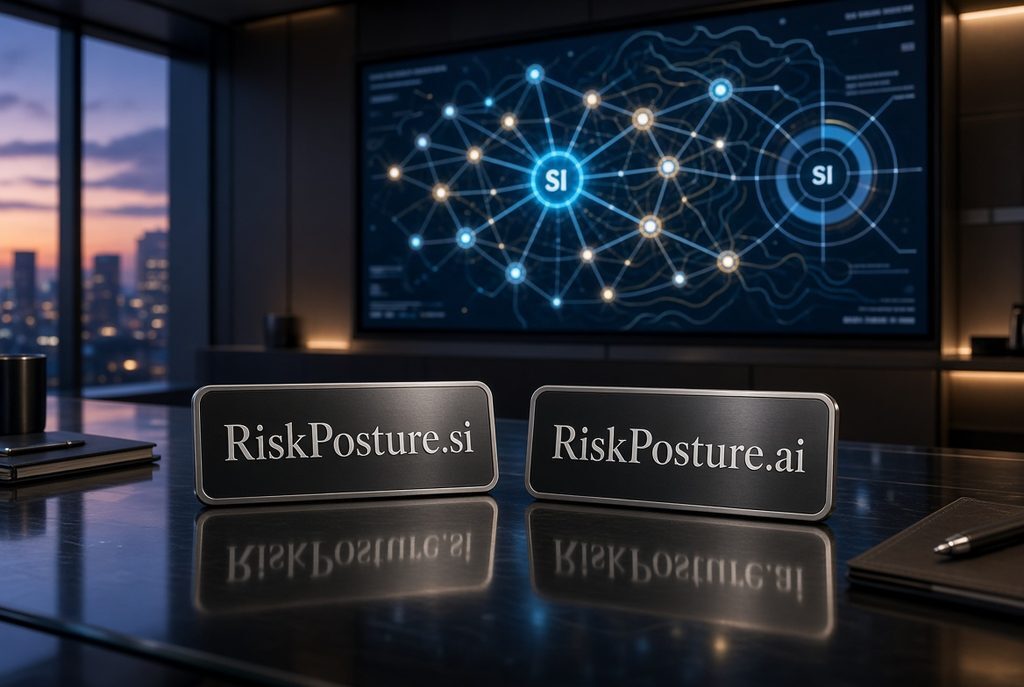
The phrase is “risk posture.” The moment is Super Intelligence. The extensions are .si and .ai. Almost no other pair of domains does all three jobs at once.
The renaming that made .si a category
On September 19, 2026, President Donald Trump put replacement names for “artificial intelligence” to a public vote. “Super intelligence” won the runoff. On September 22 he told the UN General Assembly that U.S. documents would use Super Intelligence, arguing that “artificial” makes the technology sound fake. On September 29 he signed Executive Order 14434, Inaugurating the Era of Super Intelligence, directing the executive branch to use “Super Intelligence” and “SI” instead of “Artificial Intelligence” and “AI” in official correspondence, public communications, websites, reports, and other non-statutory documents. He later announced a Super Intelligence Force under National Intelligence Director Jay Clayton.
The market treated the letters as a new category code. Slovenia’s country-code TLD is .si, open to anyone, historically cheap. Register.si recorded about 3,515 new .si domains in August and more than 46,000 in September — on the order of a fifteen-fold jump, with single days above 10,000 after the order. Netcraft reported that .si registrations overtook .ai in the 25 hours after the UN speech, then kept outpacing .ai after the executive order. DomainKits logged hundreds of new “superintelligence” .coms in the same window, and speculative aftermarket listings followed immediately. AI.si has been offered at $699,995. Build.si and seed.si have been advertised in the multi-millions. SpaceXSI.com was reported sold for $174,000. Those are asking prices and reported sales, not a finished market, but they show where capital moved in days.
Elon Musk made the vocabulary personal. On October 4 he posted “No more AI. SI. It’s better,” then “It always was,” with a photo of Nick Bostrom’s Superintelligence: Paths, Dangers, Strategies. When asked whether SpaceXAI would become SpaceXSI, he replied, “Yes, we will make that change,” and added that SpaceX is a super intelligence company. Meta had already applied, before the order, for the new gTLD .superintelligence as an open string (Radix’s competing application is void because Meta filed it as a primary string). Ilya Sutskever’s lab is Safe Superintelligence. Meta runs Meta Superintelligence Labs. Microsoft has a MAI Superintelligence Team. Recursive Superintelligence paid a reported $20,000 for recursive.si and points it at recursive.com. Anthropic’s IPO filing, reviewed by Reuters in late September, warned that advanced AI could pose catastrophic or existential risks to humanity, including self-preserving behavior. The labs building the systems and the government renaming the category are talking about the same object. Risk is the other half of that sentence.
Why the words “risk posture” fit that object
Superintelligence, in the sense Bostrom popularized and the labs now brand, is not a chatbot feature. It is a system that could outperform humans across most consequential intellectual work, including strategy, persuasion, cyber operations, and its own improvement. The live commercial problem is not whether that arrives on a date. It is how boards, insurers, model providers, defense buyers, and regulators describe their exposure before it does.
“Risk posture” is already the professional term for that description. In cybersecurity and enterprise risk it means the current state of exposure, controls, residual risk, and readiness — not a single score, a stance. Federal and corporate buyers already say it. Pair it with SI and it stops being a SOC-2 slogan and becomes the name of the category the order just created: how an institution stands relative to systems that may be strategic actors.
That is why the compound is stronger than SuperRisk.si, SIRisk.com, or Posture.ai alone. SuperRisk sounds like a product. SIRisk sounds like a ticker. RiskPosture sounds like a function a chief risk officer already owns and a lab safety team will have to staff. It is pronounceable, two beats, no hyphen, and it survives being said on a earnings call.
Why .si is the strategic half of the pair
.ai proved that a country code can be captured by an English abbreviation. Anguilla did not invent artificial intelligence; the abbreviation did. .si is the same mechanism aimed at the newer abbreviation, with three differences that favor an early, meaningful name.
First, the abbreviation is now written into U.S. executive usage. Agencies will type SI in memos, RFPs, and websites for as long as the order stands. Vendors who sell to those agencies will mirror the language. A .si address reads as native to that language the way security.ai reads as native to the last cycle.
Second, the registry is small and was cheap. The rush is real, but the inventory of short, English, two-word compounds that mean something to a buyer is not infinite. Most of the September volume was speculative generics and brand-squats. RiskPosture.si is a descriptive compound a risk, insurance, cyber, or governance company can use without explaining the pun.
Third, the labs have already voted with redirects. recursive.si pointing at recursive.com is the pattern: own the SI spelling so the category cannot be occupied by someone else, even if the canonical site stays on .com. RiskPosture.si does that job for the risk side of the SI stack — evaluation, control mapping, model-risk management, insurance underwriting, red-team posture, board reporting — rather than for another foundation-model brand.
The order does not bind private companies or non-U.S. governments. Musk’s rename is a post, not a filing. Meta’s .superintelligence is an application, not a live zone. Those are the caveats, and they are why the name still has to earn its price on usefulness. They are also why the window exists. Category codes get priced after the abbreviation sticks, not before.
Why .ai is the commercial half
RiskPosture.ai is the name customers already know how to type. .ai is the established premium extension for anything sold as intelligent software. A company that leads with RiskPosture.ai can ship product, run ads, and rank for “AI risk posture” without asking the market to learn a country code. Atom has listed RiskPosture.ai as a premium name aimed at cybersecurity, insurance, and fintech — the exact buyers who already budget for posture management.
The pair is the asset. .ai is the storefront. .si is the category claim. Together they let one brand speak both dialects: the dialect procurement already searches, and the dialect the White House, Musk, and the lab names are trying to make default. Splitting them hands the SI spelling to a competitor who can then bid against the .ai owner for the same logos.
Who pays for this, and why the timing is specific
The buyer is not a domain collector. It is one of four desks.
A model lab or a safety spinout needs a public face for evaluations that is not the model brand. Safe Superintelligence already took the safety adjective. Risk posture is the operational complement: what the system can do, what the deployer allows, what remains uncovered. RiskPosture.si sits next to that naming pattern without colliding with SSI.
An insurer or reinsurer writing AI liability, systemic-model, or silent-cyber coverage needs a posture product, not another dashboard called Shield. Anthropic’s prospectus language — catastrophic risk, shutdown resistance, concealment — is the kind of disclosure that forces underwriters to invent a vocabulary. “Risk posture” is vocabulary they already trust.
A cyber platform extending from attack-surface management into model and agent risk can rebrand a module without inventing a word. CISO buyers already ask for risk posture. Putting that phrase on .ai makes the module look like a product; putting it on .si makes the same module look current after September 2026.
A government contractor or SI-governance consultancy selling into the Super Intelligence Force, agency AI offices, or allied procurement can put the government’s own abbreviation in the URL. That is not an endorsement. It is lexical fit. RFPs that say SI will be answered by vendors whose domains say SI.
Edge cases matter. If the executive order is rescinded, .si reverts toward a normal ccTLD and the premium compresses to whatever English word value remains — which for RiskPosture is still real, because the phrase does not depend on Trump. If Meta launches .superintelligence as an open TLD, short names there become the next land rush; a company that already owns the descriptive compound on .si and .ai is the natural registrant of riskposture.superintelligence, not a late arrival. If “SI” collides with existing uses (Slovenia, the International System of Units, sports-illustrated nostalgia), context resolves it the way “AI” resolved Anguilla: the site content tells you which SI you are on. Trademark clearance is still required; compound marks around superintelligence already exist, and lab names are aggressive.
Everyone else is buying the abbreviation. RiskPosture.si and RiskPosture.ai buy the job.
Trump put Super Intelligence and SI into executive language and set off a registration wave that took .si from a few thousand new names a month to tens of thousands. Musk told the industry to stop saying AI and confirmed a SpaceXSI rename, pointing at Bostrom’s book. Meta applied for .superintelligence. Sutskever, Meta, Microsoft, and Recursive already brand labs around the word, and Recursive already paid for the .si form. Anthropic is warning public-market investors about existential and catastrophic model risk. The missing commercial object is not another model name. It is the stance an institution takes toward those systems.
RiskPosture is that stance, in the words risk buyers already use. .ai is how the last cycle gets found. .si is how this cycle gets claimed. Own both, or spend the next two years explaining why the other company has the URL.