
Imagine you took a bunch of photos of your room from different angles, and you want a computer to build a 3D version of it so you can walk around and see it from new angles you didn’t photograph.
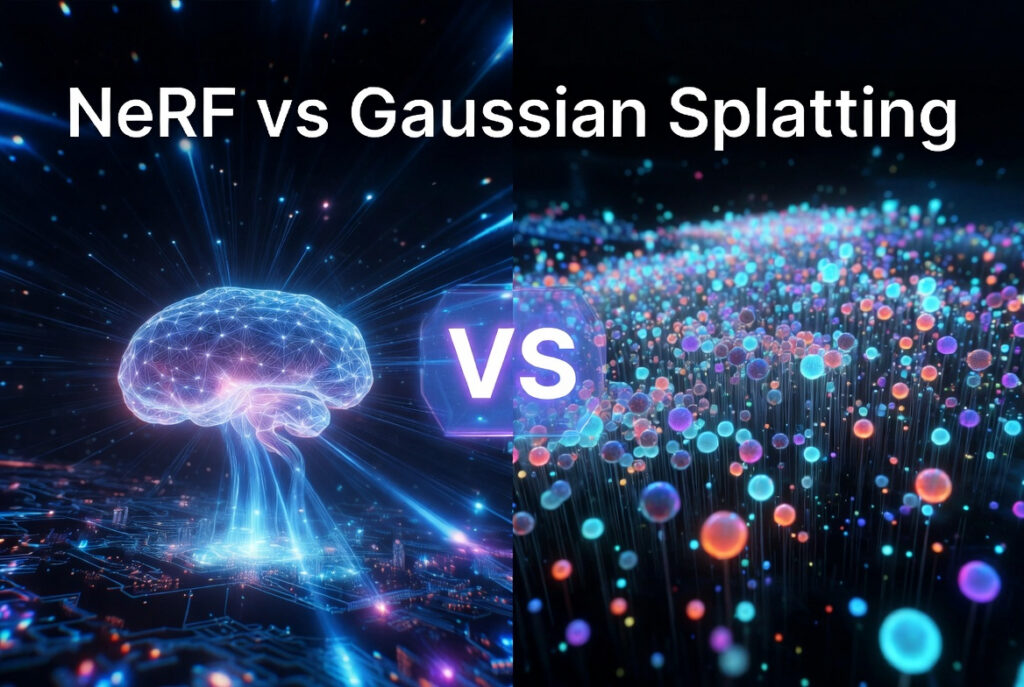
NeRF (Neural Radiance Fields) — The “Smart Painter”
- Think of NeRF like a super-smart artist who memorizes the entire room inside a neural network (a big math brain).
- When you ask “what does it look like from here?”, it shoots imaginary rays of light through the 3D space, calculates how much stuff (density) is along that ray, and figures out the color.
- Pros:
- Excellent at smooth lighting, reflections, and tricky effects.
- Good at imagining brand new views (generalizes well sometimes).
- Cons:
- Very slow to train and render (can take minutes per image).
- Like asking the artist to repaint the whole scene every time you move.
Gaussian Splatting (3DGS) — The “Lego Cloud”
- This one is newer (2023). It represents the room as millions of tiny fuzzy balls (3D Gaussians — like soft, blurry 3D Legos or paint splats floating in space).
- Each ball knows its position, size, shape, color, and how see-through it is.
- To make a picture, it just flattens those balls onto your screen (splatting them) — super fast, like throwing confetti at a canvas.
- Pros:
- Much faster training and real-time rendering (can move around smoothly).
- Often looks sharper and more detailed in practice.
- Easier to edit and lighter to store.
- Cons:
- Can sometimes have weird artifacts if the input photos aren’t great.
- Not always as good with complex lighting or very far-away novel views.
Simple Analogy
- NeRF = A magician who imagines the whole 3D world in his head (flexible but slow).
- Gaussian Splatting = A million tiny smart stickers placed in 3D space that you can quickly photograph from any angle (fast and practical).
Bottom line: Both turn photos into 3D scenes, but Gaussian Splatting has mostly taken over for real-world use (games, VR, AR, web viewers) because it’s way faster while looking just as good — or better. NeRF is still great for research or when you need maximum lighting realism.
They handle very similar use cases (photorealistic 3D from photos), but Gaussian Splatting is currently winning the popularity contest for speed.