
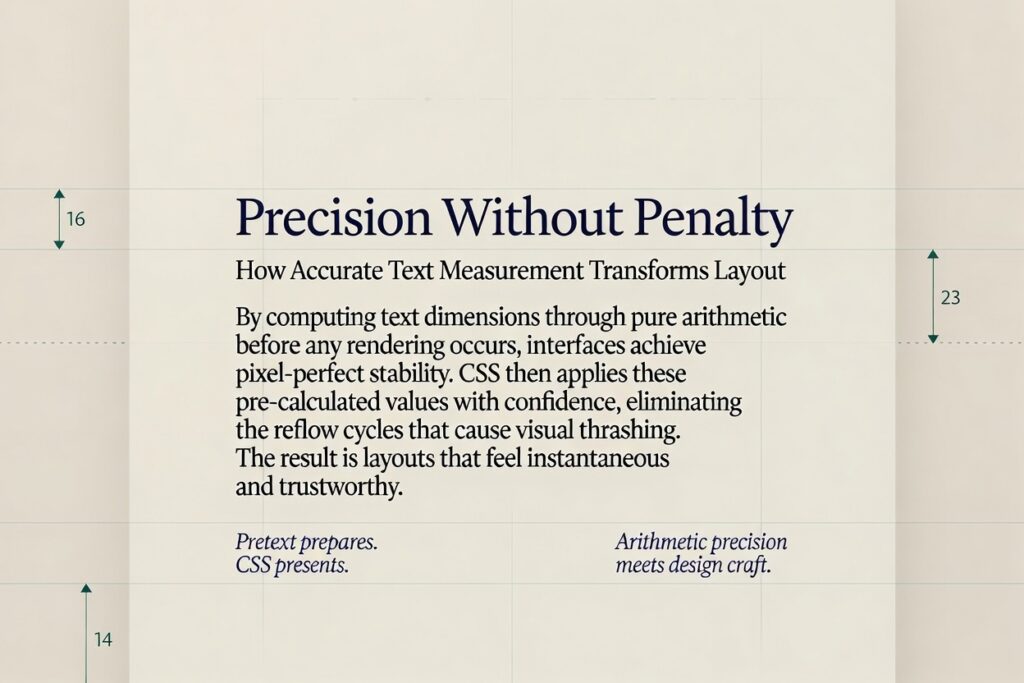
Pretext is a high-performance JavaScript/TypeScript library designed to bypass the browser’s expensive DOM reflows by calculating multiline text layouts entirely in userland. [1, 2]
Created by Cheng Lou (an engineer at Midjourney and former React core team member), this tiny 15KB library handles text geometry without calling heavy DOM methods like getBoundingClientRect(). [1, 3, 4]
How Pretext Works
The library splits the layout process into a two-phase architecture to isolate expensive operations: [1, 3, 4]
javascript
import { prepare, layout } from '@chenglou/pretext' //

// Step 1: Pay the measurement cost once via an off-screen Canvas
const handle = prepare('Hello world, no reflow needed.', '16px "Inter"'); //

// Step 2: Calculate layouts instantly at any width via pure math
const { height, lineCount } = layout(handle, 400, 24); //
Use code with caution.
- The
prepare()Phase: Pretext segments the text (handling complex Unicode, emojis, and international scripts) and measures the glyphs once using an off-screen canvas. This cached data serves as its “ground truth”. [1, 2, 3, 4, 5] - The
layout()Phase: Whenever a container resizes or text flows around elements, Pretext uses pure arithmetic over those cached metrics to instantly compute line breaks, overall height, and line boundaries. [1, 2, 3]
Key Use Cases
Because sub-microsecond layout calculations run roughly 200× to 500× faster than standard DOM querying, Pretext is explicitly utilized for: [1, 2]
- High-FPS Virtual Scrolling: Calculating exact heights for infinite feeds (like chat apps or social timelines) before rendering to prevent layout jitter. [1, 2]
- Complex UI Grids: Powering fluid masonry layouts and responsive typography that dynamically adapts to user interactions in real-time. [, 3, 4]
- Canvas, SVG, & Server-Side Rendering: Generating precise multi-line text blocks across alternative rendering backends where CSS layout isn’t natively available. [1, 2]
| Feature | Traditional CSS Way | Pretext Way |
|---|---|---|
| Measurement | Slow getBoundingClientRect() reads that lock the browser thread. | Instant, pure arithmetic calculations off-thread. |
| Styling & Colors | Handles everything (colors, fonts, borders, grids). | Does nothing. Leaves styling entirely up to your CSS. |
| The Final Output | Renders HTML elements natively to the viewport. | Feeds coordinates into your CSS, Canvas, or virtualized list wrapper. |
To dive deeper into the code or view interactive benchmarks, check out the Official Pretext Documentation or explore the source repository on Cheng Lou’s GitHub. [1, 2]
Are you working on Pretext solutions? The following domain names are available for purchase:
PretextKit.com: “Pre-calculated UI components for silky-smooth 60FPS infinite feeds.”
PretextAgent.ai: “The AI assistant that mathematically optimizes your layout constraints.”
PretextPort.com: “Bringing pixel-perfect text geometry to Canvas, WebGL, and Server Environments.”