
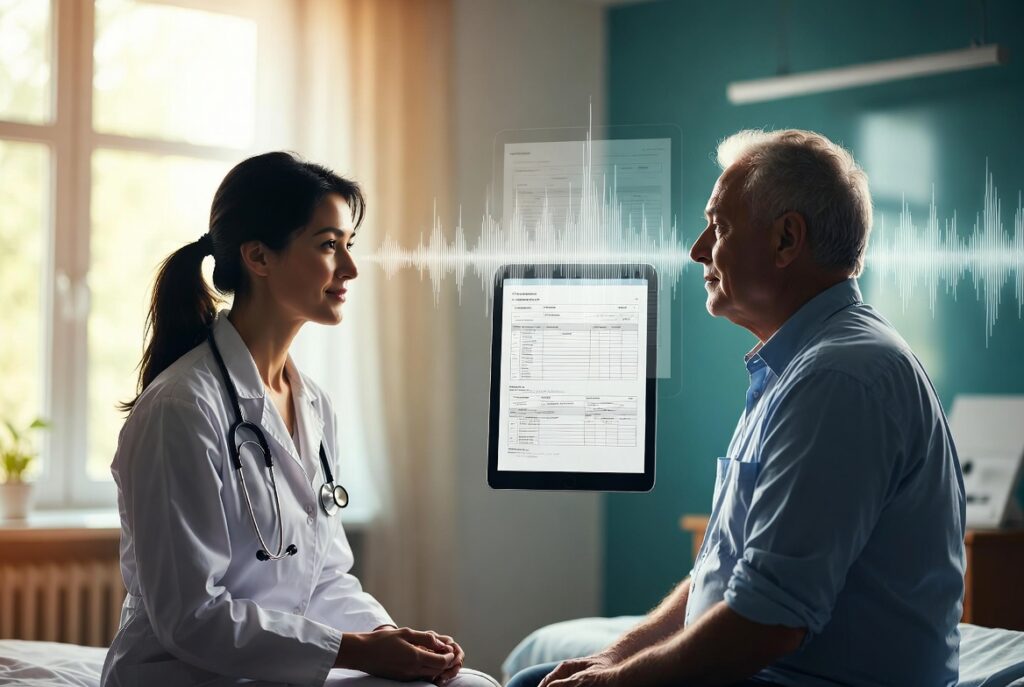
AI medical scribes (also called ambient AI scribes or AI clinical documentation tools) are software systems that use artificial intelligence—primarily speech recognition, natural language processing (NLP), and large language models (LLMs)—to automatically listen to patient-clinician conversations during visits and generate structured clinical notes.
How They Work
- Ambient listening: The AI “listens” passively (via microphone on a device, phone, or integrated into the exam room) to the natural dialogue without requiring the clinician to dictate or speak specific commands.
- Processing: It transcribes the conversation in real time or shortly after, extracts key medical details (symptoms, history, exam findings, diagnoses, plans, etc.), and formats them into a professional SOAP note (Subjective, Objective, Assessment, Plan) or other structured format suitable for the Electronic Health Record (EHR).
- Output: The clinician reviews, edits (if needed), and approves the draft note, which then populates the EHR. Many tools also suggest billing codes, generate summaries, letters, or orders.
- They do not diagnose or make clinical decisions (though some integrate with broader AI tools); they focus purely on documentation.
This is an evolution from traditional human medical scribes (who sit in or shadow visits) and earlier speech-to-text dictation tools. Modern versions are “ambient” because they work in the background without disrupting the visit flow.
Key Benefits
- Time savings: Clinicians can save significant documentation time (e.g., studies show reductions of 20-70%, with real-world examples like 15,000+ hours saved across a large group). This reduces after-hours “pajama time” charting.
- Reduced burnout: By freeing doctors from keyboard work, it improves work-life balance and satisfaction. Many report better patient interactions since they can maintain eye contact and focus on care.
- Improved efficiency and accuracy: Handles complex medical terminology, supports specialties, multilingual encounters, and integrates with major EHRs (Epic, etc.). Notes are often generated in seconds to minutes.
- Scalability and cost: Far cheaper and more available than hiring human scribes; good for solo practitioners to large health systems.
- Patient experience: Many patients appreciate the doctor being more present.
Pricing varies widely—from ~$39/month for lighter tools to custom/enterprise quotes of hundreds per provider per month.
AI medical scribes have seen rapid adoption (e.g., used in millions of encounters by large groups like Permanente Medical Group) and are a major part of efforts to combat clinician burnout while improving care efficiency. They’re continuing to improve with better models and specialty tuning. If you’re a clinician considering one, many offer trials—factors like your EHR, specialty, and volume matter most.
Buy now