
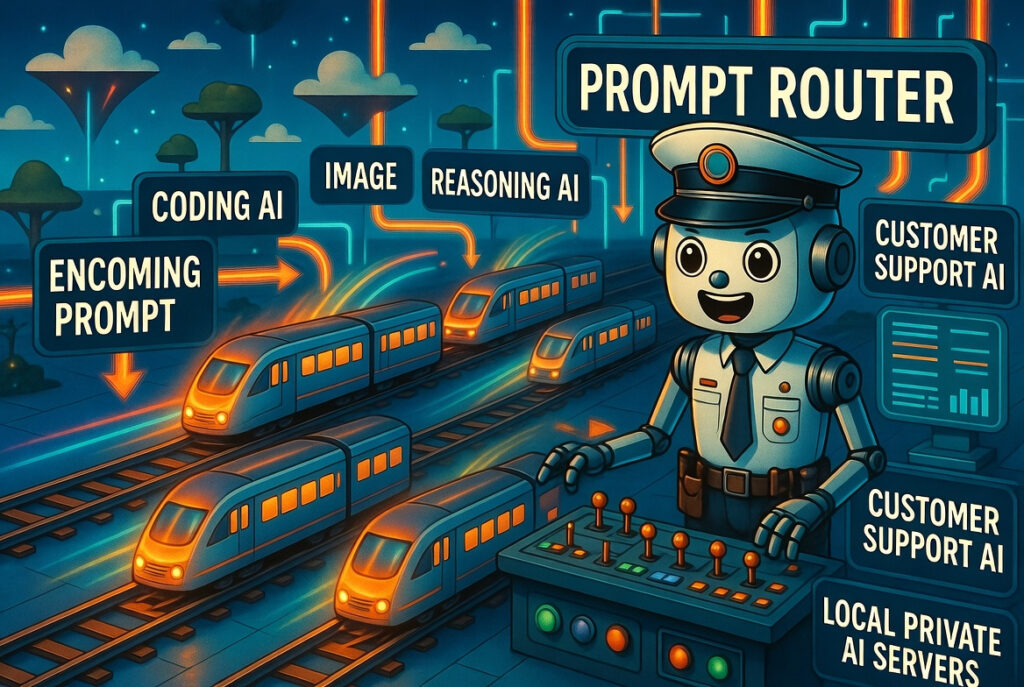
One model crushes coding, another excels at long-context reasoning, while others dominate creative writing, speed, cost-efficiency, tool calling, image generation, or multilingual performance. Prices shift weekly, providers suffer outages and rate limits, and enterprises are demanding multi-model redundancy for reliability. At the same time, powerful open-source and local models are now viable for certain workloads, and compliance or privacy rules often require keeping sensitive prompts entirely on-premise.
The smartest organizations no longer bet on one model—they intelligently route every request to the best model for the job, at the best price, with the right privacy controls.
A good router can automatically decide:
- cheapest acceptable model
- fastest acceptable model
- highest quality model
- fallback provider
- hybrid workflows
- parallel voting/consensus
- privacy / regulatory controls
That is valuable.
The problem is that “simple prompt routing” is already becoming commodity functionality. A lot of frameworks and AI gateways are adding it:
So the opportunity is not merely:
“one API to many models”
That’s already crowded.
The opportunity is likely in:
- intelligent routing
- vertical-specific routing
- observability/governance
- enterprise policy layers
- workflow-aware orchestration
- cost optimization
- autonomous agent routing
Some genuinely strong angles:
1. Cost optimizer router
“Get the same output quality for 70% less cost.”
That resonates immediately with enterprise buyers.
Example:
- classify prompt complexity
- send easy tasks to cheap models
- escalate hard reasoning to expensive models only when needed
That is compelling.
2. Reliability / failover router
Like Cloudflare for AI APIs.
If one provider:
- slows down
- rate limits
- goes offline
- spikes in cost
…the router instantly fails over.
Very enterprise-friendly.
3. Compliance-aware router
Certain prompts:
- healthcare
- finance
- legal
- internal docs
must stay on:
- local models
- private inference
- approved vendors
while general prompts can use cheaper public APIs.
This becomes infrastructure, not a toy.
4. Agentic workflow router
This is where things get interesting.
Instead of routing one prompt:
- planner model
- reasoning model
- retrieval model
- coding model
- summarizer model
all cooperate automatically.
That starts looking like an “AI operating system.”
5. Vertical-specific routing
A router optimized specifically for:
- legal AI
- restaurant AI
- customer support
- ecommerce
- medical intake
- real estate
This is often easier to market than generic infrastructure.
For example, a restaurant/menu interests actually fit this well:
- food trend model
- pricing model
- image/menu generation model
- nutrition model
- reservation/sales forecasting model
A “MenuRouter” or “Hospitality AI Gateway” could actually be differentiated.
From a branding/domain perspective, this entire category is hot:
- router
- switch
- relay
- gateway
- mesh
- orchestration
- fabric
- proxy
- flow
- dispatch
- broker
- energy
- flow
- routing
- switching
- infrastructure
- throughput
The strongest positioning is probably:
“AI infrastructure that automatically routes work to the best model.”
That’s understandable in one sentence.
PromptRouter.ai is legitimately well-positioned for this category. It’s one of those names where the product is instantly understood without sounding clunky.
A few reasons it works well:
- “Prompt” is a dominant AI-native keyword.
- “Router” implies infrastructure, orchestration, and automation.
- The combination sounds like an actual product category, not a gimmick.
- It is broad enough to pivot:
- API gateway
- model orchestration
- agent routing
- observability
- cost optimization
- workflow automation
- enterprise middleware
The .ai extension also fits naturally here. This is exactly the kind of infrastructure startup where .ai feels credible instead of second-tier.
The market is rapidly getting skeptical of thin wrappers.
The way to elevate it is positioning around:
- intelligence
- orchestration
- governance
- optimization
- resilience
“Route every AI request to the optimal model automatically.”
“AI traffic orchestration for multi-model systems.”
“The control plane for enterprise AI routing.”
The domain also has good “expandability”:
- PromptRouter Cloud
- PromptRouter Gateway
- PromptRouter Enterprise
- PromptRouter Edge
- PromptRouter OSS
- PromptRouter SDK
What I especially like is that the category itself is going to grow with model fragmentation:
- OpenAI
- Anthropic
- Mistral
- xAI
- open-source local models
- specialized reasoning models
- coding models
- image/video models
As enterprises use more providers simultaneously, routing becomes more necessary.
Prompt routing delivers outcomes, not routing mechanics.
- lower cost
- better uptime
- lower latency
- safer governance
- better outputs
“Reduce AI costs by 60% with intelligent model routing.”
PromptRouter.ai is a long-term and credible AI infra names because:
- it maps cleanly to a real emerging category
- the wording is natural
- no explanation needed
- easy to imagine venture-backed branding around it
- broad but still specific enough to feel purposeful
This is much stronger than speculative made-up words that do not clearly map to a product. This has long term viability.