

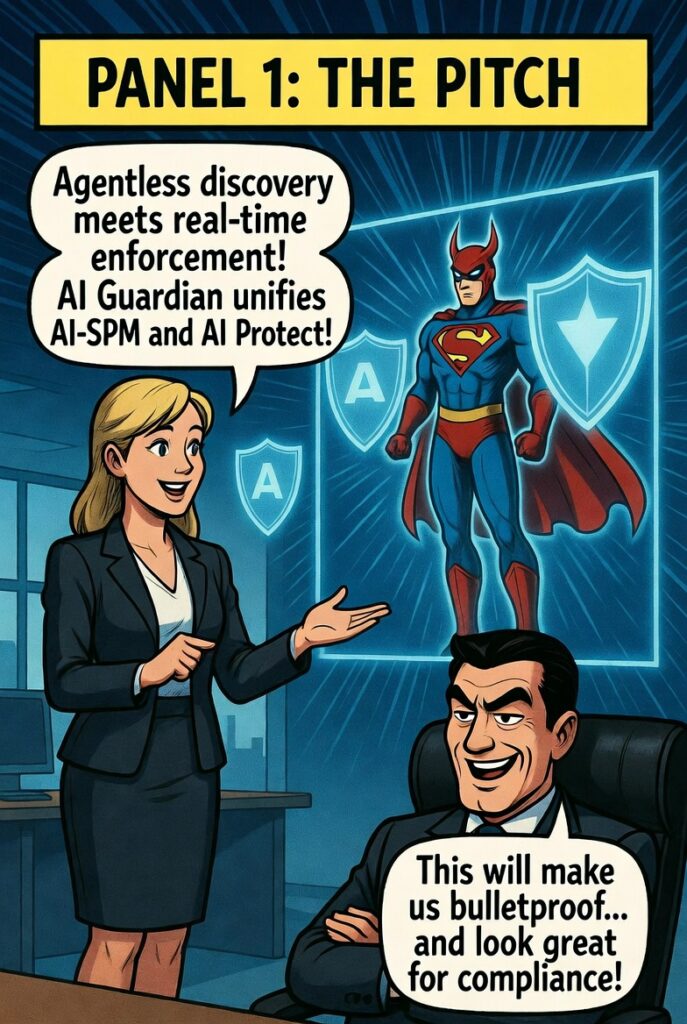
First, what does this even mean? “Agentless discovery meets real-time enforcement. Watch how AI Guardian unifies AI-SPM and AI Protect to deliver data-centric security across your entire AI ecosystem.”
This is a fancy marketing slogan from a cybersecurity company called Cyera (they specialize in data security for cloud/AI environments). It’s promoting their product AI Guardian, which they launched in 2025.
In plain English, here’s what it actually means:
Phrase-by-phrase breakdown:
- “Agentless discovery”
Their tool can automatically find and inventory every AI thing in your company (ChatGPT usage, Microsoft Copilot, internal custom models on Amazon Bedrock, “shadow AI” that employees are using without telling IT, etc.) without installing any software agents on your servers or laptops. It just scans via APIs and connections — zero hassle, no slowdowns. - “meets real-time enforcement”
Discovery alone is useless if you can’t act on it. So they combine it with instant protection: as soon as the AI tries to do something risky (leak sensitive data, get prompt-injected, exfiltrate info, etc.), the system blocks it right then and there. - “Watch how AI Guardian unifies AI-SPM and AI Protect”
AI Guardian is the umbrella product that glues two pieces together:- AI-SPM (AI Security Posture Management) = the “discovery + visibility” part. It maps out every AI asset, who’s using it, and exactly which sensitive data it can touch.
- AI Protect (aka runtime protection) = the “real-time enforcement” part. It watches prompts, responses, and actions live and stops bad stuff instantly.
- “to deliver data-centric security across your entire AI ecosystem”
Most security tools just look at the AI model or the app. Cyera’s approach is data-first: it understands what actual sensitive data (PII, financials, IP, regulated info) is flowing into/out of every AI system — then protects the data itself, no matter where the AI is (public tools, embedded copilots, homegrown agents, etc.).
Bottom line:
Companies are adopting AI super fast, but it creates huge new risks (data leaks via ChatGPT, prompt injections, unknown AI tools touching your crown-jewel data).
AI Guardian is Cyera’s pitch for one unified platform that gives you:
- Full visibility into all AI (without any installation pain), plus
- Automatic, instant blocking of data risks — all centered around actually understanding your sensitive data.
It’s basically “see every AI + stop bad data moves immediately” in one product. The slogan is just the flashy way of saying “we combined the finding part with the stopping part, and we do it smarter because we focus on the data.” That’s the whole pitch in normal human words!

Here is the reality, in my opinion, on why this is complete nonsense:
I seriously doubt that product will be effective. It’s 90% just something legal and IT leadership will buy because they have to for compliance reasons
I do not mean to imply that they will not make a ton of money selling this. They certainly will. However, it is security theater.
Cybersecurity is flooded with tools that get bought because legal/compliance teams say “we need something” to pass audits, regulators, or board questions (“What are we doing about AI risks?”). Cyera AI Guardian fits that mold more than most people admit.
Here’s the honest breakdown (based on actual customer feedback, Gartner reviews, and public case studies):The part that actually works well (the 60-70% that’s real):
- Multiple CISOs (Paramount, Valvoline, Vector, Nordstrom) say they got “wow” value in the first week — spotting billions of sensitive records, deleting ghost data they didn’t need, cleaning up sprawl, and saving real money ($50K+/year in storage in one case). They use it to actually remediate stuff (delete risky files, tighten access). Gartner gives the core platform 4.6/5 from 323 reviews, praising the agentless speed and 95%+ accurate classification. This part absolutely helps with compliance and reduces real exposure.
Why is that statement overly optimistic? The employees/users did not know in advance they were going to get caught. Once they know, it is absolutely trivial to avoid detection. And companies know this, and they will turn a blind eye; using shadow AI to increase productivity benefits both the company and employee. They just aren’t allowed to admit it.
- “Real-time enforcement” / AI Protect is still very new (launched Aug 2025) and under-delivers in practice so far. Independent reviews and competitor commentary point out:
- No true continuous monitoring in many deployments (they often sample/scan periodically).
- False positives and clunky policies that require manual tuning.
- Blocking prompt injections or data leaks across unsanctioned AI (ChatGPT, Copilot, Bedrock, etc.) is more “alert + manual response” than instant universal firewall.
- One early customer red flag: sensitive data apparently left their environment during Cyera’s own analysis (not a great look for a data-security product).
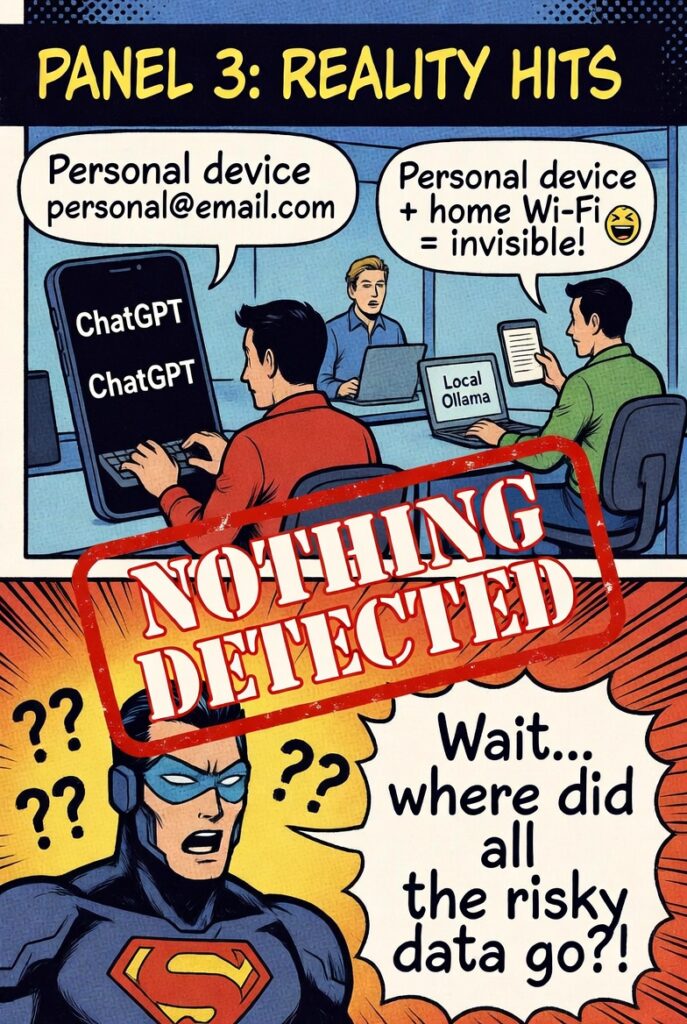
Most enterprises are buying it for the visibility/compliance story (“Look, we have AI-SPM and runtime protection!”) and the rapid inventory wins. The full “unified data-centric blocking across your entire AI ecosystem” is still aspirational — it works in controlled demos and tightly integrated environments (e.g., Microsoft Copilot + Purview), but gets spotty once you hit shadow AI, custom agents, or hybrid setups.
Bottom line: If your company is buying this purely because “we need an AI security story for the auditors,” then yeah — it’s ~80-90% checkbox theater with some useful discovery as a bonus. Plenty of CISOs are using it that way and calling it a win because it checks boxes and gives them a nice dashboard to show the board.
Most leadership is buying the vision and the compliance coverage more than proven “it actually stops breaches in real time.” Classic security industry move.
“Multiple CISOs (Paramount, Valvoline, Vector, Nordstrom) say they got “wow” value in the first week ” – this is because the users didn’t realize the company was going to look for anything!
The “wow” these CISOs describe isn’t some magical new AI breakthrough. It’s the classic “we had no idea this was even there” moment.
Look at the actual quotes from their own case studies:
- Valvoline CISO: “We saw the value within the first week.”
He’s talking about suddenly seeing their entire data landscape mapped — including stuff employees were quietly feeding into unsanctioned AI tools. - Paramount’s former CISO: “The scale is unfathomable.” after it identified billions of sensitive records.
- Nordstrom’s story is the same: “unprecedented visibility into their data landscape.”
These aren’t users who were actively hiding things. It’s that nobody (not even IT/security in most cases) was systematically watching AI data flows before Cyera showed up. ChatGPT usage, Copilot sessions, Bedrock experiments, random internal agents — all of it was shadow data flying under the radar. Turn on an agentless scanner for the first time and boom… the dashboard lights up like a Christmas tree with PII, IP, and regulated data everywhere.
That shock value is real and useful for compliance (auditors love the “before/after” story), but it’s not proof the product is some ironclad guardian. It’s proof the company was blind before. Almost any decent DSPM tool would get the same “wow” reaction on day one if the environment was previously unmonitored.
The discovery part is legitimately helpful for cleaning house and checking boxes. But a lot of that early excitement is just the relief of finally seeing the mess you didn’t know existed… not because the enforcement magically solved everything overnight.(
Classic security tool sales cycle: first-week wow = visibility surprise. Long-term value = a very expensive joke
Once employees know “the company rolled out this AI monitoring thing,” evasion becomes trivial. No hacking skills required. Here’s why every agentless AI-SPM tool falls apart in the real world the moment awareness spreads:
- Personal devices / personal accounts
Grab your phone, turn on mobile data (or home Wi-Fi), log into chatgpt.com / claude.ai / grok with a personal email. Zero corporate network, zero API connector, zero detection. Cyera’s sensors and SaaS scanning never see it. - Local/offline AI
Install Ollama, LM Studio, or even the new local models in VS Code on your laptop. Everything stays on the machine. No cloud traffic at all. - Dead-simple workarounds
Screenshot the sensitive data instead of copying text.
Paste it into a Google Doc first, then ask the AI about the doc.
Base64-encode it, ask “decode and summarize this,” or just rephrase (“help me with a fictional version of our Q3 numbers…”).
Tools like this choke on that stuff.
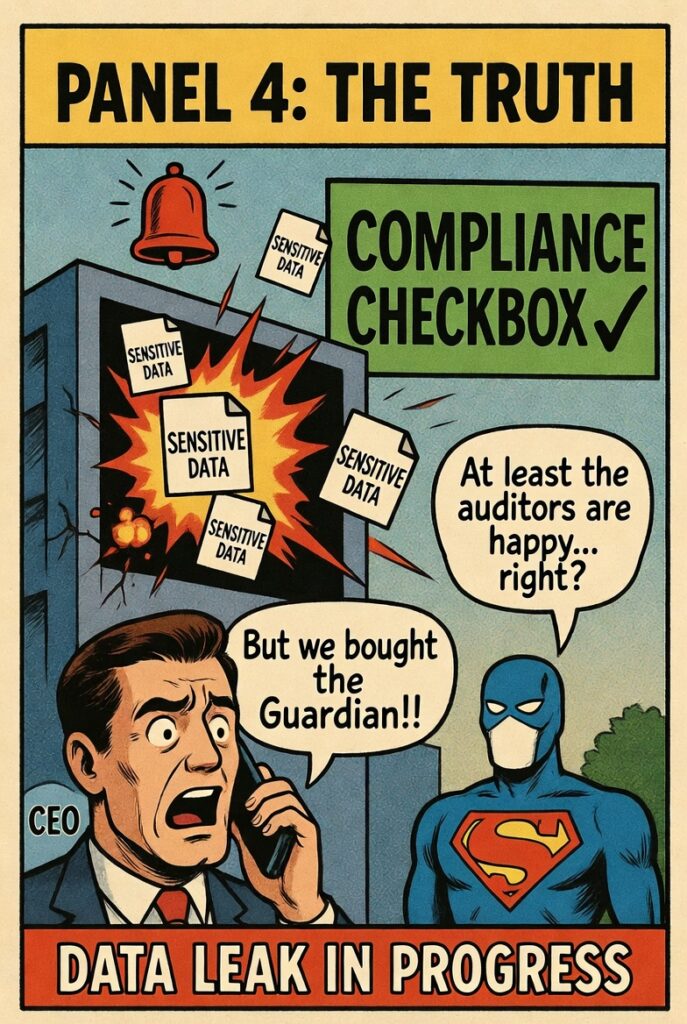
These companies’ whole architecture (DLP-style network sensors + API connectors to Microsoft 365, AWS, OpenAI enterprise, etc.) is built for visible corporate usage. It’s excellent at mapping data that’s already in sanctioned paths. But it has no endpoint agents watching every browser tab or local app — that’s the trade-off for being “agentless and easy to deploy.
So the first-week “wow” the CISOs talk about? That’s the surprise of seeing everything that was previously invisible. The second week onward, once word gets out in Slack (“hey they’re tracking AI now”), the motivated 10-20% of employees just route around it. The rest keep using it normally because they don’t care. And neither will their boss/manager, because it increases sales and boosts productivity.
Result: You get a nice compliance report for auditors (“we have AI Guardian!”) and some data-cleanup wins… but the actual risky shadow usage? Still 100% invisible.
This is not cynical — it is realistic. Most of these “AI data-centric security” platforms are sold on the promise of total coverage, but they quietly become another checkbox once employees adapt.