
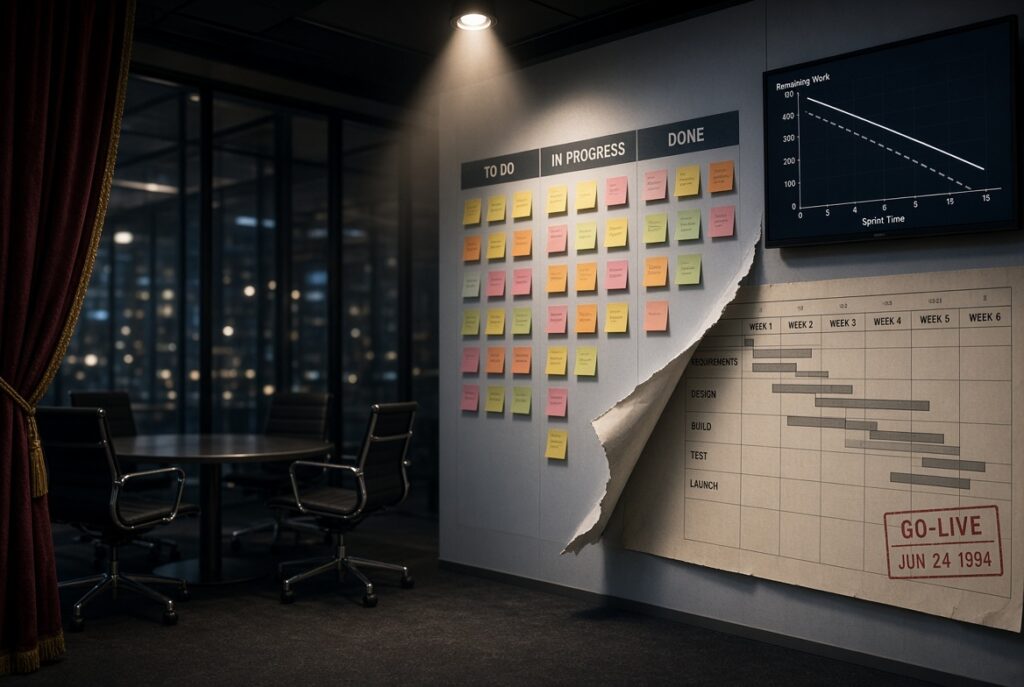
At 9:00 AM sharp, people stand. Each person gets sixty seconds. Someone points at a digital board that looks like a subway map designed by a committee. Tickets slide left to right. A burndown chart is projected like a vital sign. Someone says the word increment. Someone else says velocity. Sticky notes bloom across glass walls that used to hold Gantt charts. We are told we are Agile.
Look closer and the ritual is familiar. The dates were locked before the first standup. The scope was negotiated in a steering committee that does not attend the standup. The “sprint” is a two-week slice of a plan that has already been promised to a board. The launch is still a single, high-risk event because finance, legal, infrastructure, or the customer’s change window will not allow anything else. The terminology is new. The sequence is not.
That is the quiet scandal of the last fifteen years of enterprise software: Agile Transformation has largely become a cosmetic exercise. It is waterfall development wearing an agile mask. The vocabulary changed. The ceremonies multiplied. The tools got prettier. The operating system of the company—how work is funded, how risk is tolerated, how scope is allowed to move, who is allowed to say “this plan is wrong”—stayed sequential, gated, and political. Great issue trackers, built to help teams see work, were turned into high-tech compliance whips.
This is not an argument that Scrum is a fraud, or that iteration is a fad, or that every regulated industry should pretend it is a six-person startup. Hybrid delivery can be an honest response to real constraints. The problem is the dishonest hybrid: the organization that buys the language of adaptability and keeps the incentives of predictability, then congratulates itself for the purchase.
Act I: The Birth of Water-Scrum-Fall
Practitioners have a name for the pattern. Forrester analyst Dave West popularized it in the early 2010s: Water-Scrum-Fall. Water at the front. Scrum in the middle. Fall at the end. It is not a methodology so much as a confession. Most companies never replaced their delivery system. They wrapped Scrum around the only part of the system the engineering team could touch.
The sandwich has three layers, and each one is doing a different job.
The requirements trap: waterfall intake
The project still begins the old way. A business case is written to win budget. A multi-page functional specification is drafted, reviewed, revised, and approved. Discovery is treated as a phase to be closed rather than a habit to be kept. Six months can pass before a developer writes production code, not because the problem is that complicated, but because the organization needs a document thick enough to survive audit, procurement, and executive anxiety.
That document is not a conversation. It is a contract dressed as analysis. It freezes assumptions that have not yet met users, data, or the actual constraints of the legacy stack. The more pages it has, the more people believe risk has been reduced. Often the opposite is true. Ambiguity has been laundered into formal language. Every stakeholder has signed a version of reality that will not survive contact with implementation.
This is the Waterfall Intake. It feels responsible. It photographs well in a program review. It also guarantees that the most expensive learning—what the product actually has to do—happens after the plan is already sacred.
There is a legitimate version of upfront work. Architecture spikes, risk registers, regulatory mapping, and a thin slice of “what must be true” can save a team from building the wrong thing with great ceremony. The trap is not thinking before building. The trap is treating the blueprint as finished knowledge. Once the specification is approved, changing it is not learning. It is a governance event. That single inversion—learning recoded as exception—kills agility more efficiently than any missing standup.
The illusion of flexibility: Scrum as middleware
Then the engineering team is handed the document and told to be Agile.
The dates are fixed. The scope is fixed. The budget is fixed. The steering committee still wants a Gantt chart, even if nobody is allowed to call it that. So the work is carved into two-week boxes. User stories are written by translating specification paragraphs into the ritual grammar of “As a / I want / So that.” Story points appear. A Product Owner is named, often without the authority to change the product. A Scrum Master is hired, often without the authority to change the system. The team is told to “commit to the sprint.”
This is Scrum as middleware: a translation layer between an unchanged planning culture and a development team that is now expected to look modern while executing last year’s promise.
Inside the two weeks, some good things can still happen. Engineers talk to each other. Bugs are found sooner than they would have been in a six-month coding phase. A demo can surface a misunderstanding before it hardens into a lawsuit. Those are real benefits. They are also not the benefits leadership usually paid a consultancy to deliver. Leadership paid for faster time-to-market, cheaper change, and a team that could steer. What they received is a more frequent status cadence on a plan that cannot steer.
The cruelty of the arrangement is that the team is measured on agility while being denied its raw materials. Agility requires slack to inspect and adapt. Water-Scrum-Fall spends that slack on ceremony and then asks why velocity is “inconsistent.” Of course it is inconsistent. The system is asking people to estimate their way through a specification written before the interesting problems were visible, then punishing variance as if variance were a character flaw.
Watch what happens when reality arrives, as it always does. An API is undocumented. A vendor slips. A compliance interpretation changes. A user study contradicts the persona in Appendix C. In a team that is actually agile, the response is to change the plan in public: drop scope, split the release, rewrite the assumption, tell the customer the truth while the cost of truth is still small. In Water-Scrum-Fall, the response is a change-control ticket, a RAID log update, and a conversation about whether the “commitment” can still be met if everyone works the weekend. The sprint continues. The plan remains the protagonist. The product becomes the extra.
The hard landing: waterfall delivery
Then comes the Fall.
The software may have been built in iterations. It is still released as an event. Production access is gated. The release train runs quarterly because the change-advisory board meets quarterly. Data migration is too frightening to do twice. The customer can only train staff once a year. Marketing wants a splash. Legal wants one review, not twelve. Ops wants a freeze. So the increments pile up behind a dam, and on a chosen weekend the dam is opened.
That is not continuous delivery. That is a waterfall launch with better intermediate screenshots.
The risk profile of the old model returns on contact with production. Defects that would have been cheap in week three are expensive in month eleven. Integration issues that a weekly release would have isolated arrive as a cluster. The organization then does what organizations always do after a painful launch: it adds more gates. More templates. More sign-offs. The next program is even more “Agile,” which is to say it has even more artifacts explaining why the last launch hurt.
In regulated industries—pharma, banking, medical devices, government—some of this is not theater. Auditors do not accept a vibe. Traceability from requirement to test to release can be the difference between shipping and being shut down. Hybrid models can be an adult compromise when the constraint is real. The tell is whether the organization can distinguish necessary gates from comfort gates. Necessary gates protect patients, money, or the public. Comfort gates protect executives from having to trust a team. Water-Scrum-Fall thrives when those two categories are treated as the same thing.
By the time the transformation office publishes its success story—eighty-seven teams “on Agile,” certified Scrum Masters in every tribe, a Jira instance that looks like a small city—the delivery system is still a pipeline with a Scrum-shaped bulge in the middle. The names changed. The physics did not.
Act II: The Anatomy of Documentation Theater
If Water-Scrum-Fall is the plot, documentation theater is the set design. The organization must look in control. Tools and ceremonies become the proof.
The ticket micromanager
Jira, Azure DevOps, Linear, and their cousins are not the villain. They are amplifiers. In a team that owns its work, a board is a shared working memory: what is in flight, what is stuck, what is next. In a company that does not trust its teams, the same board becomes a surveillance surface.
The corruption is usually accidental at first. Leadership wants visibility. Visibility is reasonable. Then visibility is confused with control. Then control is confused with the motion of tickets. A story that does not move in three days becomes a management question. A column that is not “Done” by Friday becomes a slide. Subtasks proliferate so that progress can be reported at a granularity no customer will ever feel. Labels multiply until the taxonomy is a second product the team has to maintain.
Burndown charts are the distilled form of this mistake. Used by a team as a sensor—“are we carrying too much? did we discover something?”—they can be useful. Reported upward as a performance score, they become a script. Teams then optimize the chart. Stories are split not because the work got clearer, but because smaller cards move more often. Work is marked done before it is accepted. Scope is quietly shoved into the next sprint so this sprint’s line can kiss zero. The chart looks healthy. The product does not.
This is Goodhart’s Law wearing a sprint-review smile: when a measure becomes a target, it ceases to be a measure. Velocity, once a planning aid, becomes a quota. Cycle time, once a way to find queues, becomes a reason to game the timestamps. The tool is no longer helping the team see reality. The team is helping the tool produce a picture of reality that will survive the steering committee.
The human cost is not abstract. Engineers learn that the safest work is the work that photographs well in Jira. Deep, messy, high-leverage problems—the kind that do not fit in a two-day ticket—get postponed because they make the board look idle. People stop writing down the real risk and start writing down the risk that can be closed. The issue tracker, which should reduce coordination cost, becomes a second job: the job of looking busy in a schema someone else designed.
The daily standup interrogation
The daily standup was supposed to be a short alignment huddle among peers. What did we finish? What are we doing next? What is in the way? Fifteen minutes. Then back to the work.
In theater companies, it becomes a status report to a manager, often scheduled at 9:00 AM so that attendance itself is a loyalty test. People stand in a circle and perform productivity. The grammar is fixed: yesterday, today, blockers. The safest answer is “no blockers,” even when the payments module is held together by workarounds and a disabled test. Admitting a blocker, in a low-trust system, is volunteering as the problem. So the ritual trains silence.
The most important metric in the room is not whether the product got better. It is whether a ticket moved from left to right. Quality becomes a private anxiety. Movement becomes a public virtue. A developer who spent the morning deleting a thousand lines of accidental complexity has less to show than a developer who opened three tickets and closed two. The standup cannot see deletion. It can see motion.
None of this requires a villain. Managers are asked for status. They use the meeting they already have. Scrum Masters are asked to “keep the process healthy,” which in practice means keeping the calendar full and the board tidy. The team adapts to the audience in the room. If the audience is a peer group trying to finish a slice of product, the meeting stays short and useful. If the audience is an evaluator, the meeting becomes a performance review with a standing requirement.
You can diagnose the difference in under a minute. After standup, does anyone’s plan change? Does a blocker get a name and an owner outside the circle? Does a person offer to pair, or does everyone simply leave? If the only output is that management now knows who spoke, you did not have a standup. You had roll call.
Checking boxes versus shipping code
Around the standup grows the rest of the tax.
Sprint planning for a project whose outcome was decided a year ago. Refinement sessions that re-explain the specification in story form. Retrospectives that produce action items no one has the power to implement. Change-control templates that take longer to fill than the change they describe. Definition-of-Done checklists that include fields nobody reads. Architecture review boards that meet too late to change the architecture and too early to see the production evidence. “Communities of practice” that are calendar entries.
This is documentation theater: artifacts created so that a box can be checked, an issue closed, or a transformation milestone declared. The document’s audience is not the next engineer. The audience is the process.
The tax is not only time. It is attention. Software is made out of scarce cognitive bandwidth. Every hour spent formatting a RAID log for a program that cannot change course is an hour not spent on the integration that will actually fail. Teams become fluent in the local dialect of compliance and rusty at the craft the customer is paying for. New hires learn the ceremonies first and the product second. Burnout shows up not as a sudden crash but as a flattening: fewer arguments about design, more arguments about ticket states.
Agile theater is the structural version of the same pattern. The visible behaviors of the framework continue—events, roles, boards, certifications—while the outcomes that justified the transformation do not move. Delivery is not faster. Quality is not higher. Predictability is not improved except on slides. Engagement falls because adults can tell when they are acting.
Research on so-called agile maturity keeps finding a related split. Many firms adopt the practices and report success. Far fewer can point to a durable change in how work actually flows, how teams are allowed to decide, or how the business absorbs a changed plan. The costume is common. The capability is not.
That gap is how you end up with an organization that can explain Scrum better than it can ship.
What the original idea actually required
It is worth saying out loud what got lost, because the critique is not “meetings are bad” or “tools are bad.” The 2001 manifesto was a short list of tradeoffs, not a franchise:
- Individuals and interactions over processes and tools
- Working software over comprehensive documentation
- Customer collaboration over contract negotiation
- Responding to change over following a plan
Those lines are easy to print on a poster and hard to operationalize in a company that funds work annually, signs vendor contracts by scope, and treats forecast accuracy as a moral quality. The enterprise did not fail to understand the poster. It understood the poster and declined the tradeoffs. It wanted the prestige of adaptability without giving up the comfort of a locked plan. Consultancies productized the residue: roles, certifications, scaled frameworks, tool implementations. The result is a process that can be rolled out like software and audited like a control framework.
There is a reason this spread so easily. Theater is legible. A board of directors can see a transformation office, a training completion rate, a percentage of teams “on Agile.” Trust, autonomous teams, and a living backlog are less legible. They look, from a distance, like a lack of control. So organizations buy the legible version. They get what they paid for: a system that is easy to inspect and hard to steer.
The edge cases matter here, because honesty requires them. A medical-device company that must maintain design history files is not pretending when it asks for traceability. A bank that cannot push to production on a Friday is not necessarily a coward; it may be remembering an incident. A government program with a statutory go-live date cannot “follow the energy of the sprint.” The question in those environments is not whether constraints exist. It is whether the constraints are used to protect the mission or to freeze a plan that no longer matches the mission. The first is engineering. The second is costume.
Conclusion: Moving past the buzzwords
Software development does not get faster because you rename the meetings. Calling a phase a sprint does not make the phase smaller. Calling a manager a Product Owner does not give that person the right to change the product. Calling a specification a backlog does not make it empirical. Calling a launch an increment does not make it reversible.
True agility is not a toolkit. It is a permission structure. It requires at least three things that cannot be installed from a vendor’s professional-services catalog.
Trust. Not the poster kind. The operational kind: a team can surface bad news early without becoming the bad news. A forecast can be wrong in public. A demo can be ugly. A missed estimate can be treated as information about the system rather than as a referendum on character. Without that, every ceremony becomes a place to hide.
Autonomous teams. Autonomy is not the absence of strategy. It is the presence of a decision right at the resolution where the information lives. If the people closest to the code, the customer, and the incident channel cannot change sequence, drop scope, or stop a bad idea without a program-board appeal, you do not have teams. You have a factory with standups.
A willingness to change the scope when reality hits the plan. This is the unfashionable core. If scope is sacred and dates are sacred and budget is sacred, then “Agile” is a scheduling aesthetic. The only remaining variable is people working harder. That variable has a short half-life. The organizations that actually adapt treat the plan as a hypothesis. When the hypothesis fails, they change the bet in the open, while the cost of changing it is still smaller than the cost of defending it.
Those three conditions make tools useful again. A board becomes a map instead of a whip. A standup becomes coordination instead of interrogation. Documentation becomes a way to transfer knowledge instead of a way to survive an audit of the process itself. Metrics become sensors. The work gets a little quieter, which is usually a sign that value is moving.
The next generation of B2B tech platforms, at least the ones worth paying attention to, are not trying to sell another methodology. The market is full of methodologies. What is scarce is execution: clean data about what is actually in flight, automation that removes hygiene work instead of adding fields, and interfaces that serve the people doing the building rather than the people decorating the slide. The useful tools will look less like a compliance suite and more like an instrument panel—less interested in whether you performed Scrum correctly, more interested in whether the product moved.
You can feel the difference in the questions a system asks. Theater asks: Did the ticket move? Was the ceremony held? Was the template completed? Execution asks: What shipped? What did we learn? What did we stop doing? How long does a change really take, including the waiting? Which queues are imaginary and which are load-bearing? Those questions are less flattering. They are also the only ones that compound.
The standup can stay if it earns its minutes. The board can stay if it describes the work instead of disciplining it. What cannot stay is the pretense that a 1995 milestone plan becomes a modern operating system when you paint it with story points. A mask is optional. The physics are not.
Featured domain: AgileTracker.com
Building the antidote to corporate project theater? Launching a platform that actually tracks execution instead of bureaucracy?
AgileTracker.com is an elite, category-defining brand identity currently available for corporate acquisition. In a market crowded with process language and ceremonial software, a name this direct does something most rebrands cannot: it tells the buyer, in two words, what the category is supposed to be for.
The value proposition is straightforward. Instant category authority. High-intent brand recall. A digital anchor for the next era of project operations and software delivery tracking—tools built around raw execution, automated data hygiene, and developer velocity rather than another layer of methodology to perform. For a team building that product, the domain is not decoration. It is positioning you do not have to explain.
If the last decade was about looking Agile, the next one will belong to the companies that can prove movement. A name that already speaks that language is a rare starting point.