
Every era of the internet eventually needs a system of record. Search needed an index. Commerce needed a payment rail. Identity needed a certificate authority. The generative-AI era needs something more specific: a place where content, models, and decisions can be registered, signed, and later proven.
That place is a content registry. Not a blog. Not a watermarking plugin. A registry — cryptographic when the asset is media, operational when the asset is an AI system, public when the deployer is a government. In 2026 the standards, the regulations, and the buyers have all arrived at the same word. The brand that should own it is still available.
ContentRegistry.ai
The problem the market is now forced to solve
Photorealistic images, cloned voices, synthetic video, and fluent machine text no longer announce themselves. Audiences cannot reliably tell what was captured by a camera, edited in software, or generated by a model. Enterprises cannot reliably tell which models, agents, datasets, and prompts are running inside their own walls. Governments cannot tell the public which automated systems decide benefits, border screening, or school placement.
The result is not only a disinformation problem. It is an audit problem, a liability problem, and a brand-trust problem. Platforms need machine-readable disclosure. Newsrooms need a chain of custody. Camera makers need a signed capture event. Compliance teams need a living inventory. Regulators need a register they can inspect.
Two industries that used to look separate — media authenticity and enterprise AI governance — have collapsed into one infrastructure category: content provenance and cryptographic registries.
Layer one: content provenance for media
The most prominent form of an AI content registry is provenance tracking for images, video, audio, and text. The open technical standard that now dominates this layer is C2PA — the Coalition for Content Provenance and Authenticity — backed by major technology and media organizations including Adobe, Microsoft, OpenAI, and Google, with TikTok elevated to the steering committee in 2026.
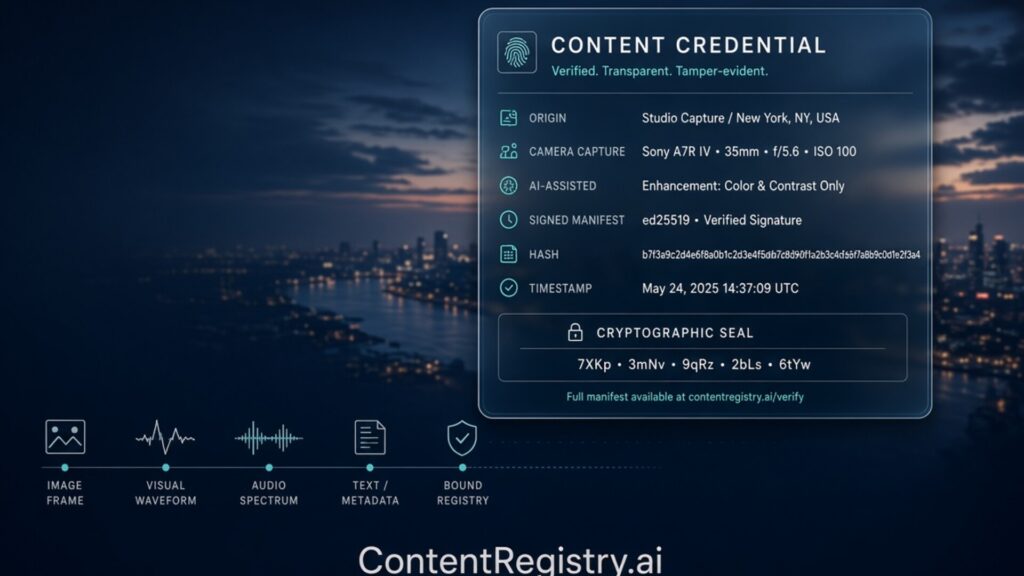
C2PA is the specification. Content Credentials is the consumer-facing implementation. Together they embed a tamper-evident, cryptographically signed “manifest” directly into a digital file.
Think of it as a permanent nutrition label attached to media. It can register whether a file was captured by a certified physical camera, edited in software such as Photoshop, or generated or assisted by an AI model. Unlike ordinary EXIF metadata, the credential is cryptographically bound to the file. Alter the history after signing and the signature breaks. Validators can then treat the signer as trusted (on the C2PA Trust List), merely valid, or failed.
By 2026 the specification is no longer a prototype. Content Credentials 2.3 added live video and additional file types, including plain-text documents. A mid-2026 implementation guide added a dedicated AI-disclosure assertion — model provenance, scientific domain, and degree of human oversight — plus regions of interest so a credential can mark the exact crop of an image, paragraph of a document, or segment of audio that an AI touched. C2PA now cites hundreds of members and thousands of affiliates with live applications.
That is what a registry looks like when it leaves the lab and hits a feed: cameras that sign at capture, models that sign on output, platforms that preserve the credential in transit.
A Content Credential is not a claim you make about a file. It is a signed history you attach to the file — and that history is only as useful as the registry that can issue, verify, and preserve it.
Layer two: enterprise and regulatory AI asset registries
In the corporate and governmental world, “AI registry” means something adjacent but equally urgent: a system of record that catalogs AI technology rather than media files. The object being registered is not a JPEG. It is a model, an agent, a dataset, a prompt library, a risk tier, an owner.
Enterprise inventories. Companies use platforms such as Collibra, Alation, and specialist AI-governance tools to keep a living inventory of every model, LLM-powered agent, dataset, and prompt deployed across their infrastructure. Shadow AI is the failure mode. A registry is the control. Without one, a firm cannot answer the questions a board, an insurer, or a regulator will ask.
Compliance mandates. The EU AI Act turned that inventory from good practice into a legal artifact. High-risk systems must be registered in the EU database before they are placed on the market or put into service. Providers record ownership, purpose, data, and status. Public-authority deployers register use. Transparency rules under Article 50 — in application since 2 August 2026 — require machine-readable marking of synthetic audio, image, video, or text. The Act does not name C2PA, but the industry’s interoperable answer to “machine-readable marking” is Content Credentials. Provenance for media and registration for systems are two sides of the same compliance coin.
Public-sector registers. Governments have already begun to treat algorithmic systems as public infrastructure that must be listed. The Netherlands and Canada have piloted public AI registers that catalog automated decision-making tools used in public services. If a system affects citizens, the public is entitled to know that it exists, what it does, and who is accountable for it. That is a registry problem with a civic face.
Why these two layers belong under one name
A media credential answers: where did this file come from, and what touched it? An enterprise AI register answers: which systems exist, who owns them, and what may they do? Both are records. Both depend on identity, signing, time-stamping, and audit. Both fail if the record can be silently rewritten. Both become more valuable as the network of issuers and validators grows.
Independent research now treats content authenticity and digital provenance as multi-billion-dollar categories through the early 2030s, driven by synthetic media, platform rules, and statutory disclosure. Whether any single forecast is precise matters less than the direction: buyers, standards bodies, and regulators are building the same kind of object — a trusted register of what was made, by whom, with which tools, and under which controls.
Category names in technology do not stay neutral for long. Search became a verb. Payments became a rail. Identity became a directory. Provenance will become a product with a homepage. The homepage that already says the category out loud is ContentRegistry.ai.
Why this domain, specifically
Premium domains work when they collapse a sentence into a brand. ContentRegistry.ai does that in three strokes.
| Piece | What it buys you |
|---|---|
| Content | The unit of value is no longer only a model. It is every artifact a model produces or consumes: images, video, audio, text, datasets, prompts, and decision logs. |
| Registry | Not a feed, not a filter, not a detector. A system of record: issue, bind, verify, inventory, and audit. The word governments and enterprises already use. |
| .ai | The TLD that places the product inside the market it serves, without forcing a longer invented brand. |
The name is category-exact rather than cute. That is an advantage when the buyer is a CISO, a newsroom standards editor, a camera OEM, a foundation-model lab, or a public-sector CTO. Those people do not want to decode a coined brand. They want to know, from the URL alone, that this is the register for content.
It also spans both layers of the market without stretching. ContentRegistry.ai can be:
- the verification destination for a Content Credential
- the SaaS inventory for an enterprise AI estate
- the public portal for a municipal algorithm register
- the developer platform that issues signing certificates and timestamps
Few names in this space can carry media provenance and model governance at once. This one can.
Who this domain is for
The natural acquirer is not a generic investor flipping a keyword. It is an operating company that intends to become the default noun in a new infrastructure layer.
- A C2PA / Content Credentials product — signing, validation, long-term archival of manifests, Trust List integration, and creator-facing credentials.
- An enterprise AI governance platform — model catalogs, agent inventories, dataset lineage, prompt registries, and audit exports mapped to the EU AI Act and successor regimes.
- A foundation-model lab or platform — the public face of “how we mark what we generate,” and the private ledger of what left the API.
- A news, media, or camera ecosystem player — capture-to-publish chain of custody, with a brand editors and audiences can remember.
- A public-sector or civic-tech builder — the named home for algorithmic transparency registers that governments are already piloting.
The cost of choosing a lesser name
In a standards-driven market, the homepage is part of the product. Sales cycles run through legal, security, and procurement. Analysts write the category before they write the vendor. If the URL is a coined word, every deck spends a slide explaining what the company does. If the URL is ContentRegistry.ai, that slide is already written.
There is also a defensive reason to acquire it. The phrase “content registry” will keep appearing in RFPs, EU database guidance, newsroom stylebooks, and academic papers on provenance. Owning the exact match in the .ai space is search equity, sales equity, and narrative control. Leave it on the aftermarket and a competitor — or a well-capitalized new entrant — will use it to look like the category itself.
The asset
| Domain | ContentRegistry.ai |
| Category | Content provenance, cryptographic credentials, and AI asset registries |
| Status | Listed for sale — available for private acquisition |
| Best use | Primary brand, product line, verification portal, or category flagship URL |
| Buyer profile | Operating company, platform, lab, or governance vendor building the system of record for AI-era content |
Close
Standards bodies write the grammar. Regulators write the deadlines. Platforms write the distribution. What remains unclaimed is the proper noun — the name a general counsel can put in a contract, a journalist can put in a sentence, and a user can type when they want to know whether a file, a model, or a decision can be trusted.
Content provenance is no longer a research topic. Cryptographic registries are no longer a thought experiment. Enterprise AI inventories are no longer optional. The market has chosen the function.
ContentRegistry.ai is the name that matches it.
ContentRegistry.ai is for sale. Serious inquiries from operators and strategic buyers are invited.