
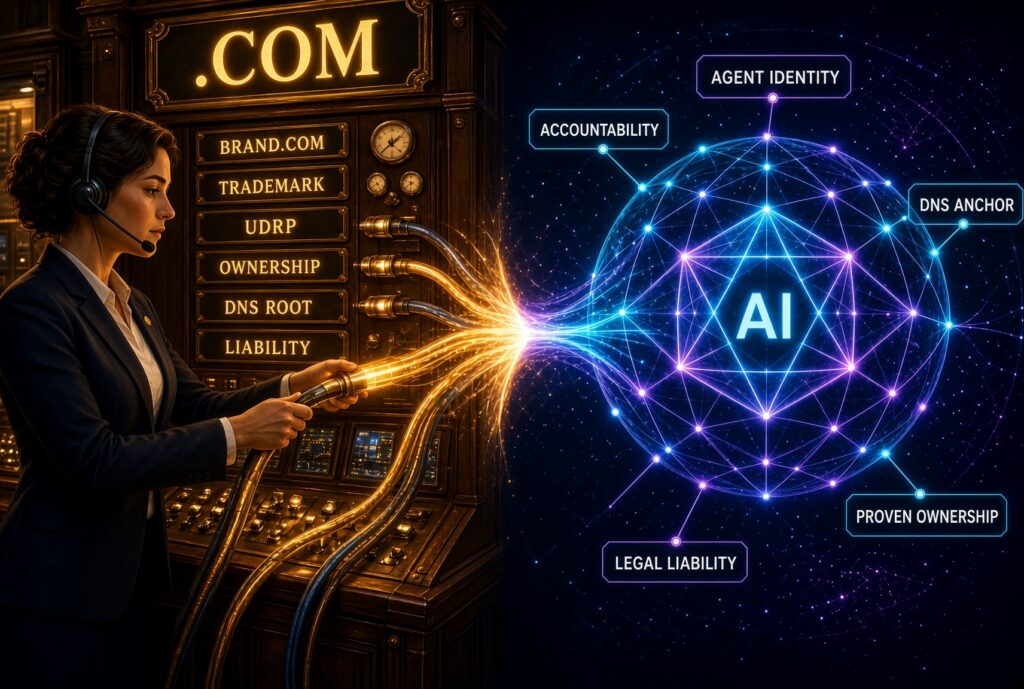
The recent argument that three-letter domains and much of the classic domain market are a “ticking time bomb” rests on a seductive but incomplete vision of the Agentic Web. It claims that because machines will talk to machines, human-memorable names lose their purpose; that visual trust is fatally flawed; that short, non-semantic domains are pure vanity or squatting artifacts of a dying human-first internet; and that the future belongs to pure cryptographic hashes, DIDs, Agent Name Services, SPIFFE identities, and ephemeral just-in-time credentials. In this view, the domain industry faces a great schism in which the “dying middle” of arbitrary LLLs and similar names collapses while only ultra-premium dictionary words survive as status symbols.
This thesis misunderstands both the nature of accountability in autonomous systems and the enduring legal, economic, and technical role of the Domain Name System. Far from fading, domain names—particularly those with clear ownership, trademark strength, and established DNS roots—gain strategic importance precisely because agents act at scale, at speed, and with real-world consequences. The switchboard-operator analogy fails. Machines do not simply “dial” hashes in a vacuum; they operate within human legal systems, commercial expectations, regulatory frameworks, and trust architectures that still run on DNS.
1. Battle-Tested Trademark Protections the Author Ignores
The domain system sits on decades of refined, enforceable intellectual property law. The Uniform Domain-Name Dispute-Resolution Policy (UDRP), the Anticybersquatting Consumer Protection Act (ACPA) in the United States, and parallel national regimes give trademark holders fast, relatively low-cost mechanisms to recover infringing names. Courts and arbitrators have handled tens of thousands of cases. Precedent is clear on bad-faith registration, confusing similarity, and legitimate interest. Registrars, ICANN, and national authorities participate in a known enforcement chain. WHOIS/RDAP data, even under privacy regimes, ultimately ties back to accountable parties. Transfer locks, escrow, and registrar cooperation make recovery practical.
Cryptographic hash systems, pure DIDs, or novel Agent Name Services lack this infrastructure. A SHA-512 string or ephemeral SPIFFE identity has no equivalent to UDRP. There is no global, battle-tested process for a brand to reclaim a colliding or abusive identifier when an autonomous agent registers or uses one that dilutes a trademark or enables fraud. Zero-knowledge proofs and short-lived credentials excel at privacy and least-privilege authentication; they do not automatically create civil or criminal liability pathways for brand owners. In a world of agentic commerce, micropayments, and automated contracting, the ability to enforce trademark rights at the naming layer is not a legacy curiosity—it is a competitive advantage and a risk-mitigation tool.
Companies that control strong domains already possess enforceable digital real estate. Agents operating under those domains inherit that protection. Agents floating on pure hashes do not. The “extortion” narrative around premium domains ignores that trademark law already disciplines abusive holding; legitimate defensive and investment holdings are protected precisely because the system is mature.
2. Mislabeling All Registrants as “Squatters”
The original argument collapses legitimate ownership into a caricature of parasitic squatting. Not every holder of a short or brandable domain is an investor waiting for a payday from a desperate startup. Many are:
- Brand owners protecting their marks across TLDs and variations.
- Companies that registered early for future product lines, geographic expansion, or defensive portfolios.
- Long-term investors who provide liquidity and discovery in a secondary market that has funded countless startups by making names available when capital arrives.
- Developers and entrepreneurs who simply registered available names that later acquired value through market demand.
Calling the entire class “squatters” erases the difference between bad-faith cybersquatting (already actionable under existing law) and the ordinary functioning of a scarce, valuable naming resource. Artificial scarcity exists in every high-value namespace—telephone numbers in the early days, street addresses in prime cities, spectrum licenses. The response has never been to declare the namespace obsolete because machines can invent infinite alternatives; it has been to build markets, rules, and enforcement around it.
In the AI era the scarcity signal itself becomes more useful. When agents and humans both need to decide whom to trust, a long-held, trademark-linked, non-ephemeral domain is evidence of continuity and skin in the game. Infinite hash space removes scarcity but also removes the economic and legal gravity that scarcity creates. Markets form around things that are hard to obtain and easy to verify ownership of. Domains already satisfy both conditions.
3. Agents Anchored to the DNS for True Accountability and Ownership
This is the decisive point. An autonomous agent that can negotiate, transact, move money, post content, or make decisions on behalf of a principal must be attributable. Liability cannot dissolve into an ephemeral cryptographic cloud.
A domain name under the existing DNS provides a persistent, publicly resolvable, legally recognized anchor. When an agent acts from (or is cryptographically bound to) company.com or brand.ai, the world knows the principal. The company that owns the domain is the party that can be sued, regulated, sanctioned, or audited. WHOIS/RDAP history, DNSSEC, certificate transparency, and registrar records create an audit trail that courts and regulators already understand. Misuse—fraudulent transactions, hallucinated advice that causes harm, data exfiltration, or market manipulation—has a clear defendant: the registrant of record and the organization behind it.
Pure hash-based or DID systems can offer strong cryptographic attestation of what an agent is at a moment in time. They do not automatically answer who stands behind it when something goes wrong. Ephemeral just-in-time credentials are excellent for limiting blast radius; they are terrible for assigning residual liability. If every action burns its key, reconstruction of responsibility becomes a forensic nightmare. Regulators, insurers, counterparties, and end users will demand durable anchors. DNS domains already supply them.
This is why serious agentic frameworks will map agents back to domains rather than replace them. An agent can still use SPIFFE identities, DIDs, or capability tokens for fine-grained authentication. Those credentials can be issued under, and resolved via, a domain. The domain becomes the root of trust and the root of liability. “This agent is acting on behalf of the legal entity that controls example.com” is a statement courts can act on. “This agent presented a one-time hash that has now been destroyed” is not.
Forbes contributors and emerging agent-ready platforms have already begun treating domains as identity anchors and as a form of DNS for agents precisely because of accountability and discoverability. Human-readable names that resolve through the global DNS remain the bridge between machine action and human (and legal) oversight.
Broader Reasons Domains Grow More Critical
Even granting the “messy middle” of continued human browsing for years, the agentic layer itself elevates domains. AI systems cite sources. Retrieval-augmented generation, agent tool use, and multi-agent discovery all surface and rank based on provenance. A clean, authoritative domain is a strong signal of legitimacy in a sea of generated content and synthetic agents. Keyword and brand domains improve visibility not only to humans but to the indexing and reasoning systems that feed agents.
Interoperability with the existing internet is non-negotiable. Agents still need to reach human-facing services, legacy APIs, payment rails, email, and regulatory reporting systems that live on DNS. ICANN and the major registrars will not vanish; they will layer new services on top of the same roots. The physical and policy infrastructure of the internet remains domain-centric. Parallel pure-hash systems may exist for specialized high-trust or privacy-critical niches, but the dominant commercial and consumer layer will continue to resolve through DNS.
Permanence matters. Brands invest years and millions in domain equity. That equity transfers across product cycles, ownership changes, and technology shifts. Ephemeral identities do not accumulate brand capital. In a world where code is cheap and disposable, the durable identifier becomes the scarce asset. Multiple analyses of the post-AI builder economy already note that when generation costs approach zero, the domain and the digital identity it represents become the core non-disposable asset.
Finally, the human element never fully disappears. Oversight boards, compliance officers, customers, journalists, and regulators will continue to type, speak, and remember names. Voice interfaces, billboards, business cards, and boardroom discussions still require pronounceable, memorable identifiers. Ultra-premium domains will thrive as status and trust signals; strong mid-tier and brandable names will thrive as practical operational anchors for the companies deploying fleets of agents.
The Real Trajectory
The domain market will evolve, not collapse. Short, liquid, brandable, and trademark-strong names will command higher premiums because the cost of confusion, liability leakage, or weak provenance rises dramatically when agents act autonomously. The “dying middle” thesis underestimates how much value accrues to any name that provides clear ownership, legal recourse, and resolvability. Artificial scarcity does not become irrelevant simply because hashes are infinite; scarcity of trusted, accountable, enforceable names becomes more relevant.
Agentic AI does not fire the switchboard operator and discard the phone numbers. It multiplies the volume and consequence of every connection, which makes the reliable, legally grounded directory more essential. Domains that sit at the intersection of human memory, trademark law, DNS resolution, and organizational liability are not relics. They are the accountability layer the agentic era cannot do without.
The companies and investors who understand this will treat high-quality domains as strategic infrastructure—more critical, not less—as agents proliferate. The rest will discover too late that infinite cryptographic address space is no substitute for a name the law, the market, and other agents already know how to trust.