
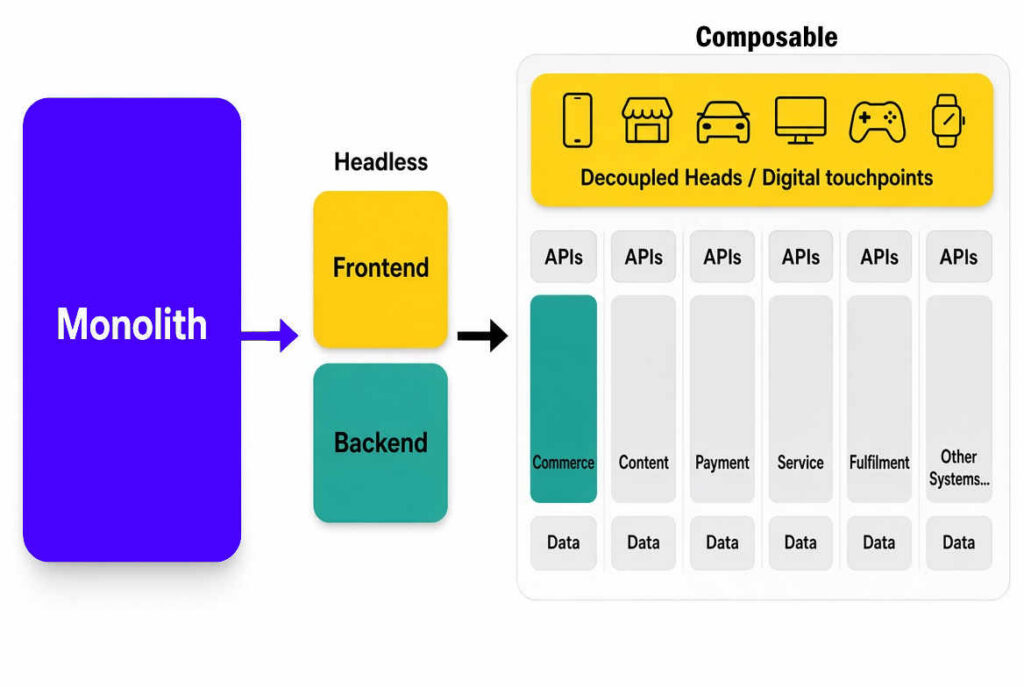
Headless and composable commerce represent two related but distinct modern approaches to building ecommerce systems. Both move away from rigid, all-in-one platforms (often called monoliths) in which the storefront, product catalog, cart, checkout, inventory, payments, and content management are tightly intertwined. In a traditional setup, changing the look of a product page or adding a new sales channel frequently requires coordinated updates across the entire system, slowing innovation and increasing risk.
Headless and composable architectures address these limitations by emphasizing decoupling and modularity. They are not identical, however, and choosing between them—or blending elements of both—depends on business scale, technical capacity, budget, and long-term goals. Open-source tools have matured significantly and now offer viable, cost-effective paths that reduce vendor lock-in compared with purely proprietary suites.
What Headless Commerce Actually Means
Headless commerce separates the presentation layer (the “head”—websites, mobile apps, progressive web apps, in-store kiosks, voice interfaces, or social commerce experiences) from the backend commerce engine that handles products, pricing, inventory, orders, and payments. Communication occurs through APIs (typically REST or GraphQL).
The frontend can be built with any modern framework—Next.js, Nuxt, SvelteKit, or others—while the backend continues to manage core commerce logic. This allows teams to redesign or optimize customer-facing experiences independently of backend operations. Content management systems or digital experience platforms can also sit alongside the commerce engine, delivering personalized or rich media content without being constrained by the commerce platform’s templating system.
Typical characteristics include:
- API-first design so that every capability is accessible programmatically.
- Frontend independence, enabling brand-specific user experiences and faster iteration on design and performance (Core Web Vitals, for example).
- Support for multiple channels from a single backend.
- Easier integration with external tools such as CRMs, ERPs, or analytics platforms.
Advantages center on speed of frontend change, the ability to create distinctive brand experiences, improved page performance, and relatively lower architectural complexity than full modularization. A retailer can launch a new mobile app or redesign its website without rewriting checkout or inventory logic.
Trade-offs are real. Building and maintaining a custom frontend requires skilled developers. Total cost of ownership can rise if teams underestimate ongoing maintenance, monitoring, and the need for robust API contracts. The backend itself often remains a relatively unified system, so deep changes to pricing rules, multi-warehouse inventory, or complex B2B workflows may still be constrained by the chosen commerce engine.
What Composable Commerce Adds
Composable commerce builds on the headless idea and extends modularity across the entire stack. Instead of treating the backend as a single commerce engine, it decomposes capabilities into independent services or packaged business capabilities—product information management, search and merchandising, cart and checkout, payments, promotions, order management, tax calculation, and so on. Each piece can come from a different provider (or open-source project) and is connected via APIs.
This approach is closely associated with MACH principles: Microservices (or modular services), API-first, Cloud-native, and Headless. Teams “compose” a tailored system rather than adopting a pre-integrated suite. Individual components can be upgraded, replaced, or scaled independently.
Key traits include:
- Freedom to select best-of-breed tools for each function.
- Independent deployment and evolution of services.
- Reduced long-term vendor lock-in at the capability level.
- Potential for more precise cost control (pay only for what is used) and optimized performance by choosing specialized services.
Benefits include maximum flexibility for complex or rapidly changing requirements, easier adoption of emerging technologies (AI-driven search or personalization, for instance), and the ability to evolve specific parts of the system without large-scale replatforming. Enterprise organizations with multi-brand, multi-region, or intricate B2B needs often find this attractive.
Challenges are substantial. Integration and governance overhead increase. Multiple vendor relationships (or open-source projects) mean coordinating updates, SLAs, security patches, and data consistency. Initial time-to-market is typically longer, and strong DevOps, API management, and architectural discipline are required. Pricing can become fragmented and harder to forecast. For many mid-market teams, the operational complexity outweighs the gains.
Core Differences in Practice
Headless primarily decouples the customer-facing experience from a (usually still coherent) backend. Composable treats nearly every functional area as replaceable. Every fully composable architecture is headless, but many headless implementations keep a unified commerce backend and are therefore not fully composable.
Architectural analogies help: headless is closer to renovating the interior and exterior of a solidly built house while leaving the foundation and utilities largely intact. Composable is more like assembling a custom structure from independent, specialized modules that must be carefully joined.
Flexibility, scalability, and future-proofing are higher with composable approaches, but so are integration effort, governance needs, and the skill requirements for the team. Speed of initial launch and operational simplicity favor headless (or even modernized monolithic platforms) for many organizations. Total cost of ownership calculations must account for both licensing/platform fees and the human cost of integration and maintenance.
A Broad Landscape of Solutions
Proprietary platforms still dominate many enterprise conversations. Salesforce Commerce Cloud, Shopify (especially Plus with Hydrogen and its Storefront API), BigCommerce, Adobe Commerce, and specialized composable engines such as commercetools offer polished ecosystems, managed services, and extensive partner networks. These can reduce operational burden and provide strong out-of-the-box capabilities, but they introduce varying degrees of lock-in and ongoing platform fees often tied to GMV or usage.
Open-source alternatives have become production-ready options that shift economics and control. Leading headless and composable-friendly open-source commerce engines include:
- Medusa (Node.js/TypeScript, MIT license): Modular by design, with a strong emphasis on customization through modules and workflows. It pairs well with JavaScript/TypeScript frontend teams and supports self-hosting or managed cloud options. Ideal for teams that want a flexible, developer-centric foundation without licensing costs.
- Saleor (Python/Django, GraphQL-first, BSD-style license): Strong multi-channel and catalog modeling capabilities. Its pure GraphQL API simplifies data fetching for modern frontends. Suitable for teams comfortable with Python or those prioritizing a clean, schema-driven approach.
- Vendure (TypeScript/NestJS, GraphQL/ hybrid open core, proprietary add-ons): Emphasizes a coherent, extensible core rather than pure microservices fragmentation. Plugin architecture and solid B2B features make it attractive for teams that want control without assembling dozens of separate services. Open-core model (core is free,).
- Spree (Ruby, with mature B2B and marketplace features)
- Shopware (PHP, with composable ambitions)
- Bagisto (Laravel-based headless options).
Complementary open-source components strengthen composable setups. Headless CMS options such as Strapi or Payload allow content teams independence. Search can leverage Elasticsearch/OpenSearch or specialized open tools; payments often use Stripe, Adyen, or open payment gateways; frontends are commonly built with Next.js, Nuxt, or SvelteKit and can be open-sourced or customized freely.
A practical open-source-leaning stack might combine Medusa or Saleor for commerce, Strapi for content, a modern React/Vue/Svelte frontend, and specialized services only where proprietary tools clearly outperform (for example, advanced AI merchandising or global tax engines). This reduces platform fees dramatically while preserving the ability to swap components later. Self-hosting or using managed open-source hosting adds operational responsibility but grants full data ownership and customization depth.
Hybrid approaches are common and often pragmatic: run a capable open-source or SaaS commerce engine in headless mode, then selectively replace high-value functions (search, personalization, OMS) with best-of-breed or additional open-source modules as needs evolve. This staged path lowers risk compared with a big-bang composable rebuild.
Decision Factors and Practical Considerations
Choosing the right path requires honest assessment:
- Frontend flexibility is the main constraint and backend capabilities already meet needs → headless (open-source or proprietary engine + custom frontend) is usually sufficient and faster to deliver.
- Multiple backend capabilities must evolve independently, complex multi-brand or B2B rules exist, and the organization has mature engineering and DevOps capacity → composable architecture (with heavy open-source components where possible) becomes more compelling.
- Team skills, budget for integration work, risk tolerance for operational complexity, and expected rate of change matter more than abstract architectural purity. Mid-market brands frequently achieve excellent results with modernized platforms or straightforward headless setups rather than full composable stacks.
- Total cost of ownership includes not only software licenses but developer time, monitoring, security, and the cost of coordination across services. Open-source shifts costs from licenses toward people and infrastructure; this is advantageous when internal expertise exists or can be built.
- Governance, API contracts, observability, and data consistency are non-negotiable in composable environments. Without them, the promised agility turns into fragility.
- Migration strategies that start with headless (decoupling the frontend first) and later modularize the backend reduce risk for organizations leaving legacy monoliths.
Edge cases exist. Very small catalogs or simple DTC brands may still prefer streamlined SaaS platforms for speed and lower operational overhead. Highly regulated industries or those with extreme customization needs lean toward open-source or fully controlled stacks. Emerging agentic commerce (AI agents interacting with APIs) favors clean, well-documented API-first systems regardless of the broader architecture label.
In short, headless commerce prioritizes independent, high-quality customer experiences while keeping the commerce core relatively unified. Composable commerce maximizes modularity across the full stack at the price of greater complexity. Open-source engines such as Medusa, Saleor, and Vendure, combined with complementary open tools, make both approaches more accessible and less locked-in than proprietary-only paths. The optimal choice is the one that matches the organization’s current capabilities, growth trajectory, and willingness to invest in integration and governance rather than any single vendor’s preferred narrative. Thorough evaluation of proof-of-concepts, realistic total-cost modeling, and staged implementation usually produce better outcomes than architectural absolutism.