
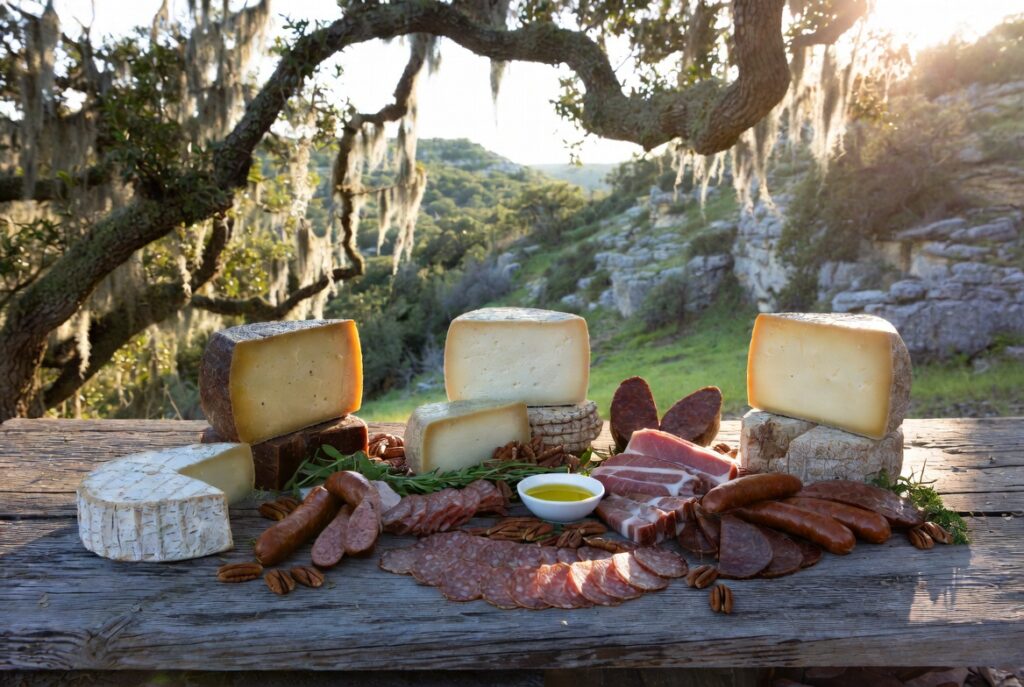
In a Hill Country curing room, whole-muscle cuts of pork hang in cool, carefully controlled air, slowly transforming under salt, time, and the quiet work of beneficial molds. Nearby, in a farmstead creamery northwest of Waco, wheels of raw-milk cheese rest on wooden shelves, their rinds developing character from the same pastures that feed the cows and sheep outside. These are not imported European specialties. They are Texas-made — products of immigrant techniques adapted to local livestock, climate, and a growing appetite for foods that carry a clear sense of place.
Historical Roots: Immigrant Traditions Meet Texas Livestock
Texas’s cured-meat and cheese traditions draw heavily from 19th-century European settlement. German immigrants who arrived in the Hill Country in the 1840s brought sausage-making, smoking, and preservation techniques suited to a time without refrigeration. They adapted recipes to local pork, beef, and game, creating the smoked sausages, head cheese, and deli-style meats still associated with towns such as Fredericksburg. Czech and other Central European influences added further depth to the state’s sausage culture.
The following domain names are available immediately
Click to buy now
TexasSalumi.com
TexasCherve.com
HillCountrySalumi.com
TexasSalumeria.com
Italian and Spanish traditions arrived later and more selectively, finding expression in modern salumi production — salami, coppa, lonza, and other dry-cured products. Spanish Iberico pig genetics, introduced more recently, have given some Texas producers access to the richly marbled, acorn-influenced pork historically linked to Spain’s jamón and chorizo. On the cheese side, farmstead makers draw from European styles while working with milk from cows and sheep raised on Texas pastures, resulting in cheeses that reflect both technique and terroir.
Cheese and salumi (the broad Italian term for cured and aged meats) represent one of the more intimate chapters in Texas’s agricultural story. Unlike pecans or wine grapes that cover hundreds or thousands of acres, these products often emerge from smaller, intensive operations where animal husbandry, fermentation science, and craftsmanship meet. The result is a diverse and increasingly confident scene of farmstead cheeses and dry-cured meats that stand alongside the state’s better-known specialties.
Artisan Cheese in Texas
Texas does not yet rival Wisconsin or Vermont in volume of specialty cheese, but a growing number of farmstead and artisan creameries produce distinctive wheels, blocks, and fresh cheeses. One of the better-known examples is the work of multi-generational operations that milk their own herds and flocks. These makers typically emphasize raw-milk or carefully pasteurized cheeses, traditional aging, and limited production that prioritizes flavor over scale.
Styles range from firm, aged cow’s-milk cheeses with nutty or savory notes to softer or washed-rind expressions and sheep’s-milk varieties that carry a distinctive richness. The state’s climate presents both opportunities and challenges: warm weather can accelerate ripening, while humidity control in aging rooms is essential. Many producers rely on climate-controlled facilities and careful monitoring to achieve consistency. The best Texas cheeses reward slow tasting — they pair naturally with the state’s wines, pecans, and olive oil, and they appear on restaurant boards and at farmers’ markets across the state.
Salumi and Cured Meats: From German Smokehouses to Iberico Pastures
The cured-meat side of the story is equally layered. In the Hill Country, traditional German-Texan smokehouses continue to produce smoked sausages, bratwurst-style links, liverwurst, head cheese, and other preserved meats using recipes refined over generations. These products remain staples at festivals, butcher counters, and family tables.
Parallel to this heritage tradition is a newer wave of dry-cured salumi. Producers working with purebred or high-percentage Iberico pigs raised on open pasture in the Hill Country have gained national attention for salamis, chorizos, coppas, and other whole-muscle cures. These meats benefit from the pigs’ distinctive fat quality and from careful, traditional curing methods. Other makers focus on classic Italian-style salami, lonza, guanciale, and regionally inspired “salumi de Tejas” that incorporate local spices or techniques. Facilities in places such as Leander and Austin have become known for small-batch, handcrafted cured products that emphasize natural fermentation and extended aging.
Across both the German-smoked and the dry-cured traditions, the emphasis is on quality of livestock, precise salt and moisture control, and time. Texas heat and humidity require careful facility design — temperature- and humidity-controlled curing rooms are essential for consistent results and food safety.
Craft, Challenges, and Culinary Place
Producing high-quality cheese and salumi in Texas demands attention to animal welfare and diet, rigorous sanitation, and mastery of fermentation and aging science. Regulatory requirements for raw-milk cheeses and for meat processing add layers of complexity and cost. Scaling remains difficult; many of the most interesting products stay small-batch by design. Climate presents ongoing management needs, and building consumer awareness of Texas-made versions of traditionally European foods takes time.
Yet the rewards are tangible. These products have earned recognition in national competitions, appear on menus of chefs who emphasize local sourcing, and give Texans a chance to taste foods that reflect both Old World technique and New World place. A Texas sheep’s-milk cheese with a glass of High Plains Tempranillo, a slice of Hill Country Iberico salami with a drizzle of local olive oil, or smoked German-style sausage alongside pecan-crusted dishes all feel like natural extensions of the state’s broader food identity.
Closing the Series
Across five installments, this series has traced a set of distinctive Texas products: the deep-rooted pecans of Seguin and Groves, the expanding wine regions of the High Plains and Hill Country, the delicate and labor-intensive possibility of saffron, the hard-won olive oil of carefully chosen sites, and now the intimate craft of cheese and salumi. Each reveals a different facet of how people work with Texas land, climate, and history.
Some of these products are ancient in the region (pecans). Others are relatively recent experiments that required adaptation and resilience (olives, saffron). Still others represent living immigrant traditions refined over generations or reimagined with new livestock genetics (cheese and cured meats). What they share is a commitment to quality that goes beyond novelty. They are not simply “made in Texas” as a marketing phrase; they are shaped by Texas soils, weather, water realities, and the people who choose to grow, raise, and craft them here.
Taken together, they sketch a fuller picture of the state’s agricultural and culinary identity — one that balances scale with craft, tradition with innovation, and abundance with the particular. In a place long associated with cattle, cotton, and oil, these products quietly expand the definition of what Texas can grow and make well. The work continues in orchards, vineyards, small fields, pastures, creamery aging rooms, and curing chambers across the state. The results, when they reach the table, carry the unmistakable flavor of place.
The following domain names are available immediately
Click to buy now
TexasSalumi.com
TexasCherve.com
HillCountrySalumi.com
TexasSalumeria.com