
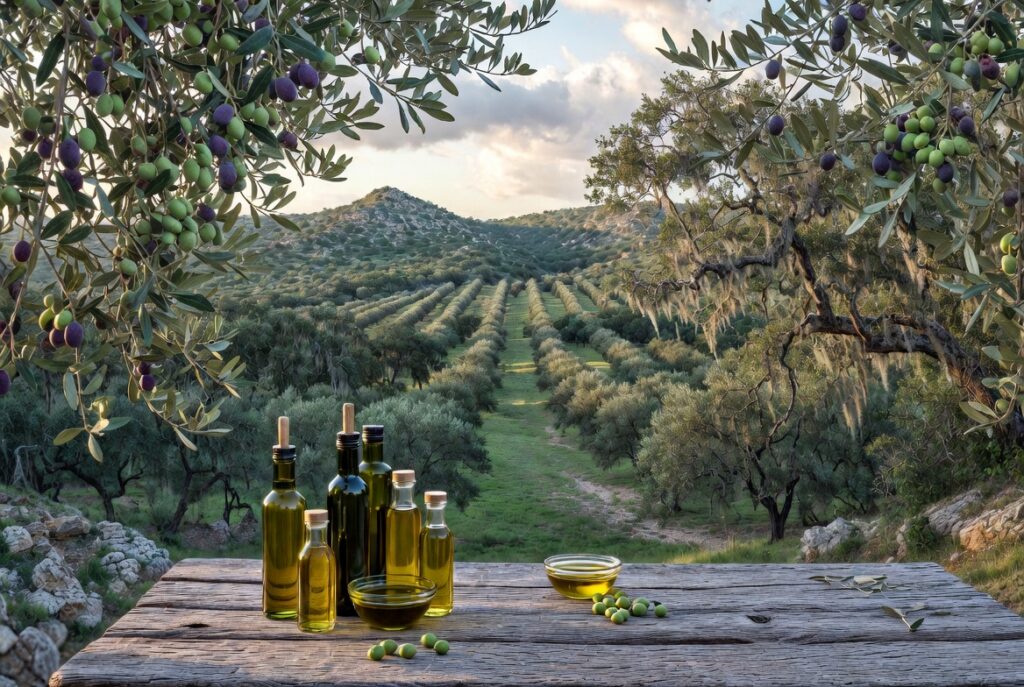
On a clear late-summer day in the Texas Hill Country or the Winter Garden region southwest of San Antonio, rows of silvery-green olive trees catch the light. Their narrow leaves shimmer against limestone or caliche soils, and clusters of green fruit begin the slow turn toward purple-black. These are not the ancient groves of Andalusia or Tuscany. They are a relatively recent and still experimental expression of Texas agriculture — an attempt to grow a classic Mediterranean tree in a continental climate that delivers both intense heat and occasional, devastating freezes.
Commercial olive orchards have existed in Texas for at least twenty-five years. The industry has known periods of optimistic expansion and sharp setbacks. Today it remains a specialized, high-effort enterprise focused primarily on extra-virgin olive oil, with a smaller amount of fruit directed toward table olives. Success depends less on nostalgia for the Old World and more on careful matching of variety, site, and management to the realities of Texas weather.
Climate Realities: Mediterranean Tree, Continental Place
Olive trees (Olea europaea) evolved in a true Mediterranean climate of hot, dry summers and mild, wet winters with reliable but moderate chilling. Texas offers something different: a continental pattern of greater temperature extremes, occasional prolonged freezes, and highly variable rainfall. Flowering and fruit set can be disrupted by rain, near-freezing temperatures, high humidity, or hot dry winds during the critical spring bloom window. Winter freezes remain the single greatest risk. Temperatures that drop into the teens or lower for extended periods can kill wood or, in the worst cases, entire trees to the ground.
The February 2021 Winter Storm Uri provided a stark illustration. Subfreezing temperatures lasting for days damaged every commercial orchard in the state; many trees were killed back to the roots. Five years later, recovery continues. Surviving trees have been pruned and nursed back into production, and new plantings of more carefully chosen varieties have gone in, but the setback delayed the industry’s trajectory by several seasons and prompted some growers to diversify or reduce acreage.
Despite these challenges, certain regions offer workable conditions. The Hill Country (elevations roughly 1,200–1,800 feet) with its well-drained limestone soils, the Winter Garden area north of Laredo and southwest of San Antonio, and selected sites along the Gulf-influenced coast have supported the majority of commercial plantings. Northern and far-western extremes are generally too cold or too variable. Good internal soil drainage is non-negotiable; olives tolerate drought once established but suffer badly from waterlogged roots. Many Texas orchards are therefore planted on raised berms.
Varieties That Work
Variety selection is the most important decision a Texas grower makes. Cold hardiness, chill-hour requirements, self-fertility, and oil quality all matter. Arbequina has emerged as the dominant commercial choice. Originating in Spain, it is relatively cold-tolerant (surviving temperatures into the mid-teens Fahrenheit under good conditions), self-fertile, compact, and productive with relatively low chill needs. It is well suited to high-density plantings and produces a mild, fruity oil popular with many consumers.
Other varieties with proven or promising performance include Mission (a historic California selection with good dual-purpose potential), Arbosana (often paired with Arbequina for pollination and complementary oil characteristics), Koroneiki (high oil content, compact habit), and selected others such as Frantoio or Manzanilla where microclimates allow. Experience has shown that some varieties rated cold-hardy in traditional regions can lose their acclimation during Texas’s warm winter spells and then suffer greater freeze injury. Texas A&M AgriLife Extension publications emphasize testing and local performance data over catalog claims.
Growing Practices and the Path to Oil
Successful orchards begin with site preparation that ensures drainage and removes competing vegetation. Trees are typically planted from rooted cuttings. Spacing varies: traditional systems may use wider spacing, while modern high-density or super-high-density plantings (common with Arbequina and Arbosana) allow mechanical or semi-mechanical harvest and higher early yields per acre. Irrigation is critical, especially from six to eight weeks before bloom through fruit set. Once established, olives are relatively drought-tolerant, and regulated deficit irrigation after pit hardening can help manage vegetative growth and concentrate oil quality. Fertilization needs in Texas often include attention to nitrogen, potassium, and micronutrients such as zinc, sulfur, and magnesium.
Harvest in Texas usually begins in early September and continues as fruit matures from green to fully colored. Yields have historically been modest compared with California or Mediterranean benchmarks — mature high-density plantings have reached around two tons of fruit per acre in good years, with many orchards producing less. Conversion ratios typically require 50 to 100 pounds of fruit for one gallon of oil. Milling capacity within the state remains limited; many growers transport fruit to shared or commercial presses. The resulting extra-virgin olive oil is marketed for its freshness, local origin, and distinctive character shaped by Texas soils and climate.
Pests and diseases present a mixed picture. Texas lacks some of the classic Mediterranean threats such as the olive fruit fly, olive knot, and peacock spot in many locations. Cotton root rot and root-rot pathogens favored by poor drainage are more serious local concerns. Overall, the pest complex is lighter than in some traditional regions, which is a genuine advantage when other factors align.
Economics, Scale, and Outlook
Olive oil production is capital- and labor-intensive. Land may be less expensive than in California, and water and regulatory pressures can be more favorable in some Texas counties, but freeze risk, variable yields, and the cost of establishing and protecting orchards keep the industry specialized. Most commercial activity remains focused on direct sales, farmers’ markets, tasting rooms, and regional distribution rather than bulk commodity markets. Some operations have added agritourism components — orchard tours, oil tastings, and event spaces — to diversify income.
Post-Uri recovery has been uneven. Larger plantings that survived or were replanted are returning to production, and new acreage continues to appear in the most favorable zones. At the same time, some smaller growers have reduced olive plantings or shifted emphasis to other crops. The industry has not yet reached the scale once hoped for in the pre-2021 years, but it has demonstrated resilience and a clearer understanding of which varieties and sites offer the best odds.
Flavor and Place on the Texas Table
Texas extra-virgin olive oil tends toward the milder, fruitier end of the spectrum when made primarily from Arbequina, with notes of green apple, almond, or fresh grass depending on harvest timing and milling. Stronger, more peppery oils appear when other varieties or earlier harvests are used. These oils pair naturally with Texas ingredients — drizzled over grilled meats, used in dressings for local greens and tomatoes, or finished on seafood from the Gulf. The novelty of a “Texas olive oil” still carries marketing power, especially when the story of climate adaptation and local production is told alongside the flavor.
Closing Reflection
Olive growing in Texas is an exercise in realism as much as ambition. The tree is not native, the climate is imperfect, and freezes will always be a threat. Yet in the right places, with the right varieties and careful management, olives can produce a distinctive, high-quality oil that belongs on Texas tables. Like the pecans, wines, and saffron explored earlier in this series, the crop illustrates a recurring theme: the state’s agricultural identity is not fixed. It expands through experiment, absorbs hard lessons from weather and markets, and gradually claims new products that express both the land and the people who work it.
The silvery leaves and green-to-black fruit remain a relatively rare sight across the broader Texas landscape. Where they succeed, however, they add another layer to the state’s growing repertoire of place-based foods — proof that even a Mediterranean classic can find a workable, if hard-won, home under the Texas sun.
(Next in the series: Part 5 Made in Texas cheese and salumi.)