
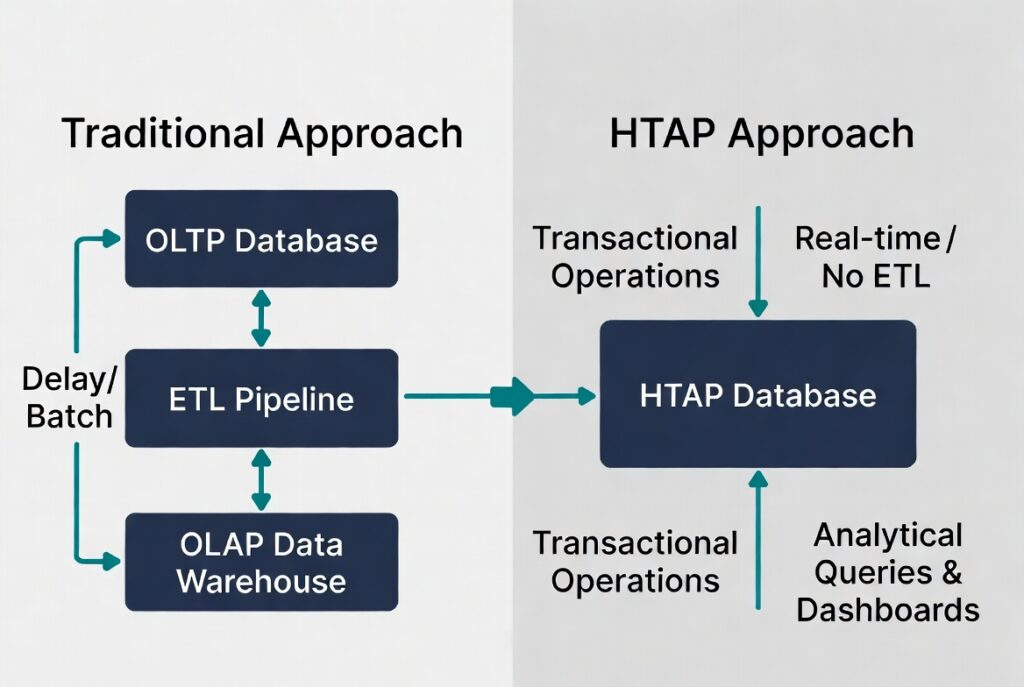
HTAP databases allow you to run both fast transactions and complex analytics on a single platform without needing complex ETL pipelines. Major database providers and specialized platforms sell HTAP databases: [1, 2]
- Cloud Providers: Google offers AlloyDB, a PostgreSQL-compatible HTAP database. Alibaba Cloud sells PolarDB, which features scale-out HTAP capabilities. [1, 2, 3]
- Specialized & Distributed SQL: SingleStoreDB provides a unified platform built from the ground up to handle both row and column stores. PingCAP offers TiDB, a distributed open-source HTAP database with separate transactional and analytical engines. [1, 2, 3]
- Enterprise Solutions: SAP offers the highly recognized in-memory SAP HANA platform. Oracle provides HTAP extensions for MySQL via HeatWave. [1, 2]
TiDB, SingleStore, and Oracle Autonomous Database are among the top options for Hybrid Transactional/Analytical Processing (HTAP), each catering to different architectures, budgets, and open-source preferences. [1, 2, 3]
QueryConverge.ai
Premium AI Domain for Query Routing
Modern .ai domain perfect for AI-powered query routing, intelligent workload management, or hybrid data platforms.
Acquire QueryConverge.ai – Strong brand for AI-driven data infrastructure.
The table below provides a scannable comparison of the most prominent HTAP databases on the market. [1]
HTAP Database Comparison
| Database [1, 2, 3, 4, 5] | License Type | Primary Compatibility | Deployment Model | Key Strength |
|---|---|---|---|---|
| TiDB | Open-source | MySQL | Multicloud / On-prem | True distributed scaling |
| SingleStore | Proprietary | MySQL / Native | Multicloud / On-prem | Ultra-fast in-memory speed |
| Oracle Autonomous | Proprietary | Oracle PL/SQL | Oracle Cloud / Cloud@Customer | Deep enterprise automation |
| AlloyDB | Proprietary Engine | PostgreSQL | Google Cloud / On-prem | Enterprise Postgres scaling |
| MariaDB ColumnStore | Open-source | MySQL / MariaDB | Multicloud / On-prem | Direct open-source MySQL fork |
| Hydra | Open-source | PostgreSQL | Cloud / Self-hosted | Lightweight Postgres extension |
| MySQL HeatWave | Proprietary Engine | MySQL | Oracle Cloud / AWS / Azure | Cost-effective cloud MySQL HTAP |
Pros and Cons of Each Option
1. TiDB (PingCAP)
- Pros: Fully open-source core with a vibrant community. It features separate, isolated compute engines for transactions (TiKV) and analytics (TiFlash), meaning heavy analytics will never slow down your live apps.
- Cons: High architectural complexity with multiple moving parts, making self-hosting demanding on DevOps resources. [1, 2, 3, 4, 5]
2. SingleStoreDB
- Pros: Exceptionally fast ingestion rates and sub-second query responses due to its unified, patented “Universal Storage” engine. Highly versatile for real-time dashboards and AI vectors. [1, 2, 3, 4]
- Cons: Proprietary licensing can become highly expensive as data grows. It is not 100% MySQL feature-complete, requiring minor code tweaks during migration. [1]
3. Oracle Autonomous Database (ATP)
- Pros: Highly sophisticated automation for indexing, tuning, and patching. The in-memory dual-format architecture delivers unparalleled enterprise-grade performance for massive legacy workloads.
- Cons: Vendor lock-in to the Oracle ecosystem. It requires expensive enterprise licensing and runs optimally only within Oracle Cloud Infrastructure (OCI). [1, 2]
4. Google Cloud AlloyDB [1, 2]
- Pros: Maintains 100% strict compatibility with standard PostgreSQL while using a decoupled compute/storage layer to accelerate analytical queries up to 100x faster than stock Postgres.
- Cons: The advanced HTAP acceleration features are proprietary to Google Cloud, limiting multi-cloud flexibility. [1, 2]
5. MariaDB Enterprise / ColumnStore
- Pros: Built by the original creators of MySQL as a true open-source alternative. It allows you to combine standard transactional tables and columnar analytical tables in the same database.
- Cons: Analytical scaling requires manual table configuration and lacks the automated storage tiering found in newer distributed SQL engines. [1, 2, 3]
6. Hydra
- Pros: Lightweight and fits directly into existing PostgreSQL environments as an open-source extension. Perfect for teams that want basic HTAP functionality without adopting an entirely new database system.
- Cons: It is a younger project with a smaller community compared to mature ecosystems like Citus or TiDB. [1]
- Pros: Seamless upgrade path for existing cloud MySQL applications without changing a single line of code. It delivers massive analytical speedups at a lower price point than raw cloud infrastructure.
- Cons: The HeatWave query accelerator is closed-source and ties you closely to Oracle’s cloud-managed services. [1, 2, 3, 4]