
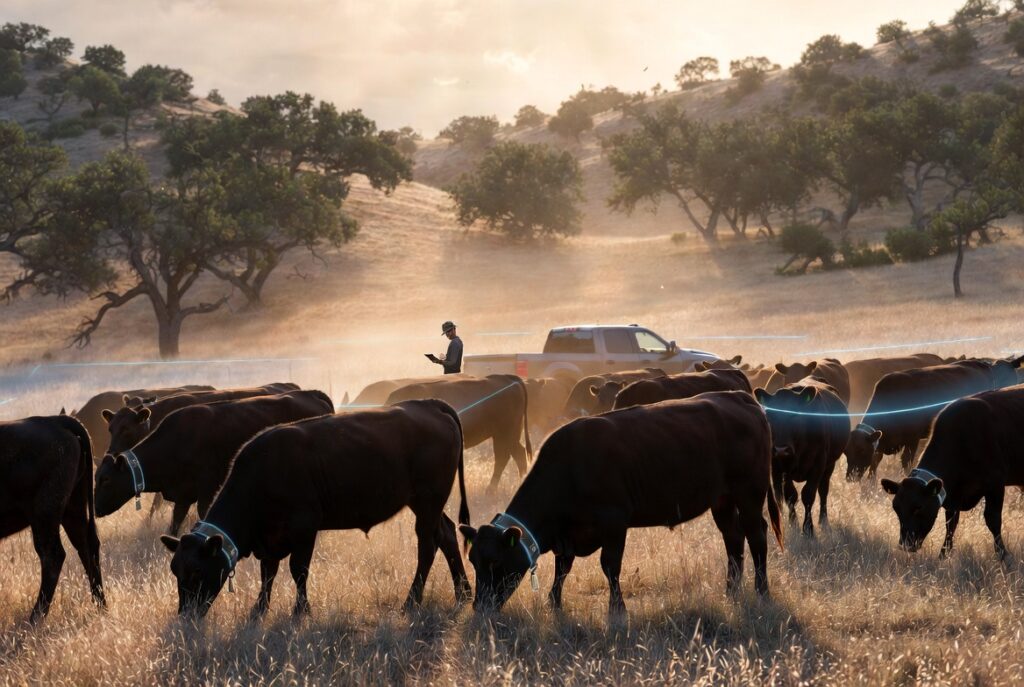
Halter’s trademarked Cowgorithm® technology is transforming how cattle are managed on ranches across Texas and beyond. All photos in this article are original AI renderings generated for illustrative purposes and do not depict the actual Halter product.
In the sun-baked pastures of Texas and the lush hills of New Zealand, ranchers are trading barbed wire and all-terrain vehicles for something far more futuristic: solar-powered smart collars and a smartphone app. No more stringing endless fences or chasing strays on horseback at dawn. Instead, cattle respond to gentle audio cues and vibrations, guided by invisible digital boundaries drawn with a finger swipe. This isn’t science fiction—it’s the reality created by Halter, a New Zealand agtech startup whose latest funding round has Silicon Valley’s most contrarian investor, Peter Thiel, pouring in capital at a $2 billion valuation.
In March 2026, Thiel’s Founders Fund led a $220 million Series E round for Halter, doubling the company’s valuation from roughly $1 billion just nine months earlier. The deal was heavily oversubscribed, drawing in returning backers like Blackbird, DCVC, Bond, Bessemer, NewView, Ubiquity, Promus, and Icehouse Ventures. For a sector long dismissed as too gritty and slow-moving for venture capital, this ranks among the largest agtech raises ever. And Thiel—who first backed Halter in its early Series A nearly a decade ago—is betting big that AI isn’t just for chatbots and self-driving cars. It’s for cows.
The Tech: Virtual Fences and the “Cowgorithm”
Halter’s system is deceptively simple yet deeply engineered. Each solar-powered collar—lightweight, durable, and GPS-enabled—pairs with on-farm communication towers to create a private network. Ranchers open the app, outline virtual paddocks on satellite maps, and tap to shift herds. The collars use a proprietary AI engine the company calls the Cowgorithm®: machine learning trained on animal behavior that issues directional audio tones and vibrations to nudge cattle back into bounds. If needed, a mild electric pulse (far gentler than legacy electric fencing) reinforces the lesson. Over days, the herd learns the rules autonomously.
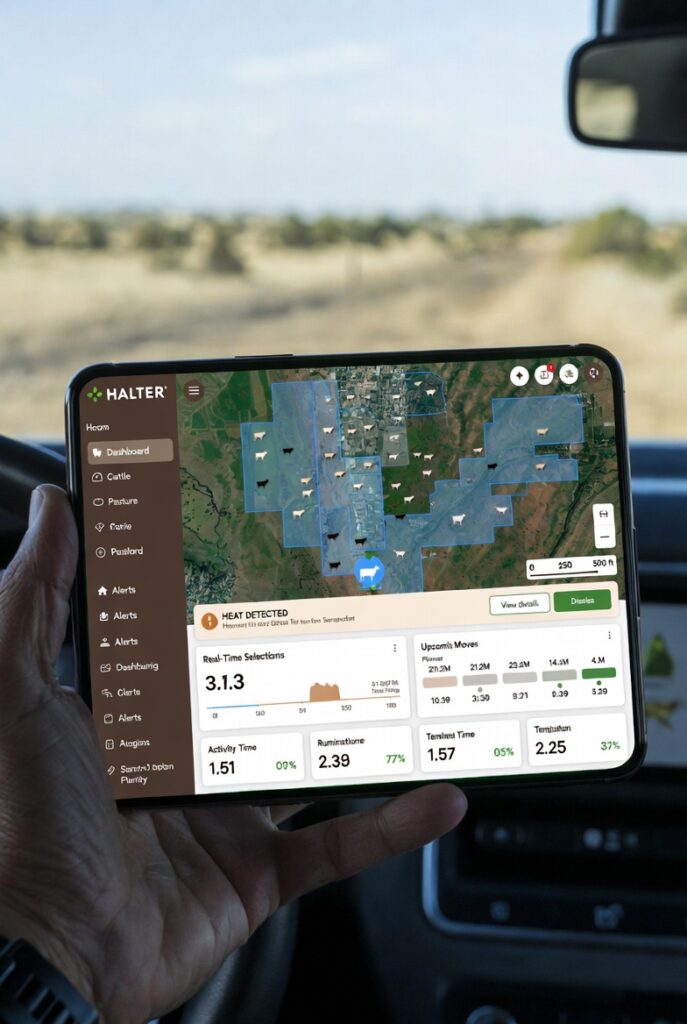
But Halter goes beyond fencing. The collars deliver 24/7 telemetry: real-time location, grazing patterns, health metrics (activity, rumination, temperature proxies), and even heat detection for breeding. Ranchers gain a dashboard view of every animal without leaving the truck. In the U.S. alone, customers have already created over 11,000 miles of virtual fencing—roughly the perimeter of the continental United States—saving an estimated $220 million in traditional fencing costs.
Founder Craig Piggott, whose family ran dairy operations in New Zealand’s Waikato region, built the company to solve the frustrations he saw firsthand: labor shortages, inefficient pasture use, and the physical grind of moving fences every few days. Launched commercially in New Zealand, Halter expanded to Australia and entered the U.S. market in 2024 with an office in Colorado. Today it manages operations across three continents, with more than one million collars deployed and thousands of ranchers subscribed.
The business model is classic SaaS for the farm: a recurring subscription (typically $60–$97 per head per year), generating predictable revenue that scales with herd size rather than one-time hardware sales.
Why Now? Ranching’s Perfect Storm Meets AI
Traditional cattle ranching faces headwinds. U.S. beef herds hit a 75-year low amid drought, high feed costs, and generational labor shortages. Beef prices have climbed sharply, yet margins remain squeezed by inefficiency. Climate pressures demand better land stewardship—rotational grazing to sequester carbon, reduce overgrazing, and improve soil health. Virtual fencing delivers exactly that: precise, adaptive pasture management that boosts weight gain, cuts labor by hundreds of hours annually, and minimizes environmental impact.
The broader AI livestock farming market is exploding in response. Valued at roughly $355 million in 2023, it’s projected to reach nearly $3 billion by 2033 at a blistering 23.8% CAGR, driven by IoT sensors, predictive analytics, and precision tools. Cattle management software alone is growing at nearly 11% annually.
Halter isn’t the only player, but it stands out for its integrated hardware-software platform. Competitors include Norway’s Nofence (cellular-based collars), Australia’s Gallagher eShepherd, and Vence (acquired by Merck Animal Health), which focus more narrowly on virtual fencing. Halter’s edge lies in its “operating system for the ranch”—combining fencing with health and pasture analytics—plus proven scale in pasture-based systems.
Thiel’s Vision: Physical AI for the Real World
Peter Thiel has long championed technologies that deliver “definite optimism”—tangible breakthroughs rather than incremental apps. Agtech has burned many investors with long sales cycles and conservative customers, yet Founders Fund’s repeated bets on Halter suggest Thiel sees something bigger: a platform that digitizes one of the world’s oldest, most analog industries. In an era of AI hype cycles, applying intelligence to physical assets like livestock collars represents “zero to one” innovation—creating new value where none existed.
The data Halter collects isn’t just operational; it’s a flywheel for future AI advancements—predictive health alerts, optimized breeding, even carbon credit verification. As ranching globalizes and urbanizes, remote management becomes essential. Halter’s U.S. expansion targets exactly the vast, labor-scarce operations where the technology pays for itself fastest.
Challenges remain: infrastructure setup in remote areas, initial training of herds, and ensuring animal welfare (though studies and rancher feedback show reduced stress compared to constant human intervention). Regulatory scrutiny around new agtech could emerge, as could competition from big ag incumbents integrating similar sensors.
Yet the momentum is undeniable. With one million collars sold and adoption accelerating, Halter is proving that AI doesn’t have to live in the cloud alone—it can clip right onto a cow’s neck and quietly transform how the world raises beef and dairy.
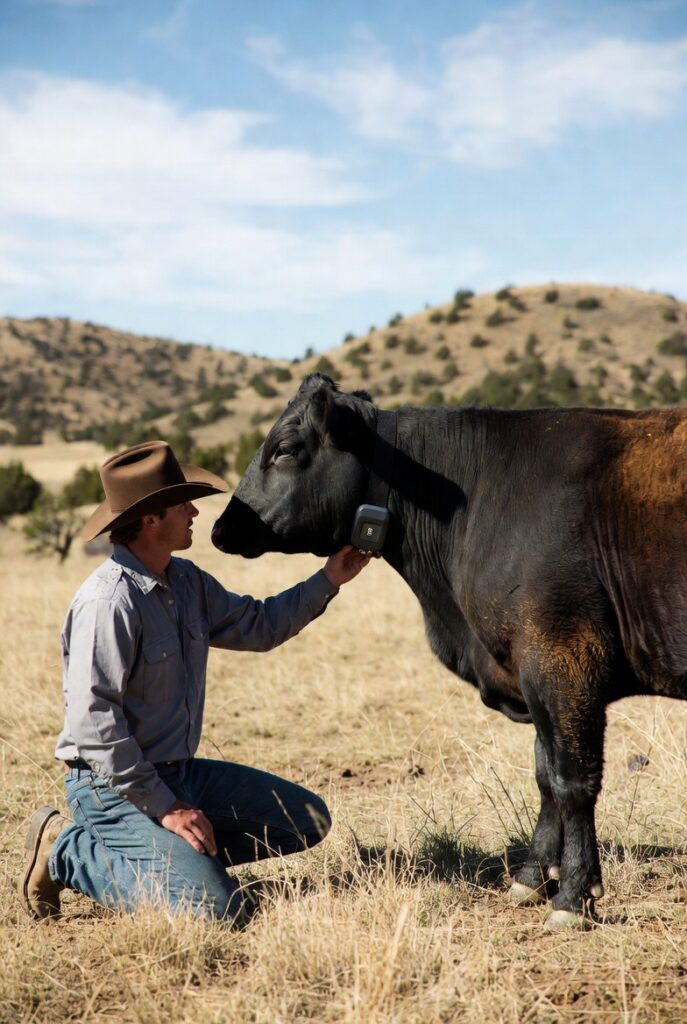
Peter Thiel’s latest wager isn’t a gamble on hype. It’s a calculated bet that the future of food production will be as intelligent as the technology we already use to order groceries online. In the AI cattle ranching market, Halter isn’t just herding cows—it’s herding an entire industry into the 21st century. And investors are stampeding to get in.
“Halter®, Cowgorithm®, and related marks are trademarks of Halter USA Inc. All other trademarks mentioned are the property of their respective owners. This article is for informational purposes only and is not affiliated with or endorsed by Halter.”